Search results for: “focus display”

  • Best Computer Specs Guide: RAM, SSD, CPU and What .NET Really Does

    Best Computer PC Specs buying Guide for 2025 and beyond: RAM, CPU, SSD, graphics card, gaming and more explained

    If you’re planning to buy a computer now, pause before diving into the best PC specs. Keep in mind that dealers often clear out older models during holiday sales. To make sure you know exactly what you’re getting, skip down to the section on ‘Older and Newer Naming’ of laptops.


    Specs You Need and PC Details Explained

    • Memory (RAM):
      64 GB DDR5 (4800–5600 MHz, dual channel, expandable to 128 GB on some models). Continue for more detailed advice, for Best Computer Specs Guide.
    • Storage (SSD):
      2 TB PCIe Gen 4 NVMe SSD (blazing fast read/write speeds, optional dual SSDs up to 4–8 TB total)
    • Graphics (GPU):
      NVIDIA GeForce RTX 5090 Laptop GPU (16–24 GB GDDR7 VRAM)
      or workstation option: NVIDIA RTX 6000 Ada (48 GB VRAM)
    • Display:
      14‑inch UHD (3840 × 2160) Mini‑LED, 120 Hz refresh rate, HDR support
      or 14- 16‑inch OLED, 240 Hz for gaming/creative workloads

    Reduce Eye Strain with a High Resolution Curved Screen

    • Ultra HD / 4K: 3840 × 2160 pixels
    • 8K UHD: 7680 × 4320 pixels
    • Highest Resolutions Available (2025)
    • 8K UHD (7680 × 4320):
      • Currently the highest mainstream resolution for TVs and monitors.
      • It is Extremely sharp, but requires powerful GPUs and large screens to notice the difference.

    Best Curved Monitors (2025)

    BrandBest ModelSize / ResolutionUse CaseKey Strengths
    SamsungOdyssey OLED G949″ Dual QHD (5120×1440)Gaming / Immersion240 Hz refresh, deep 1000R curve, HDR OLED
    Dell / AlienwareAlienware AW3425DW34″ QD‑OLED (3440×1440)Gaming / EsportsFast response, vivid colors, G‑Sync Ultimate
    Dell UltraSharpU4025QW40″ 5K2K (5120×2160)Productivity / MultitaskingHuge workspace, USB‑C hub, color accuracy
    LGUltraGear 45GR75DC45″ WQHD (3440×1440)Gaming / CreativeOLED panel, 240 Hz, immersive ultrawide
    HPE45c G545″ Dual QHD (5120×1440)Productivity / OfficeReplaces dual monitors, ergonomic design
    GigabyteG27FC27″ Full HD (1920×1080)Budget Gaming / Entry LevelAffordable, decent curve, FreeSync support

    Quick Recommendations

    • For Gaming Immersion: Samsung Odyssey OLED G9 or Alienware AW3425DW.
    • For Productivity/Work: Dell UltraSharp U4025QW or HP E45c G5.
    • For Budget Buyers: Gigabyte G27FC.
    • For Hybrid Use (Gaming + Creative): LG UltraGear 45GR75DC.

    Other items you need for laptop and more USBs for a desktop

    • Ports & Connectivity:
      • 2 × Thunderbolt 4 / USB‑C
      • 3 × USB‑A 3.2
      • HDMI 2.1
      • Ethernet RJ‑45
      • Wi‑Fi 7 + Bluetooth 5.4
      • Keyboard:
        QWERTY keyboard, with Applications/Menu key
      • Around 4 pounds ≈ 1.81 kilograms.

    How to Find Your Computer Specs (Windows 11, December 2025)

    1: Using System Settings

    1. Press Windows key + E to open File Explorer.
    2. Press Shift + Tab to move focus to the Navigation Pane.
    3. Arrow down to This PC (usually near the bottom).
    4. Right‑click on This PC and choose Properties (or press Enter).
    5. A window will open showing basic system information, including:
      • Device name
      • Processor (CPU)
      • Installed RAM
      • System type (32‑bit or 64‑bit)
      • Windows edition and version

    2: Using Settings → About

    1. Press Windows key + I to open Settings.
    2. Navigate to System.
    3. Scroll down and select About.
    4. Under Device specifications, you’ll see:
      • Processor (CPU)
      • Installed RAM
      • Device ID
      • Product ID
      • System type
    5. Under Windows specifications, you’ll see:
      • Edition (e.g., Windows 11 Pro)
      • Version and build number

    3: Advanced Specs (Optional)

    For deeper details like graphics card, storage, and drivers:

    • Press Windows key + R, type dxdiag, and press Enter.
    • This opens the DirectX Diagnostic Tool, showing CPU, RAM, GPU, and driver versions.

    Summary

    • Basic specs (CPU, RAM, Windows version) → System → About or This PC → Properties.
    • Detailed specs (graphics card, drivers) → dxdiag.
    • These steps work with keyboard navigation and are accessible for screen reader users.

    Find information in MSINFO32

    • MSINFO32 is the command that opens the System Information utility in Windows.
    • It provides a comprehensive overview of your computer’s hardware, software, and system components.
    • Unlike the simple “About” page, MSINFO32 gives deep technical details useful for troubleshooting, upgrades, or support.

    How to Open MSINFO32

    1. Press Windows key + R to open the Run dialog.
    2. Type msinfo32 and press Enter.
    3. The System Information window will appear.

    What You’ll See in MSINFO32

    • System Summary (default view):
      • OS name and version
      • System manufacturer and model
      • Processor type and speed
      • Installed RAM
      • BIOS version/date
      • Boot mode (UEFI or Legacy)
    • Hardware Resources:
      • IRQs, DMA, I/O ports, memory addresses
      • Useful for diagnosing hardware conflicts
    • Components:
      • Display (graphics card details)
      • Storage (drives, controllers)
      • Network (adapters, protocols)
      • Input devices
    • Software Environment:
      • Loaded drivers
      • Running tasks
      • Services
      • Environment variables

    Why It’s Useful

    • Troubleshooting: Quickly check BIOS version, drivers, and hardware conflicts.
    • Upgrades: Confirm RAM slots, CPU type, and expansion options.
    • Support: Export system info to share with IT or tech support.

    Memory Details

    These values describe how your computer uses RAM (physical memory) and virtual memory:

    • Installed Physical Memory (RAM): 64.0 GB
      The total amount of RAM physically installed in your system.
    • Total Physical Memory: 63.8 GB
      The usable portion of your installed RAM. A small amount is reserved for system hardware.
    • Available Physical Memory: 56.2 GB
      The amount of RAM currently free and available for use by applications and the system.
    • Total Virtual Memory: 67.8 GB
      This includes physical RAM plus page file space. Virtual memory allows your system to use disk space as extra memory when RAM is full.
    • Available Virtual Memory: 58.9 GB
      The portion of virtual memory that’s currently unused and available.
    • Page File Space: 4.00 GB
      The size of the page file (a reserved portion of your hard drive used as virtual memory).

    Go to Programs and features and make sure you have all your security and power to run programs so do a find command for “run” and look for your .nets.

    What .NET Does for a Computer—let’s just say it IS REALLY IMPORTANT

    • Runs Applications:it is software framework/platform
      .NET provides the Common Language Runtime (CLR), which acts like a virtual machine. It takes code written in languages like C#, F#, or VB.NET and makes sure it runs correctly on your computer.
    • Manages Resources:
      The CLR handles memory management, security, thread management, and error handling. This means programs don’t have to reinvent these functions — they rely on .NET to do it safely.
    • Provides Libraries:
      The Framework Class Library (FCL) is a huge collection of pre‑built code for everyday tasks:
      • Reading/writing files
      • Connecting to databases
      • Networking and internet communication
      • User interface controls
      • Math, cryptography, and more
    • Supports Multiple Languages:
      Developers can write programs in C#, F#, VB.NET, and others. .NET makes them interoperable, so code written in one language can work with another.
    • Cross‑Platform Evolution:

    Go get those important computer items at: Ninite.com

    Beat Graphics card for computers using screen readers or other access technologies: NVIDIA
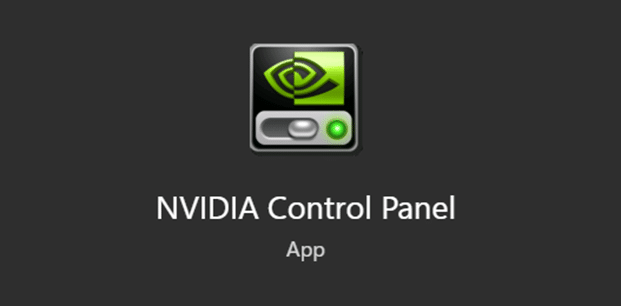
    Image of NVIDIA control panel for its graphics card running on computer

    GRAPHICs card RUN that screen reader–get a good one GAMING computers will get you the specs you need for a screen reader or just regular use

    NVIDIA RTX cards dominate the high‑end market with unmatched ray tracing, AI features (DLSS, CUDA, Omniverse), and raw compute power.–the BEST for screen readers and older students–middle school up

    • AMD Radeon RX cards offer better value for money, strong rasterization performance, and more efficient power use, especially at 1440p and 4K gaming.

    The applications key– is KEY of importance-the funny looking horseshoe on a gaming computer or square with lines in it on general computers–it is a right click of a mouse or 1 press of a key.
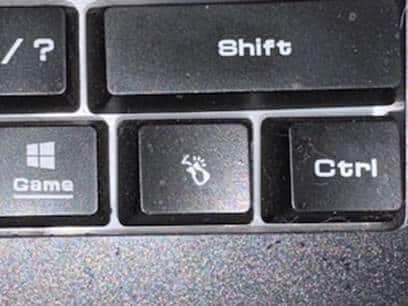

    applications key on gaming computer looks like a horseshoe
    applications key on all other computers is a box with 3 lines in it

    Basic specifications for a laptop: gaming computer will have the speed and video card needed for performance

      Processor (CPU): some use the words i5, i7, i9 but the new words are Ultra 5,7 or 9 on machines–i9 is compared to ultra 9 and so on like this

    Intel Naming Shift

    Older naming convention (up to 13th Gen): so if you have this then know it is an older model and during holidays, this is what companies are selling cheaply to get rid of–so just be aware–

    • Intel Core i3, i5, i7, i9
    • Example: Intel Core i7‑12700H
    • New naming convention (14th Gen and newer):
    • Intel Core Ultra 5, Ultra 7, Ultra 9
    • Example: Intel Core Ultra 9 185H
    • The “Ultra” branding emphasizes AI acceleration and new architecture (Meteor Lake, Lunar Lake).

    How They Compare

    • Core i5 → Core Ultra 5
    • Core i7 → Core Ultra 7
    • Core i9 → Core Ultra 9


    Intel Core Ultra 9 285HX (24 cores, up to 5.5 GHz turbo)
    or AMD Ryzen 9 7945HX (16 cores, up to 5.4 GHz turbo)

    • Graphics (GPU):
      NVIDIA GeForce RTX 5090 Laptop GPU (16–24 GB GDDR7 VRAM)
      or AMD Radeon RX 7900M (16 GB GDDR6 VRAM)
    • Memory (RAM):
      64 GB DDR5 (4800–5600 MHz, dual channel, expandable to 128 GB on some models)
    • Storage (SSD):
      1 TB PCIe Gen 4 NVMe SSD (with option for dual SSDs up to 4 TB total)
    • Display:
      17.3‑inch UHD (3840 × 2160) Mini‑LED, 120 Hz refresh rate, HDR support
      or 16‑inch OLED, 240 Hz for gaming/creative work

    Favorite computers for running software such as JAWS, NVDA and other blind ware–You must have HIGH RAM and speed

    Top Favorite: ASUS

    ASUS Laptop Weights–based on student–

     ZenBook Series (ultralight)

     New ZenBook A14: as low as 2.18 lbs (0.99 kg)

      VivoBook Series (mid‑range everyday use series)

     ROG Gaming Series (heavy duty)

      Zephyrus G14: ~3.53 lbs (1.6 kg)

      Strix G15: ~5.07 lbs (2.3 kg)

    A black keyboard with yellow lights
ASUS laptop  showing an applications key shared with right CTRL Pic of ASUS-ROG-heavier with numpad

    Surface Pro-top Favorite

    Microsoft Surface Pro Weights–lightest and most powerful of laptops

    • Surface Pro 3–7: ~1.7 lbs (0.77 kg)
    • Surface Pro 8–10: ~1.94–1.96 lbs (0.88–0.89 kg)
    • Surface Pro 11 (latest): ~1.96 lbs (0.89 kg)
    • Surface Pro X (ARM model): ~1.7 lbs (0.77 kg)

     comparing true laptop form factors, ASUS ultrabooks and Surface Laptop models are closer in weight, while Surface Pro remains the lightest option in the 2‑in‑1 category.

    •  
    Surface pro keyboard with applications key--great laptop

    Different versions and do not suggest this collapsible one for students, that flips up–just too easy to flip down

    image of the flip back surface pro which is to be avoided for a student

    Get Surface Pro with a true laptop lid that opens easily

    image of surface pro computer-top choice

    HP computers

    Be careful as most do not come with applications key any more–yes you can use Insert F10 but … takes 2 keys to implement a keystroked of right click

    HP EliteBook 645 G10 includes a dedicated Applications/Menu key on its keyboard layout.

    Build your computer: EliteBook 645 G10 is a lightweight, secure, and efficient business laptop with AMD Ryzen 7000 series power

     Processor Options:

    • AMD Ryzen 5 7530U: 6 cores / 12 threads, up to 4.5 GHz-elementary and middle school
    • AMD Ryzen 7 7730U: 8 cores / 16 threads, up to 4.5 GHz-high school
    • These are efficient 7nm chips with solid multitasking and productivity performance.
    • Graphics:
      • Integrated AMD Radeon RX Vega 6 GPU
      • Suitable for office work, media playback, and light graphics tasks
      • Not designed for gaming or heavy 3D rendering.–but that is fine as that is not why you buy it
    • Memory:
      • Configurable up to 64 GB DDR4 RAM
      • Dual SO-DIMM slots, user-upgradable.
    • Storage:
      • PCIe SSD options, typically up to 1 TB
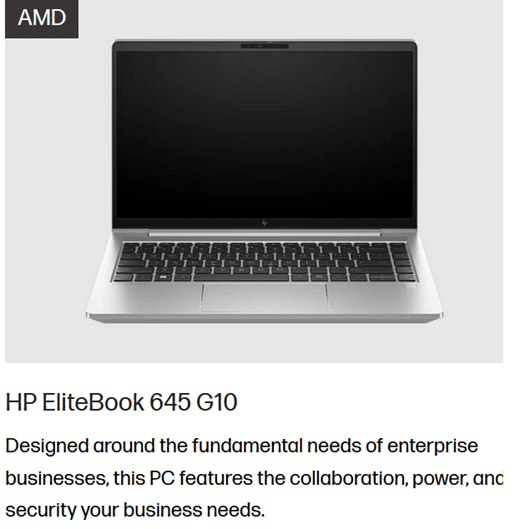
    image of HP Elitebook

    HP HP EliteBook 870 G11 (17‑inch) -4.1 lbs–keep in mind you want a laptop carry case for laptops

    High‑Performance PC Laptop Models

    • HP ZBook Fury 16 G11 – workstation powerhouse for engineering, CAD, and 3D rendering
    • MSI Raider 18 HX AI – top‑tier gaming laptop with desktop‑class GPU
    • ASUS ROG Strix G18 / Zephyrus G16 – high‑end gaming and creator laptops

    Best Computer Specs Guide with how to place bump dots- to create muscle memory in fast typing skills

    Do NOT overdo bump dots on keyboard to find position for touch typing-then student start counting dots to get to keys–create muscle memory which means you want to have them repeat typing skills–explanation below dot placements.

    Place bump dots on keys: 5 and 0 on num row above qwerty keys-backspace is already large

    Place dots on F4, F12–if all the keys run together  then either F8 or F9. My F keys are broken up in panels from F1 to F4 and F5 to F8 and F9 to F12 so I do not need any bump dots–a gaming keyboard is divided up for speed of access so no bump dots needed

    Many computers share the arrow keys with home, end pg up and pg down–only put a bump dot on up arrow to quickly move hand to the right while left hand holds down the FN key and right hand to do the pg up and so forth

    Remember, the keyboard already has built in bump dots on f and j so do not place any more bump dots on keys

    Dell is not my top choice of a computer but is a fine machine with specs you can get with:

    Processors: Intel Core Ultra 7/9 or AMD Ryzen 9 HX — powerful x86 chips for heavy workloads.

    Serviceability: Easier to upgrade storage, RAM, and wireless adapters

    Memory: Configurable up to 64–128 GB DDR5 RAM, far beyond Surface’s 16–32 GB.

    Storage: Options up to 2–8 TB PCIe NVMe SSDs.

    Graphics: Dedicated NVIDIA RTX GPUs (e.g., RTX 5090 or workstation Ada cards).

    Displays: Larger 16–18″ screens, often 2.5K or 4K OLED, high refresh rates.

    Ports: Rich I/O (USB‑A, USB‑C/Thunderbolt, HDMI, Ethernet, SD card).

    Weight: Heavier (≈4 lbs / 1.8 kg), but more versatile for gaming, AI, or workstation tasks.

    What I Use on a Daily Basis-I work very long hours

    So I do have a Ultra HD / 4K: 3840 × 2160 pixels and it has changed my life with no more headaches from long hours at my screen and always have night light on-if you do not know about this feature, press your windows key and type night and night light will generate–decrease the brightness to more muted colors and it takes out more blue light which reduces eye strain. But the 4k does that by itself, then the night light takes away brightness–I am very light sensitive so light in general causes my eyes pain which gives headaches (I no longer have that issue with the 4k.). I use my screen reader often–hence the needed power in general.

    My PC Computer Specs Explained

    CLX computers are made by CLX Gaming, which is a division of Cybertron International Inc., a long‑standing U.S. system integrator based in Wichita, Kansas and an incredible company to work with for any product they sell.

    About CLX

    • Founded: January 29, 2016, as a brand under Cybertron International.
    • Focus: Custom gaming PCs, workstations, and desktops tailored for gamers, content creators, and professionals.
    • Specialty:
      • Fully customizable builds (CPU, GPU, RAM, cooling, case design).
      • Award‑winning custom paint and chassis designs.
      • Product families named after Egyptian mythology (Ra, Set, Scarab, Horus, Osiris, Anubis).
    • Support: Free lifetime technical support, up to 3 years parts warranty, and lifetime labor coverage.

    Why CLX Stands Out and why I picked it–I could build exactly what I wanted and needed and their service support is exceptional in the industry as if or when you call, you get a person who knows anything you ask.

    • Customization: You can configure nearly every component, from Intel/AMD CPUs to NVIDIA/AMD GPUs.
    • Performance: Builds range from mid‑tier gaming rigs to extreme workstations with 64–128 GB RAM and multi‑GPU setups.
    • Design: Known for bold, artistic case designs and RGB lighting.
    • Reliability: As part of Cybertron International (established in 1997), CLX benefits from decades of PC integration experience.
    • Takeaway
    • CLX computers are custom‑built in the USA by CLX Gaming (Cybertron International), offering high‑performance, highly customizable systems for gamers and professionals who want both power and personalization.

    The CLX is the Best machine I have every owned and then I go portable with my Surface Pro which is also exceptional for power and portability

    More Help for you on computers:

    Speed up and Fix a SLOW Computer

    Restore System & fix PC issues

    Optimizing Windows 11 Efficiency for Screen Reader with Key Settings and Configurations
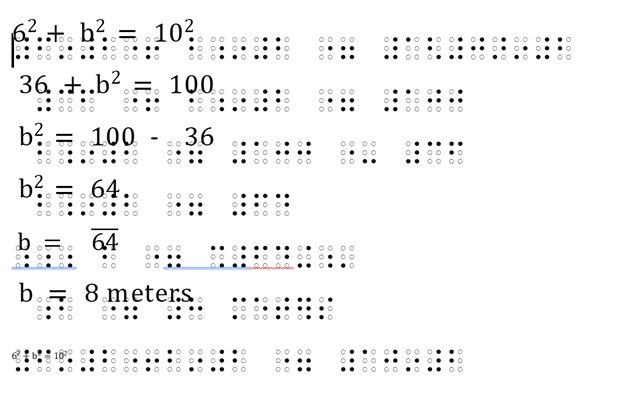
  • Emboss Math with Tiger 9 TSS in WORD

    This video takes you through setting up the Tiger 9 software from ViewPlus Technology for translating math equations into braille so you can emboss Math with Tiger. Dr. Robinson demonstrates how to access the Tiger ribbon, open her existing profile settings, and configure options like the braille type and math notation style. She also shows how to adjust ink settings if needed for embossing printed text alongside braille. Then she translates the math and gets it ready to emboss for student.

    Tiger 9 Math Translation and Editing


    Dr. Robinson demonstrates how to use Tiger 9, to translate math content in Word. She use a 40 cell FOCUS braille display but emphasizes the importance of using an 80-cell braille display if the student is going into math or STEM fields. Dr. Robinson also explains how to use the WORD math equation editor or Braille math editor on the Braille display to emboss Math with Tiger. She concludes by solving a right triangle problem using the math contents then embossing the math for hard copy if desired.

    Emboss Work with Tiger 9 in WORD
    Emboss Work with Tiger 9 in WORD

    Go onto learn how to emboss graphics in WORD using Tiger software also for students to feel all needed math symbols and pictures to learn on their own. Ideally, all students have embossers at home. ViewPlus embossers with software are fully accessible for all exclusive screen reader users.

  • Properly Format a Paper

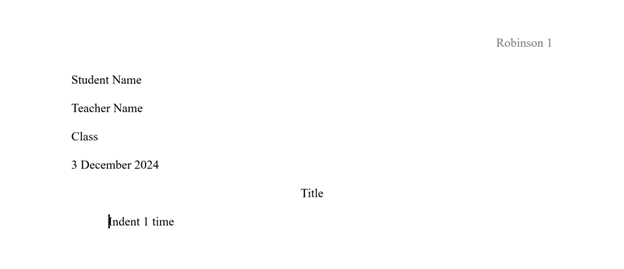
    Dr. Robinson demonstrates Tech Tricks on How to Properly Format a Paper. Such as how to correct formatting issues in a document, emphasizing the importance of proper indentation, font usage, and spacing. She also explains how to rebuild a normal template, adjust page views, and input a header correctly. Lastly, she discusses the process of correcting formatting issues in a document, particularly for works cited or reference pages, and stresses the importance of following specific requirements when formatting papers.

    Step by Step directions on:

    Properly Format of a Paper

    When your word template is not adjusting or working the way it needs to, then rebuild it.

    Delete Normal Template

    • Windows R and type %appdata%\Microsoft\Templates and enter.
    • Press  N for normal and hit delete and get rid of it. Alt F4 and close

    Go back to WORD

    Rebuild the Normal template

    • Alt O then P to your paragraph spacing.
    • Alt F to “after” spacing and you will hear 8 pt, so type 0
    • tab once hit S for single spacing and make sure it is selected then tab.
    • save as default with Alt D then Alt A to save all documents based on the normal template.
    • Close dialog box
    •  Now control D to your font dialog box and you can select any font that is required by APA or MLA, but we typically use Times New Roman so type Tim
    • Down arrow to Times New Roman
    • Tab twice and make sure the font size is 12.
    • Set default with Alt D then Alt A for all documents based on the normal template.
    • Close dialog box

    Your WORD Template is now ready to go for a Properly Formatted Paper

    If you have already written your paper, then open it up

    • select it all with ctrl A then ctrl C to copy it.
    • Alt Tab to the new WORD document and you will paste in using this option to get rid of all formats.
    • Alt H to home, V to paste and T to keep text only.
    • Ctrl A to select all and Ctrl 1 to truly make sure it is single spaced.
    • If you start a New writing assignment-keep it single spaced and then when done, do the following also. We are humans and make mistakes.
    • Control home to make sure you are at the top of the paper.
    • Down arrow one line at a time and listen for any line that says blank and backspace or delete and get rid of it.
    • You do not want any blank lines in this document because it is now single space. If you are just typing it out, do not hit enter twice but only when you begin a new paragraph
    • When you hear: Works Cited or References: press control enter to make a brand-new page to stand alone. Do this for all: Works Cited or References for a new page
    • When you get to the bottom of your References or if you are typing it out, then when at the end
    • control shift up arrow to select all your citations then do a Ctrl T for hanging indent which means the first line is the longest and every line thereafter will be indented ½ inch.
    How to Properly Format a Paper
    How to Properly Format a Paper

    To Begin a Proper Paper or to Double check it

    F12 to save as and name it properly and place it in proper folder:

    • Ctrl Shift N makes a new folder,
    • type the name of the class and enter to solidify name of class.
    •  Then enter to open folder
    • Alt n to file name again to make sure it is correct. Retype if it changed.
    • Alt S to save it.
    • place paper there and all other drafts.

    Enter into the header first (that is the white space of the margin) with Alt V, H

    • Insert your page number first:
    • Alt N to insert NU to number (listen for top of page and enter or right arrow to open)
    • down arrow to Plain number 3 which places your number on the right-hand side of your header and press enter.
    • Now type in your last name and press space to put a space between your last number and page number and hit escape to get out of your header.

    Now type a proper heading:

    • Type your name and enter.
    • Type the professors or teachers’ name and enter.
    • Type the subject and enter.
    • insert the date the professor requires for either MLA or APA with Alt N, D, then down arrow to the proper format requested and enter and it will automatically insert into paper.

    Now Check Format of Paper

    control home

    • Make proper paragraphs.
    • Ctrl down arrow jumps you 1 paragraph at a time so tab 1 time and hear indent 1.5 inches. That means margin is 1 inch and indent is .5 inches.
    • Listen carefully and feel your display as when you ctrl down arrow and you see spaces then there is already a bad indent there so delete it until it is 1 inch which you can feel on your display also, then tab and hear 1.5 inches and continue. Be incredibly careful that you do not go into the works cited page so listen carefully and stop at the end of the paper.
    • When done with indents, Ctrl home.
    • control A to select the whole document and control 2 for double space.
    •  Down arrow to your title and control E to center your title and make sure it is in title case. Insert f3 takes you through case formats so you do not need to retype.

    Now control home once again and press F7 for the editor .

    • Your screen reader will tell you what percentage score you have, and you want to get it to 100 percent.
    • Tab once and make sure it says formal writing. You have three options under here, but formal writing is the default:
    • Tab to corrections and you hear spelling then down arrow to grammar and make sure those are down to zero when you are done.
    • Tab to refinements then down arrow through clarity, conciseness, formality, inclusiveness, punctuation conventions, resume, sensitivity geopolitical references and vocabulary.
    • Keep in mind if it starts selecting proper nouns you can always tab to ignore as you are going through your options.
    • When you lose focus of the editor or escape to jump back into paper to add or change paper details, just F7 to resume editor.
    • Tab To the next option of similarity and check for similarity to online sources (this is what your professor or teacher does to make sure you did not plagiarize. Make corrections as needed so you are not plagiarizing.
    •  Tab to insights where document stats will be and enter.
    • This dialog box tells you what level you are writing at so if you need to write at a college level make sure you are writing at your grade level or above.
    • As you make all the corrections that the editor suggests it will immediately improve your scores.

    If you check your paper and you accept improper formats or spelling, then do the following to tell the editor to recheck your paper.

    Alt F to file and T to tools then P to proofreading:

    First, Alt w to writing style and make sure you have the grammar and refinements option selected.

    alt K to recheck your paper and enter to close, then F7 to recheck your paper again.

    Continue Learning on how to Properly Format a Paper with:

    MLA APA format paper writing-Tech Tip

    Microsoft Word MLA format with Christopher Duffley

  • Low Vision Computer Tricks

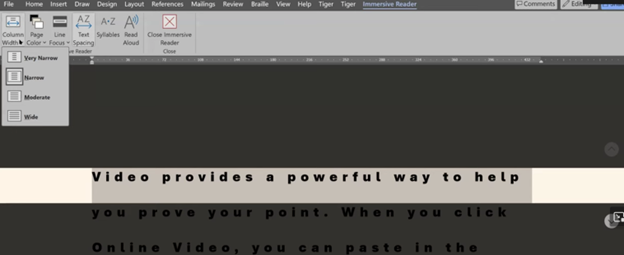
    Low-vision users enhance visibility and accessibility using tech tricks for screen scaling, mouse visibility, and reading tools. Immersive Reader in Microsoft Word, accessible from the View tab, adjusts text spacing, column width, and background color. UsersThese Low Vision Computer Tricks improve readability by customizing these settings to suit their visual needs efficiently. In Microsoft Edge, Immersive Reader activates on supported pages to simplify reading and navigation. These tools combine to provide low-vision users with a personalized, accessible digital experience.

    Dr. Robinson teaches strategies to enhance accessibility using low-visionLow toolsVision Computer Tricks in Microsoft Word, Edge, and system settings. First, she demonstrates how to adjust display settings for optimized visibility using the Windows key. By typing “display,” users can access scaling options, which enlarge screen content for better readability. Additionally, increasing mouse pointer size and inverting its color improves navigation while reducing eye strain.

    Next, in Microsoft Word, Dr. Robinson highlights Immersive Reader, available in the View tab, to enhance readability and adjust text settings. For instance, users can change font styles and sizes with Ctrl+A and Ctrl+Shift+> or Ctrl+Shift+< for better clarity. These Low Vision Computer Tricks include changing font styles and sizes with Ctrl+A and Ctrl+Shift+> or Ctrl+Shift+< for better clarity. Furthermore, the Line Focus feature reduces clutter by focusing on one or a few lines, aiding users with dyslexia. Moreover, Read Aloud, activated with Alt+Ctrl+Space, provides text-to-speech support with adjustable speed and voice options.

    In Edge, pressing F9 activates Immersive Reader, which simplifies web pages by removing clutter for a cleaner reading experience. Users can also customize text preferences or enable Read Aloud for auditory assistance. These Low Vision Computer Tricks also include customizing text preferences or enabling Read Aloud for auditory assistance. Notably, Dr. Robinson recommends Edge for its built-in accessibility commands, though Chrome and Firefox offer similar tools.

    Immersive reader for low vision
    Immersive reader for low vision

    Finally, she emphasizes using Night Light mode to reduce blue light exposure and protect long-term eye health. These tools, combined with her strategies, empower low-vision users to navigate technology effectively.

    Include in your learning with Finding the Mouse Cursor FAST and How to SEE your computer better with Low Vision

  • Tricks to Learning Math

    Tricks to Learning Math

    Dr. Robinson emphasizes practical and efficient math strategies for visually impaired students using assistive technology. Moreover, she demonstrates accessible solutions that empower students to engage independently in math tasks. Some of the best tricks to learning math for visually impaired students include understanding how to use technology effectively. For example, she teaches the Word Math Editor, activated with Alt+Equals, which enables students to access and edit equations effectively. Furthermore, this tool allows students to calculate expressions, such as a circle’s area, using keyboard shortcuts for greater efficiency. In addition, she introduces the Braille Math Editor, which enhances accessibility and provides tactile support for understanding complex math concepts. Continue with Advanced Math with LaTex using Mathkicker.AI-Matrices also.

    Dr. Robinson configures Braille displays and the Braille Math Editor to improve accessibility and clarity for students. Students solve problems efficiently by using built-in features like scientific calculators and shortcuts such as Ctrl+C and Ctrl+V.

    Dr. Robinson demonstrates advanced techniques, including LaTeX for math notation and proper vinculum coverage in equations. She converts equations between professional and linear formats to ensure accuracy in math tasks. Knowing tricks to learning math, such as using LaTeX, can greatly benefit students. Add Tactile Math Tools for even better understanding.

    She teaches code structures and tools to help students work independently with their peers during lessons. By optimizing settings and using shortcuts, students gain confidence and efficiency in solving complex math problems.

    Dr. Robinson ensures students participate fully in math classes and achieve academic success. Her methods, which include easy ways to learn math, integrate the latest assistive technologies to empower visually impaired students in STEM fields.

    Increase Learning in Nemeth also with Digital Math in WORD and Braille Math Editor for Nemeth or UEB Input/Output via MathCat with JAWS or NVDA

    Continue advancing your math skills with Desmos Graphing Calculator and creating all shapes but we focus on Geometry. You learn how to create graphs with solid or dotted lines with color and more. Find the steps you need to compete with your peers in this video. More Mathkicker lessons to show you the ease of completing math quickly to hand into teachers.

    Ask TechVision to Teach directly to teachers for School’s Professional Development Days.

  • Blue Light Low Vision Tech Tricks

    Decrease Eye Strain and See Your Computer More Easily

    Blue light emitted from computer screens can be harmful to your eyes over time, contributing to digital eye strain, disrupted sleep patterns, and even long-term vision damage. For those with low vision, the strain caused by blue light can make using a computer even more challenging. In this post, I will guide you through simple adjustments to your computer settings that will not only help reduce blue light exposure but also make your screen and browser easier to view, enhancing your overall comfort and visual experience with Blue Light Low Vision Tech Tricks.

    Blue light from electronic devices can cause a number of issues, including: 

    • Eye strain

    Blue light from screens can reduce contrast, leading to eye strain, dry eyes, and fatigue. 

    • Retinal damage

    Long-term exposure to blue light can damage retinal cells, which can lead to vision problems like age-related macular degeneration. 

    • Sleep disruption

    Exposure to blue light before bed can affect the body’s production of melatonin, which can disrupt sleep patterns. 

    • Other health issues

    Research suggests that exposure to blue light may contribute to cancer, diabetes, heart disease, and obesity. 

    Blue light gone for easy reading with low vision
    Blue light gone for easy reading with low vision Tech Tricks in a Browser

     Report on Blue Light Eye Damage

    To protect your eyes from blue light, you can: 

    • Limit screen time and take frequent breaks 
    • Use blue light-blocking glasses or filters on your devices 
    • Adjust your display settings 
    • Follow the 20/20/20 rule: every 20 minutes, focus on an object about 20 feet away for at least 20 seconds 
    • Get regular eye exams 

    Constant exposure to blue light over time could damage retinal cells and cause vision problems such as age-related macular degeneration. It can also contribute to cataracts, eye cancer and growths on the clear covering over the white part of the eye.

    Change the setup of your computer and save your VISION!

    Other Low Vision Lessons

    Finding mouse cursor FAST-low Vision tricks

    Proper Touch-Typing Methods-save your back

    Other Vision impairment Information


    These lessons and anything you need can be added to your School’s Professional Development Days.

  • Digital Math in WORD and Braille Math Editor for Nemeth or UEB Input/Output via MathCat with JAWS or NVDA

    Digital Math in WORD and Braille Math Editor for Nemeth or UEB Input/Output via MathCat with JAWS or NVDA. This lesson empowers you to learn skills for teaching yourself and others Nemeth or UEB math. By incorporating Math AI, you can transform inaccessible math images into usable formats in just seconds, significantly speeding up the learning process compared to transcribing character by character. While the video covers some essential skills, the following links provide comprehensive lesson details from the Digital Math in WORD Video.

    MathCat with JAWS or NVDA

    Learning how to teach or learn Nemeth math using assistive technology can seem challenging, but with the right tools and approach, it becomes manageable and effective. Whether you’re a parent helping your child, an educator supporting students, or an independent learner, using a Focus 40 Braille Display and JAWS screen reader provides an accessible way to master Nemeth code. In this guide, I will walk you through setting up your technology and using the Braille Math Editor to confidently teach and learn math concepts from basic arithmetic to advanced algebra. Let’s simplify the process and enhance your skills.

    Setup your computer to work the best with Screen readers and Digital Math in WORD

    Before beginning the challenge of learning Nemeth or UEB with screen readers, make sure you Optimize your Windows 11 computer for Efficiency with Screen Readers with Key Settings and Configurations. Optimizing Windows 11 Efficiency for Screen Reader with Key Settings and Configurations takes an hour most often 2 or so to complete. Longer if you are new to screen reader and how Windows 11 works. It is different than other OS systems so give yourself grace as you learn all there is to know about this system. As you move through your keyboard and discover you would like a particular key somewhere, like the applications key, you can remap a key to create that yourself. AND, you MUST have Local Admin on School Computers.
    Mathkicker.AI

    Mathkicker for digital math access with Jaws or NVDA
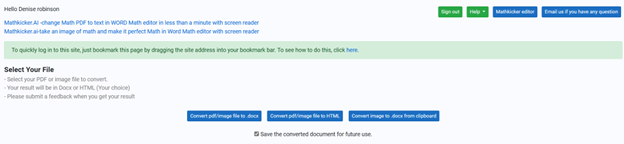
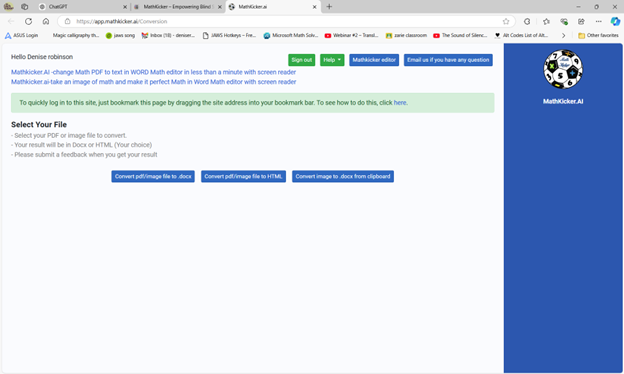
    Mathkicker for digital math access with Jaws or NVDA-Login Page

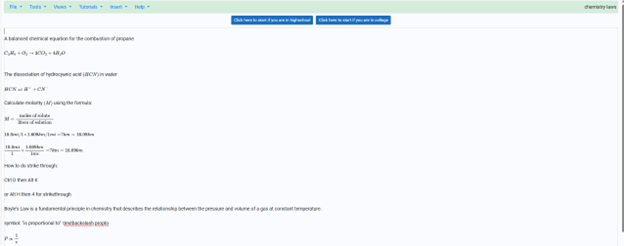
    Making inaccessible Math images into accessible math is easily done with Mathkicker.AI. With this full demonstration of Digital Quadratic Math with Jaws or NVDA in Mathkicker.ai – auditory and/or braille display. More importantly, is finishing work quickly with Mathkicker.AI in completing advanced mathematics such as Matrices with a quick command of Alt M and typing in the size of the matrix that is needed.

    Mathkicker editor with Jaws or NVDA and display for math access
    Mathkicker editor with Jaws or NVDA and display for math access

    Continue advancing your math skills with Desmos Graphing Calculator and creating all shapes but we focus on Geometry. You learn how to create graphs with solid or dotted lines with color and more. Find the steps you need to compete with your peers in this video. More Mathkicker lessons to show you the ease of completing math quickly to hand into teachers.

    These lessons and anything you need can be added to your School’s Professional Development Days.

    UEB Math Lessons to continue to add to your Learning

    Teach or Learn UEB Math with JAWS and Braille Display

    UEB Math Lessons Galore with AI

    Desmos Graphing Calculator

    Creating Geometry Tables in Desmos from WORK

    Geometry in DESMOS graphing Calculator with screen reader

    STEM: Desmos with JAWS and Embossing

    Use Desmos graphing calculator to emboss graphs & insert Graphs into Math Work for teacher

    3D graphing calculator with screen reader commands in Desmos

    Desmos graphing calculator with shaded Parabolas, screen reader, braille display and embosser

    Drag and Drop with Desmos using graphing games with JAWS

    Desmos Graphing Calculator: Creating and Exporting Graphs

  • Blind Baseball Announcer Keith Bundy Lives his Dream

    Keith Bundy, a blind baseball announcer, shared his journey of overcoming obstacles to live his dream as a sports announcer. Mr. Bundy, blind since childhood, longed to play sports but lacked opportunities in Southern Indiana. Listening to baseball broadcasts fueled his dream. In 2001, he received an invitation to announce an American Legion Baseball game. With family support and a refreshable braille display, Bundy began announcing for teams semi-professionally.

    Blind Baseball Announcer Keith Bundy Inspiring Journey-watch on YouTube

    On August 29th and 30th, significant events took place in Madison, South Dakota. The Dakota State University Trojans and the Madison Bulldogs both won their first games in their new stadiums. However, a less noticed but equally significant event occurred on August 29th. Keith Bundy, who grew up blind in Southern Indiana, fulfilled a lifelong dream by becoming an announcer in stadiums. It was a monumental day for Blind Baseball Announcer Keith Bundy.

    Growing up, Keith was passionate about sports but couldn’t participate due to his blindness. He spent many nights listening to baseball broadcasts and dreaming of being part of a team. In 2001, a chance opportunity to announce an American Legion Baseball game changed his life. With the support of his family and the use of assistive technology like a refreshable braille display, Keith began announcing baseball games. Over the years, he announced for various teams, including Dakota State University and the Madison Broncos.

    Blind baseball announcer Keith reading stats from braille display
    Blind baseball announcer Keith reading stats from braille display

    Keith is FIRST person to in new stadium

    On August 29th, Keith became the first person to announce an event in the new stadium, a moment he described as humbling and significant. He emphasized that blindness is not an insurmountable obstacle and credited his success to the right circumstances, a strong work ethic, and the support of many people, including his wife Peggy and his friend Tom Frel. Blind Baseball Announcer Keith Bundy has shown that anything is possible with the right support.

    Keith’s story is a testament to perseverance and proper education. Most of all, the power of community support in achieving one’s dreams.

    Blind individuals, with the right instruction and tools, can achieve their dreams just like anyone else. By learning essential skills, such as using assistive technology, braille, or orientation and mobility training, they can overcome obstacles that once seemed insurmountable. With guidance tailored to their needs, they gain confidence, independence, and the ability to pursue passions, whether in academics, sports, or careers. By embracing the right resources and support, blind people can turn their dreams into reality and thrive in any field they choose.

    Lessons to Help you Live YOUR Dreams

    Braille Math in Word with editor, JAWS, braille display and ease for multi-line math problems

    Graphing Inequalities, functions and shading with Desmos and screen reader

    Create Geometry Shapes from Math Work in Desmos with screen reader

    Geometry in DESMOS graphing Calculator with screen reader

    Desmos graphing calculator with shaded Parabolas, screen reader, braille display and embosser

    MLA APA format paper writing-Tech Tip

    Other Inspiring Stories

    Braille Math editor Contracted out, computer in mode with Tay–most efficient

    Jaws Braille Math editor in Word by Aubrey

    Braille Math Editor in Word with Jaws, Focus Braille Display by Campbell

    Atlanta Teen para-climber heading to Switzerland Olympics- Raveena Alli

    Microsoft Word MLA format with Christopher Duffley

  • UEB Math Lessons Galore with AI

    Unified English Braille (UEB) was officially adopted by the Braille Authority of North America (BANA) in November 2012. However, the implementation of UEB, including its use for math and science, began in January 2016. It’s important to note that while UEB was adopted, the Nemeth Code for Mathematics and Science Notation continues to be used in the United States. Many students learn both UEB Math and Nemeth Code, allowing them to advance in their learning regardless of the math materials they receive, giving them access to UEB Math Lessons Galore.

    Today, over eight countries, including Australia, Canada, South Africa and the United Kingdom, use UEB Math. Other countries lack access to assistive technologies, including braille, is a significant challenge globally. Nearly one billion people with disabilities, particularly in low- and middle-income countries, lack access to these essential tools1Additionally, almost half of the world’s population, around 3.7 billion people, remain offline and disconnected from digital technologies2.

    For those people in poorer countries who can acquire access technology but not braille, there are auditory options for learning. Here is a way to Teach or learn UEB Math in WORD.

    More options for JUST auditory learners or braille learners and taking totally inaccessible images of WORD and making them accessible using Mathkicker.AI.

    UEB math Lessons galore with Mathkicker AI
    UEB math Lessons Galore with Mathkicker AI

    Setup Computer and Screen Readers first

    Optimizing Windows 11 for Screen Reader Efficiency with Key Settings and Configurations
    MathCAT-set it up with NVDA or JAWS, UEB MATH or Nemeth with screen readers

    Hayes learns proper Word setup for Math with Math Editor and Jaws commands with brailliant display

    Setting up Braille Math editor in WORD to left justify and work in computer and contracted braille

    UEB Math Lessons Galore with JAWS or NVDA

    Prepare for College: Trigonometry with Math Editor: LaTex or Braille, JAWS or NVDA

    Highlights of 8 videos in: Nemeth or UEB via MathCat: Math Access in WORD and Braille Math Editor with JAWS or NVDA

    Digital UEB Math & Braille Math Editor in WORD with JAWS UEB Mode

    UEB Math using Braille Math and Word Math Editors with Jaws and split-braille-for-buffer-mode

    UEB Math with NVDA in WORD using unicode-LaTex or Braille -easy to advanced math

    Digital Math with UEB Math, NVDA completing Matrices in WORD Math Editor 365

    JAWS or UEB Math in WORD Math Editor-Unicode-LaTex Braille=learning easy to advanced math

    Quadratic Formulas with UEB Math or Nemeth and/or display with JAWS audio & MathCat

    Matrices in WORD Math Editor-Braille Math editor with Jaws using LaTex, auditory and/or Braille

    MathKicker. AI- Solutions to Math Issues

    Digital Quadratic Math with Jaws or NVDA in Mathkicker.ai – auditory and/or braille display

    Complete Advanced Math with LaTex to finish math fast using Mathkicker.AI, JAWS, NVDA and/or display

    Math & AI =Mathkicker.ai convert PDF math or any work into WORD docx.

    Perfect Digital Math at all levels using only audio or tactile Braille or both in Mathkicker.ai

    Math & AI is MathKicker.ai — convert to .docx from clipboard- make inaccessible accessible

    Mathkicker.ai-take an image of math and make it perfect Math in Word Math editor with screen reader

    Mathkicker.AI -change Math PDF to text in WORD Math editor in less than a minute with screen reader

    Graphing, Split Braille and More

    Transcribe Math into Word documents for blind students using Math editor, Jaws and a Braille Display

    Quadratic equation and how to fix math mistakes, braille math editor, Jaws in Word Math editor

    Braille Math in Word with editor, JAWS, braille display and ease for multi-line math problems

    Graphing Inequalities, functions and shading with Desmos and screen reader

    Create Geometry Shapes from Math Work in Desmos with screen reader

    Geometry in DESMOS graphing Calculator with screen reader

    Desmos graphing calculator with shaded Parabolas, screen reader, braille display and embosser

    Students with Math

    Braille Math editor Contracted out, computer in mode with Tay–most efficient

    Jaws Braille Math editor in Word by Aubrey

    Braille Math Editor in Word with Jaws, Focus Braille Display by Campbell

    More YouTube Channel solutions

  • Access Training

    Access Technology Training Lessons provide detailed instruction to enhance your skills.

    TechVision provides direct, remote training to students and clients around the world. We teach exactly what each learner needs so they can access the same work as their peers. Additionally, we focus on real assignments, real deadlines, and real expectations from school, work, or rehabilitation programs.

    We tailor every lesson to the student’s current tasks and long‑term goals. This individualized approach builds confidence, independence, and strong academic performance. Furthermore, we write IEP goals directly related to each student’s needs, ensuring progress, and school expectations align per grade level and skill.

    Students learn to use screen readers, braille displays, and other access technologies to complete the same documents, graphs, tests, and projects as their classmates. This targeted training prepares students for success in school, work, and daily life. Additionally, many TechVision Specialists are blind themselves and provide authentic guidance that strengthens student independence. In addition to being incredible mentors.

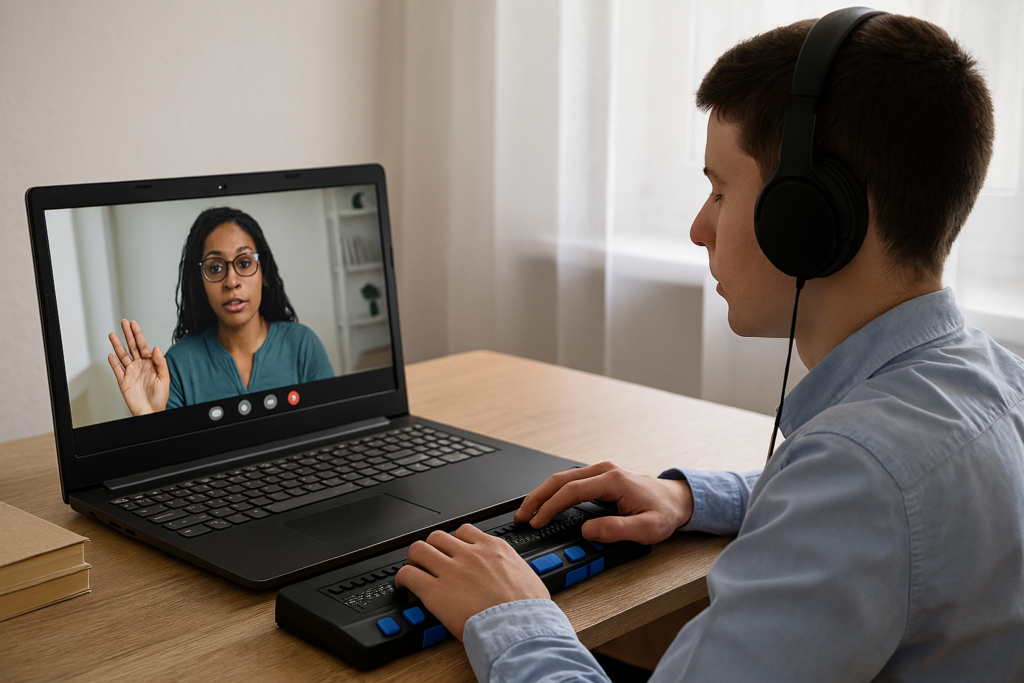
    Zoom remote instruction
    Remote teaching with Access Training Teacher

    In addition to live remote lessons, learners, families, and educators can continue building skills through yourtechvision.com and our YouTube Channel. These videos demonstrate access technology in action and allow people to review, practice, and learn at their own pace. Moreover, districts, rehab centers, and private clients often combine direct training with these resources for ongoing support.

    TechVision Access Training Instruction Model

    TechVision’s model blends real‑time, one‑on‑one teaching with on‑demand video lessons. This combination ensures students can meet immediate expectations and continue growing independently over time. Ultimately, our goal is equal access to education, work, and life through practical, powerful training using access technology.

    TechVision provides lessons in access technology through yourtechvision.com and our YouTube Channel.

    To Maximize the Effectiveness of these Lessons

    TechVision’s empowers lifelong learning and independence. Additionally, our YouTube Channel and website offer ongoing access to essential skills and demonstrations.

    Let us know how we can help you: Contact US: TechVisionTraining@yourtechvision.com