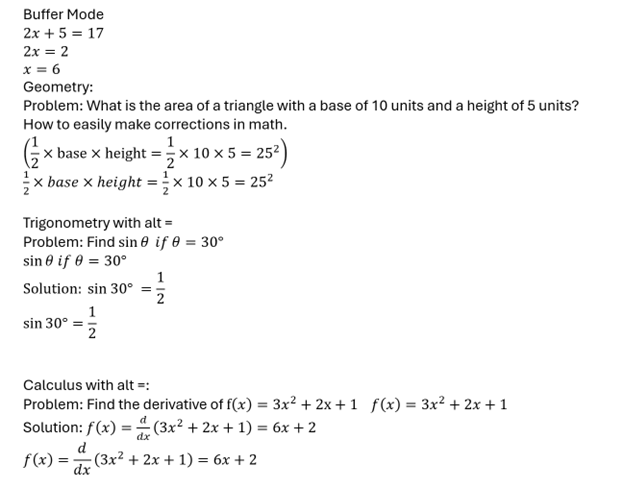
Dr. Robinson emphasizes practical and efficient math strategies for visually impaired students using assistive technology. Moreover, she demonstrates accessible solutions that empower students to engage independently in math tasks. Some of the best tricks to learning math for visually impaired students include understanding how to use technology effectively. For example, she teaches the Word Math Editor, activated with Alt+Equals, which enables students to access and edit equations effectively. Furthermore, this tool allows students to calculate expressions, such as a circle’s area, using keyboard shortcuts for greater efficiency. In addition, she introduces the Braille Math Editor, which enhances accessibility and provides tactile support for understanding complex math concepts. Continue with Advanced Math with LaTex using Mathkicker.AI-Matrices also.
Dr. Robinson configures Braille displays and the Braille Math Editor to improve accessibility and clarity for students. Students solve problems efficiently by using built-in features like scientific calculators and shortcuts such as Ctrl+C and Ctrl+V.
Dr. Robinson demonstrates advanced techniques, including LaTeX for math notation and proper vinculum coverage in equations. She converts equations between professional and linear formats to ensure accuracy in math tasks. Knowing tricks to learning math, such as using LaTeX, can greatly benefit students. Add Tactile Math Tools for even better understanding.
She teaches code structures and tools to help students work independently with their peers during lessons. By optimizing settings and using shortcuts, students gain confidence and efficiency in solving complex math problems.
Dr. Robinson ensures students participate fully in math classes and achieve academic success. Her methods, which include easy ways to learn math, integrate the latest assistive technologies to empower visually impaired students in STEM fields.
In today’s digital age, technology has transformed how we approach learning, especially in subjects like accessible math. More importantly, this transforms how all screen reader users can access math like their peers. MathKicker.AI math program provides access to AP classes and advanced math for high school and college students. This accessible tool caters to diverse learning needs, offering compatibility with various screen readers. This video features Advanced Math with LaTex and shows how it can enhance your mathematical skills, making complex equations easier to tackle.
Matrices
Dr. Robinson explains the basics of navigating MathKicker.AI. Matrices can easily create a Matrix with Alt = and type it in LaTex. This quickly provides accurate math and F9 will allow you to see and enter LaTex. You can also learn the LaTex from just typing the math into Mathkicker. The session showcases the ease of solving matrix equations, demonstrating how to find the matrix C resulting from matrices A and B.
Throughout the demonstration, Dr. Robinson shares tips for efficient navigation, including using the home key and arrow keys to read through equations. She highlights the functionality of the F9 key for processing inputs and emphasizes the need to verify details when working with complex equations.
As she works through a specific problem, Dr. Robinson illustrates how to structure equations and maintain clarity while performing calculations. Remember to double-check your work and she encourages people to utilize the program’s features for swift problem-solving.
By the end of the session, Dr. Robinson summarizes the output clearly, showcasing the successful application of Math Kicker. She encourages students to explore this tool for enhancing their math skills, particularly in higher education and advanced high school courses.
This tutorial not only highlights the software’s capabilities but also empowers screen reader users and all students to embrace technology in their learning to keep up with their peers.
Mathkicker editor with Jaws or NVDA and display for math access for advanced math
Other Math Lessons from Basic Math to Advance Skills
Digital Math in WORD and Braille Math Editor for Nemeth or UEB Input/Output via MathCat with JAWS or NVDA. This lesson empowers you to learn skills for teaching yourself and others Nemeth or UEB math. By incorporating Math AI, you can transform inaccessible math images into usable formats in just seconds, significantly speeding up the learning process compared to transcribing character by character. While the video covers some essential skills, the following links provide comprehensive lesson details from the Digital Math in WORD Video.
MathCat with JAWS or NVDA
Learning how to teach or learn Nemeth math using assistive technology can seem challenging, but with the right tools and approach, it becomes manageable and effective. Whether you’re a parent helping your child, an educator supporting students, or an independent learner, using a Focus 40 Braille Display and JAWS screen reader provides an accessible way to master Nemeth code. In this guide, I will walk you through setting up your technology and using the Braille Math Editor to confidently teach and learn math concepts from basic arithmetic to advanced algebra. Let’s simplify the process and enhance your skills.
Setup your computer to work the best with Screen readers and Digital Math in WORD
Before beginning the challenge of learning Nemeth or UEB with screen readers, make sure you Optimize your Windows 11 computer for Efficiency with Screen Readers with Key Settings and Configurations. Optimizing Windows 11 Efficiency for Screen Reader with Key Settings and Configurations takes an hour most often 2 or so to complete. Longer if you are new to screen reader and how Windows 11 works. It is different than other OS systems so give yourself grace as you learn all there is to know about this system. As you move through your keyboard and discover you would like a particular key somewhere, like the applications key, you can remap a key to create that yourself. AND, you MUST have Local Admin on School Computers.
Mathkicker.AI
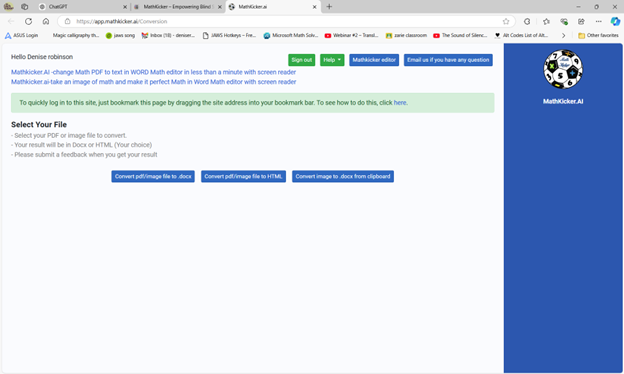
Mathkicker for digital math access with Jaws or NVDA-Login Page
Learning how to teach or learn Nemeth math using assistive technology can seem challenging, but with the right tools and approach, it becomes manageable and effective. Whether you’re a parent helping your child, an educator supporting students, or an independent learner, using a Focus 40 Braille Display and JAWS screen reader provides an accessible way to master Nemeth code. In this guide, I will walk you through setting up your technology and using the Braille Math Editor to confidently teach and learn math concepts from basic arithmetic to advanced algebra. Let’s simplify the process and enhance your skills.
Setup Nemeth with JAWS
Start by setting JAWS to the proper Nemeth settings. Access the JAWS Settings Center with Insert + 6 then Control+Shift+D to set default: type “Braille m” in the search box. Navigate to “Braille Mode” and make sure you hear “Structured” mode, ensuring that both the active cursor and Braille cursor follow each other. This will allow you to track what the student is doing on their display.
Alt + F to language profiles, and alt + D to details. Once open Alt + M to math options and up arrow to Nemeth if it is not selected. This will ensure that math expressions are correctly read and displayed in Nemeth Braille. Enter to close, Alt + A to apply and enter to close.
Teach or learn Nemeth JAWS, braille display and BME
Using the Braille Math Editor is key to teaching and learning math effectively. Type out equations like “1+2=3” or more complex algebraic expressions, and feel the Braille output directly on your Braille display. Correct mistakes quickly using the Braille display and JAWS auditory feedback, making it easy to follow along. Use the Braille Viewer to see it visually and compare with the Braille Display by opening JAWS context menu, go to Utilities and Braille Viewer to turn it on.
This step-by-step approach works for basic arithmetic to complex math such as algebra, Trigonometry, calculus and beyond. Both the Braille Math Editor and Word Math Editor can help you visualize and interact with Nemeth code to easily learn it and/or teach others. Practice consistently to improve your tactile reading skills and build confidence in math.
By following this guide, you’ll gain the tools to teach and learn Nemeth math efficiently, whether for yourself or for your students.
In this lesson, you’ll learn how to teach and practice Unified English Braille (UEB) math using a Focus or Brailliant Braille display with JAWS. Start by setting up the correct Braille settings in JAWS, ensuring your Braille display and cursor follow each other for accurate feedback. Adjust your language profiles and choose UEB Grade 2 for output and input. Navigate through basic arithmetic and algebra problems using JAWS’ Braille Math Editor, making corrections easily. This step-by-step method will help both new and experienced teachers guide students in learning UEB math effectively.
First, set up JAWS properly by accessing the JAWS Settings Center Insert + 6 followed by (Ctrl+Shift+D) to set default. Type out and Navigate to “Braille mode” and ensure your display is set to “Structured” mode. Enable the settings that allow the active cursor to follow the Braille display and vice versa. This ensures that wherever your student is on the screen, you can follow along on your display. Turn on the Braille Viewer also to see the braille at the top of your monitor if you have sight.
Next, Alt + F to Language profiles then Alt + D to details and open and confirm UEB Grade 2 and Unicode by default. You can continue to Tab or Alt + M for math and select the UEB Math option in JAWS settings. Enter to close then Alt A to apply and enter to close. You are ready to go.
Practice using the Braille Math Editor
For practicing, you’ll use JAWS Braille Math Editor to create and edit math expressions as 1 option. Other options are WORD Math editor and LaTex as another as you become more advanced. Start with basic arithmetic, typing out equations such as “1+2=3,” and use the Braille display to feel the corresponding Braille output. This method works for both teaching and self-learning. As you advance to algebra, geometry, Trigonometry and calculus, use the WORD Math editor or Braille Math Editor to navigate complex equations. The editor allows easy error correction, reinforcing concepts as students work through problems.
Teach Math with Jaws and braille display-Basic to advanced math formulas
This method also helps auditory learners who can listen to JAWS while simultaneously feeling the Braille on the display. Practicing consistently with both the Braille Math Editor and JAWS will solidify UEB math skills and improve teaching efficacy.
To enter college, you need a foundation in Algebra and Geometry. For STEM fields, add Calculus and Trigonometry. Trigonometry studies the relationships between angles and sides of triangles. With tools like Trigonometry with Math Editor, Braille Math Editor and screen readers, you can easily explore these relationships. It uses sine, cosine, and tangent functions to relate angles to side lengths. These functions are essential in physics, engineering, and astronomy. They help solve problems involving distances and angles. For example, trigonometry determines the height of a building or the distance across a river without direct measurement.
Trigonometry provides tools to model and solve problems involving angles and distances. It is fundamental to mathematics and its applications.
Going to College
If you go into STEM field IN college, you need advanced classes in but not limited to college algebra, trigonometry and calculus. When you are a screen reader and Braille user, these skills will allow you the options and opportunities to complete work as sighted peers.
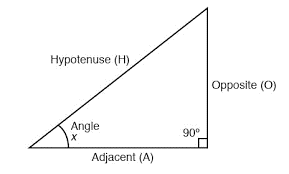
Let’s talk about: Trigonometry which is a branch of mathematics that studies the relationships between the angles and sides of triangles
Right triangle for Trigonometry with math editor
You can copy this content and paste into WORD OFFICE 365. Make sure you select Math 1 at a time and alt = to turn into true math. Then you can Ctrl = to change to professional or keep the LaTex then enter and braille it in again using Nemeth or UEB Math or practice LaTex.
Problem 1: Finding the Length of a Side
Given: A right triangle with one angle of 30° and the hypotenuse of 10 units. Find: The length of the side opposite the 30° angle.
More options for JUST auditory learners or braille learners and taking totally inaccessible images of WORD and making them accessible using Mathkicker.AI.
Creating Geometry tables in Desmos provides a structured way to input and explore data, especially for users who rely on screen readers or keyboard navigation. Desmos is designed to be accessible, allowing blind and visually impaired users to create tables and input values using simple keyboard commands. By using the table function, users can input x- and y-values and navigate through cells seamlessly. This accessibility enables full participation in mathematical exploration and data visualization, making Desmos a valuable tool for both students and professionals. Through keyboard shortcuts and screen reader compatibility, creating and managing tables in Desmos becomes an intuitive and efficient process: even creating 2 or more shapes.
To create a table in Desmos, follow these steps, especially if you’re using a screen reader or keyboard navigation:
Creating Geometry Tables in Desmos Using Keyboard:
Open Desmos Graphing Calculator:
Go to the Desmos website and open the graphing calculator interface.
Activate the Add Expression Button:
If you’re using a screen reader, navigate to the “Add Expression” field by pressing Tab until you hear the option.
Enter the Table Command:
Type table() and hit Enter. This will create an empty table. The screen reader will announce that a table has been created, and it will move you into the table input fields.
Fill in Table Values:
To fill in the values for your table, use the arrow keys to navigate between cells.
Input the x-values in the left column and the y-values in the right column.
After typing each value, press Enter to move to the next cell. The screen reader will confirm each input.
Navigation Commands (for Screen Readers):
Move to the Next Cell: Press the Right Arrow or Down Arrow to move between cells.
Move Back: Press the Left Arrow or Up Arrow to go back to previous cells.
Delete an Entry: Use Backspace to delete the contents of a cell.
Add More Rows: Navigate to the last row and press Enter. This will automatically add a new row for more data points.
Keyboard Shortcuts in Desmos:
Navigate between expressions/tables: Use the Up and Down Arrow keys.
Create a new table: Type table() in the expression line.
Results
By typing table() into the Desmos expression field, users can create tables and populate them with x- and y-values. Or just create a Table from menu. Screen readers will provide auditory feedback, helping users navigate through the cells and input values. Desmos’ intuitive keyboard commands make this process efficient for users relying on screen readers or those who prefer keyboard navigation.
The DESMOS Graphing Calculator offers a powerful and accessible tool for blind and visually impaired students to explore geometry and all mathematics. By integrating seamlessly with screen readers like JAWS and NVDA, DESMOS provides real-time audio feedback and tactile support, enabling students to plot points, create shapes, and analyze graphs. With features like Audio Trace and braille compatibility, this innovative tool ensures that all learners can engage meaningfully with geometric concepts, fostering independence and confidence in STEM learning. Combine with embossing what is created gives the whole picture to a student under their fingers.
Using the DESMOS Graphing Calculator with a screen reader, such as JAWS or NVDA, gives blind and visually impaired students accessible tools to engage with geometry and other mathematical concepts.
Key Features of Geometry in DESMOS graphing Calculator with screen reader
Screen Reader Compatibility: First, DESMOS integrates with screen readers, offering spoken feedback for graph creation, interaction, and navigation. It reads inputs aloud.
Graphing and Plotting Points: Next, students plot points, lines, or shapes using equations or coordinates. The screen reader then reads back the corresponding inputs and outputs.
Geometric Shapes: Additionally, DESMOS supports various geometric figures like circles and triangles. Students define these shapes, and the screen reader provides immediate feedback.
Accessibility Features: Moreover, the “Audio Trace” feature converts visual graphs into sound. Pitch and tone changes represent graph shifts, offering an auditory experience.
Tactile Representation: For tactile interaction, emboss the graph or use refreshable braille displays which allow students to access the calculator’s output, further enhancing their understanding of graphs.
Exploration of Graphs: Meanwhile, users navigate graphs with arrow keys, and the screen reader offers real-time feedback on points, intersections, and key areas.
Labeling and Describing: Finally, DESMOS allows labeling of points and graphs. The screen reader reads these labels aloud, improving organization and understanding of complex graphs.
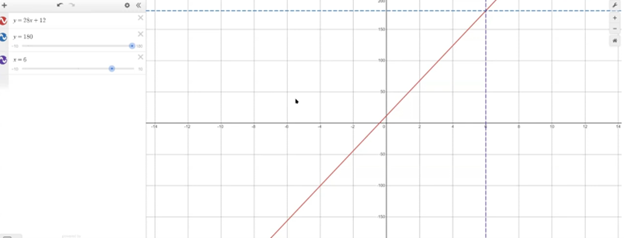
Desmos Geometry shape with dotted line solutions
By leveraging these features, blind or visually impaired students can effectively learn and apply geometric concepts, making DESMOS a valuable tool for STEM education. If Desmos is not an option Excel works well also with shapes. Continue learning anything you need and if you cannot find it, just ask.
Access Technology Training Lessons provide detailed instruction to enhance your skills.
TechVision provides direct, remote training to students and clients around the world. We teach exactly what each learner needs so they can access the same work as their peers. Additionally, we focus on real assignments, real deadlines, and real expectations from school, work, or rehabilitation programs.
We tailor every lesson to the student’s current tasks and long‑term goals. This individualized approach builds confidence, independence, and strong academic performance. Furthermore, we write IEP goals directly related to each student’s needs, ensuring progress, and school expectations align per grade level and skill.
Students learn to use screen readers, braille displays, and other access technologies to complete the same documents, graphs, tests, and projects as their classmates. This targeted training prepares students for success in school, work, and daily life. Additionally, many TechVision Specialists are blind themselves and provide authentic guidance that strengthens student independence. In addition to being incredible mentors.
Remote teaching with Access Training Teacher
In addition to live remote lessons, learners, families, and educators can continue building skills through yourtechvision.com and our YouTube Channel. These videos demonstrate access technology in action and allow people to review, practice, and learn at their own pace. Moreover, districts, rehab centers, and private clients often combine direct training with these resources for ongoing support.
TechVision Access Training Instruction Model
TechVision’s model blends real‑time, one‑on‑one teaching with on‑demand video lessons. This combination ensures students can meet immediate expectations and continue growing independently over time. Ultimately, our goal is equal access to education, work, and life through practical, powerful training using access technology.
TechVision’s empowers lifelong learning and independence.Additionally, our YouTube Channel and website offer ongoing access to essential skills and demonstrations.