Search results for: “low vision”

  • Team Specialists

    TechVision Team Specialists have provided remote instruction worldwide since 2007. Additionally, under the leadership of Dr. Denise M. Robinson, they empower students through comprehensive education for the blind. Furthermore, with expertise in screen readers, braille displays, braille, Nemeth code, and assistive technologies, the team delivers individualized instructional support for every learner.

    A defining strength of the TechVision Team specialists is that over 90% of our instructors are blind themselves. They use the same technology they teach. This brings unmatched authenticity, lived experience, and practical mastery to every lesson. Alongside a small number of sighted specialists, this blended team works together with purpose and unity. They model independence, confidence, and real‑world problem‑solving for every student they serve.

    Their commitment to equal access in education guides every aspect of their work. Additionally, they provide real‑time, one‑on‑one instruction and collaborative school‑team training to support full educational access. Furthermore, every TechVision Team Specialist shares a mission of removing barriers and creating pathways to independence.

    A Diverse Group of Team Specialists
    A Diverse Group of Team Specialists

    Our Mission & Impact

    TechVision Team Specialists create global impact through a mission‑driven approach to education for the blind. I Additionally, they provide personalized, one‑on‑one remote instruction for learners of all ages.

    Our specialists hold advanced degrees and certifications in Orientation & Mobility (O&M), Teaching Students with Visual Impairments (TVI), Assistive and Access Technology, and Special Education. Each instructor uses specialized blind and low vision technology daily at an expert level, allowing them to deliver direct instruction across all subject areas including math, science, English, and history aligned to each learner’s individual needs. Instruction supports individuals of all ages from early childhood through adulthood and emphasizes real-world application, independence, and full access to the general education curriculum.

    This real-time, individualized instruction empowers students and clients to compete equally in school, work, and daily life. TechVision specialists: both blind and sighted, are central to this mission, ensuring every learner has the tools, skills, and access they need to succeed.

    TechVision Director, Assistant Director and Director of Business

    Dr. Denise M. Robinson

    Director & Founder
    Ph.D., TVI, Access Technology, IT, Braille, Nemeth, AI, CVI

    Dr. Denise M. Robinson is dedicated to empowering students to reach their full potential. Additionally, she leads a team of expert instructors who share her commitment to excellence and inclusion. Together, they provide comprehensive blind skills instruction across all areas of education.

    Furthermore, with deep expertise in instructional technology, Dr. Denise ensures that students of all ages receive essential, on‑demand educational skills. As a result, her leadership continues to guide the transformative work of the TechVision team.

    In addition, as a passionate program developer and nationally recognized speaker, she creates innovative instructional models that merge technology with blind skills. Through this work, she equips learners with the tools they need to pursue education, careers, and independence.

    Dedication

    TechVision’s dedication stems from a deep belief in the transformative power of education and the right of every individual to be fully included in the world. By merging technology with blind skills, the team works to eliminate barriers and ensure equal access and opportunity for all students.

    Outside of her professional work, Dr. Denise enjoys spending time outdoors—working with tractors and equipment, hiking daily, gardening, and meeting new people. She finds joy in the diversity of the world and the meaningful connections it brings.

    Beth Sellers

     Assistant Director of Educational Programming, MA
    Teaching AT, Braille, Nemeth & Additional Skills

    Beth Sellers is a graduate of James Madison University and Eastern Mennonite University, where she earned her master’s degree in education. With more than 20 years of experience in special education and community-based disability services, Beth brings extensive expertise in assistive technology and blind skills instruction.

    At TechVision, she teaches braille and access technology and provides consulting services to school divisions in assistive technology. Beth is a former president of the Virginia Chapter of the National Organization of Parents of Blind Children and volunteers with the AMCSI Conference Planning Team and her local SPCA.

    In her spare time, Beth and her children enjoy time on the lake, caring for their two dogs and many rescue cats, and exploring new activities—including cross-country skiing with Ski for Light.

    James Robinson

    Director of Business Services, BS

    James Robinson brings extensive administrative experience to TechVision, having previously served as an administrator in care facilities. As TechVision expanded to meet the growing demand for high‑quality remote instruction, he transitioned his leadership and operational expertise into the role of Director of Business Services.

    In this capacity, James oversees all business operations, including accounting, billing, financial coordination, and organizational systems. His strong background in management and service administration ensures that TechVision functions efficiently and that both the instructional team and clients receive consistent, reliable support. His work is essential to sustaining TechVision’s growth and mission‑driven impact.

    Let us know how we can help you: Contact US: TechVisionTraining@yourtechvision.com
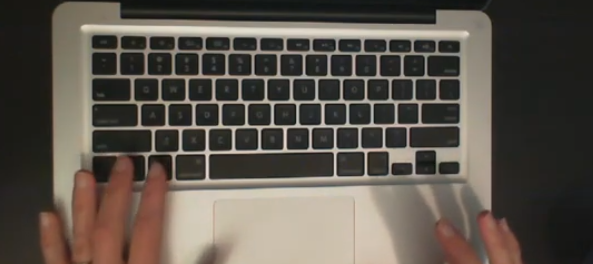
  • Mac with VoiceOver and Key Commands

    Navigating a Mac with VoiceOver is essential for blind and low vision users. By using keyboard commands, you can efficiently manage tasks without relying on a mouse. VoiceOver provides auditory feedback, guiding users through menus, applications, and files. Key commands like Command + F5 to toggle VoiceOver, or Control + Option + D to access the Dock, streamline the process. This guide introduces basic navigation techniques, helping you quickly move between applications, windows, and other essential areas of your Mac with Voice Over.

    Finger gestures on a Mac track-pad allow for smooth navigation and interaction. With VoiceOver enabled, the following gestures are common on track pad on Mac with VoiceOver and Key Commands :

    1. One-Finger Swipe: Swipe left or right to move between items.
    2. Double-Tap: Activate or select an item.
    3. Three-Finger Swipe: Move the content, such as scrolling up or down.
    4. Two-Finger Rotate: Adjust the rotor to different navigation options.
    5. Three-Finger Tap: Brings up additional VoiceOver information about the item.
    Mac with Voice Over and VO keys
    Mac with Voice Over and VO keys

    Finger tap or swipe gestures on the Mac trackpad with VoiceOver and Key Commands provide an intuitive way to control navigation using VoiceOver. Here are some common gestures:

    1. Single Tap: Select an item under the cursor.
    2. Double Tap: Activate the selected item (like clicking a mouse).
    3. Swipe Left or Right with One Finger: Move to the next or previous item.
    4. Two-Finger Swipe Up/Down: Scroll through a document or webpage.
    5. Three-Finger Swipe Left/Right: Navigate between open applications or spaces.

    These gestures make interacting with your Mac faster and more efficient when using VoiceOver.

    Then continue to Practice those perfect Touch typing skills and learn more commands via YouTube

  • Save a Google Doc as Plain Text Using Keyboard Commands

    Google offers several tools to make inaccessible images of work accessible through translation and text extraction. Google Translate includes an image translation feature, where users can upload an image and the tool will detect and translate the text within it into another language. Additionally, Google Drive and Google Docs use Optical Character Recognition (OCR) to convert images, like scanned PDFs, into editable text. This makes visual content, such as images with embedded text, accessible for screen readers, helping blind or low vision users engage with the content more easily. Using Google Docs as plain text can further streamline this process.

    Here’s how to save a Google Doc as plain text using keyboard commands:

    1. Open your document.
    2. Press Alt + Shift + F to open the “File” menu. (Many times you can just use Alt+F)
    3. Press Down Arrow to navigate to Download.
    4. Press Right Arrow to expand the options, then press Down Arrow to select Plain Text (.txt).
    5. Press Enter to download the document as a plain text file.
    6. Open the .txt file, select with CTRL + A, Copy it with CTRL+C and paste into WORD with CTRL+ V

    These steps will extract text then download the document with no formatting, leaving only the raw text. Then transfer it into WORD for easy reading

    Google Doc as Plain Text Using Keyboard due to doc being side ways image
    Google Doc as Plain Text Using Keyboard due to doc being side ways image

    More Tech Lessons here and more on adapting work

  • What Does Legally Blind Look Like?

    Many people wonder what does legally blind look like? In fact, visual acuity below 20/200 qualifies as legally blind. To actually fit the definition, the person must not be able to attain 20/200 vision even with prescription eye wear. People with legal blindness can function effectively in daily life using appropriate glasses or contact lenses.

    Educational Definition for Services

    Under the new criteria, if a person’s visual acuity is measured with one of the newer charts, and they cannot read any of the letters on the 20/100 line, they will qualify as legally blind, based on a visual acuity of 20/200 or less. Based on acuity Work will need to be adapted.

    These images as examples used in presentations.

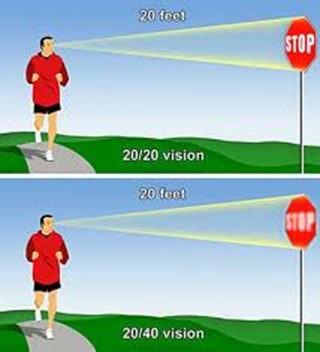
    20/20 and 20/40

    20/20 vision
    20/40 vision-sight blur

    Low Vision Options can adjust how ones sees the computer or even access the use of a mouse.

    20/70 is not legally blind

    20/70 visual acuity--very blurry
    20/70 visual acuity–very blurry

    This vision means that a person sees at 20 feet what someone with normal vision sees at 70 feet. It is a form of visual impairment classified as mild low vision. Here’s a breakdown of what this means and its implications: Based on diagnosis, this acuity can get worse throughout the day.

    1. Definition of 20/70 Vision

    • In a standard eye exam, the results are written as a fraction, with 20/20 being considered normal vision.
    • The first number (20) refers to the distance (in feet) from which a person views an object.
    • The second number (70) indicates the distance at which a person with normal vision can see the same object with clarity.
    • Thus, someone with 20/70 vision must be closer to an object (20 feet away) to see it as clearly as a person with 20/20 vision can from 70 feet.

    2. Implications of 20/70 Vision

    • Legally Not Blind: This level of vision does not qualify as legal blindness, which is defined as 20/200 or worse with corrective lenses.
    • Difficulty with Certain Tasks: Individuals with 20/70 vision may struggle with tasks requiring clear distance vision, such as reading road signs, recognizing faces from a distance, or seeing objects clearly in low-light conditions.
    • Daily Life Adjustments: Depending on the person’s environment, they may need glasses or contact lenses to enhance their vision for specific tasks. However, vision aids may not fully restore perfect clarity.

    3. Corrective Measures

    • Eyeglasses or Contact Lenses: Many individuals with 20/70 vision wear corrective lenses to improve visual acuity.
    • Low Vision Aids: Some people might benefit from magnifying devices, large-print materials, or enhanced lighting to assist with reading or other close-up tasks.
    • Adaptive Technology: Screen magnifiers, larger fonts on digital devices, and software that enhances visual contrast can also help improve accessibility for people with 20/70 vision.

    4. Potential Causes

    • Refractive Errors: Conditions like myopia (nearsightedness), hyperopia (farsightedness), or astigmatism can result in 20/70 vision if not corrected.
    • Eye Diseases: Conditions like cataracts, macular degeneration, glaucoma, or diabetic retinopathy may cause a person’s vision to deteriorate to 20/70.
    • Age-Related Changes: Vision often declines naturally with age, and some individuals may experience 20/70 vision due to presbyopia or other age-related conditions.

    5. Treatment and Management

    • Regular eye exams are essential to monitor vision changes.
    • Wearing prescribed corrective lenses and using adaptive aids can help individuals maintain independence and improve their quality of life.
    • Early detection of underlying conditions (e.g., glaucoma or cataracts) through eye exams can prevent further vision loss.

    In summary, 20/70 vision reflects a moderate visual impairment. While it can pose challenges for certain activities, corrective measures and assistive technologies can significantly enhance visual functioning and quality of life.

    legally blind looks like-all acuity levels compared-
    all acuity levels compared

    20/100 vision means that a person sees at 20 feet what someone with normal vision can see clearly at 100 feet. This level of visual acuity is considered moderate low vision. Here’s a detailed explanation of what 20/100 vision means and its implications:

    1. Definition of 20/100 Vision

    • Visual Acuity Measurement: Vision is typically measured using a Snellen eye chart, and the result is expressed as a fraction. The first number (20) represents the distance at which the person is standing from the chart. The second number (100) indicates the distance at which a person with normal vision (20/20) can see the same object clearly.
    • Therefore, a person with 20/100 vision must be much closer to an object (20 feet away) to see it clearly, while someone with normal vision can see it clearly from 100 feet away.

    2. Implications of 20/100 Vision

    • People with 20/100 vision are considered legally visually impaired. However, this does not meet the definition of legal blindness, which is 20/200 or worse. Even with corrective lenses, they fall under the low vision category. This means normal vision remains unattainable.
    • When it comes to daily tasks, they often struggle with seeing distant objects clearly. For instance, they may have trouble reading signs from far away. Recognizing faces across a room or on the street is also challenging. Watching TV or presentations requires sitting close. Driving presents challenges, as they may not clearly see signs or signals from a safe distance.
    • Close-up tasks can be easier for those with 20/100 vision. Reading or using a computer may not be as difficult. However, many still require magnification or adaptive tools to assist with these activities.

    3. Impact on Daily Life

    Technology has changed everything toward independence, including AI apps that will read to you what you cannot see.

    • Driving: In many regions, individuals with 20/100 vision may not meet the vision requirements for driving. Driving may be possible with special accommodations or vision aids, but restrictions usually apply.
    • Work and Education: Individuals with 20/100 vision may need accommodations in the workplace or classroom, such as enlarged print materials, magnifiers, or assistive software. Special seating or devices may also be necessary to ensure they can participate fully.
    • Mobility: While 20/100 vision allows for some independent movement, it can still make navigating unfamiliar environments more challenging. Some individuals may benefit from mobility aids like a cane or guide dog in certain situations. Based on diagnosis, 20/100 can change to 20/200 or worse during any day at school or work based on eye fatigue.

    Different levels of Vision Loss to easily compare:

    20/20 visual acuity to see people clearly in distance
    20/20 visual acuity to see people clearly in distance
    20/200 seeing blurry people in the distance
    20/200 seeing blurry people in the distance
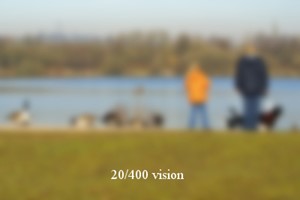
    20/400 acuity seeing people extremely blurry in distance
    20/400 acuity seeing people extremely blurry in distance

    What legally blind looks like and is:

    20/200 vision is a severe level of visual impairment and is often classified as legal blindness in many regions. It means that a person with this level of vision can see at 20 feet what a person with normal vision can see clearly at 200 feet. Here’s an overview of 20/200 vision and its implications: Technology has changed everything toward independence, including AI apps that will transcribe the inaccessible to accessible for you what you cannot see

    1. Definition of 20/200 Vision

    • In an eye exam, vision is expressed as a fraction. The first number (20) refers to the distance (in feet) from which the person views an object. The second number (200) indicates the distance at which a person with normal vision can see the same object clearly.
    • Therefore, someone with 20/200 vision must be much closer to an object (20 feet away) to see it with clarity, while a person with normal vision can see it clearly from 200 feet away.

    2. Legal Blindness

    • Legally Blind: A person with 20/200 vision is considered legally blind. Legal blindness is defined as having a visual acuity of 20/200 or worse in the better eye with the best possible corrective lenses.
    • Low Vision Category: While legally blind, individuals with 20/200 vision may still have some functional sight. They fall under the category of low vision, meaning that although their vision is severely impaired, they can still benefit from visual aids.

    3. Impact on Daily Life

    • Challenges with Distance Vision: Individuals with 20/200 vision have significant difficulty seeing objects, signs, or faces at a distance. Recognizing faces across a room, reading road signs while driving, or watching TV from a typical distance can be very challenging or impossible.
    • Mobility and Orientation: Moving through unfamiliar environments may require assistance or adaptations. People with 20/200 vision often need to use mobility aids, such as a white cane or guide dog, to navigate safely.
    • Reading and Close-Up Work: Although close-up vision may be better, people with 20/200 vision often require magnifiers or other visual aids for reading or detailed work.

    4. Corrective Measures

    • Eyeglasses or Contact Lenses: In some cases, corrective lenses may slightly improve vision. However, they often cannot bring a person’s vision to normal (20/20) levels when the vision loss is significant.
    • Low Vision Aids: Various devices can assist people with 20/200 vision in their daily lives, including:
      • Magnifiers: Handheld or electronic magnifiers for reading and detailed work.
      • Screen Readers: Digital devices or computers with screen readers that convert text to speech.
      • CCTV Systems: Closed-circuit television systems that enlarge printed text or images onto a screen.
      • Large-Print Materials: Books and materials with large text can make reading easier.

    5. Driving Restrictions

    • Not Eligible for Driving: In most countries and regions, individuals with 20/200 vision are not permitted to drive. Driving requires a higher level of visual acuity to safely recognize signs, signals, and hazards.

    6. Assistive Technology and Adaptations

    • Adaptive Technologies: Screen readers, screen magnifiers, and voice commands on computers and smartphones help individuals with 20/200 vision engage with digital content.
    • Environmental Modifications: Enhanced lighting, contrast modifications, and large-text displays make daily tasks like reading, working, and navigating spaces easier.
    • Orientation and Mobility Training: People with 20/200 vision need O&M (orientation and mobility) training to help them navigate safely and independently using mobility aids or techniques.

    Results

    20/200 vision signifies severe visual impairment and is categorized as legal blindness. When in School, immediately acquire services so students can learn independence. Access lessons to acquire those needed computer skills with screen readers.

    20/800 or More

    20/800 visual acuity


    20/800 vision is a severe visual impairment often classified as profound low vision or near-total blindness. This means a person with 20/800 vision can see at 20 feet what someone with normal vision sees at 800 feet. Consequently, this level of impairment presents significant challenges for daily functioning. Even with corrective lenses, the limitations remain.

    1. Definition of 20/800 Vision

    A person with 20/800 vision must be 20 feet away to see something that a person with normal vision can see clearly from 800 feet. This substantial loss of visual acuity severely limits the ability to see details at any distance.

    2. Legal Blindness and Classification

    Individuals with 20/800 vision fall under the category of profound low vision. Although some residual vision may remain, it is limited. People with 20/800 vision are legally blind. Legal blindness is defined as having a visual acuity of 20/200 or worse in the better eye, even with corrective lenses.

    3. Impact on Daily Life

    People with 20/800 vision face significant visual challenges in everyday tasks. They may struggle with activities such as reading, recognizing faces, or navigating unfamiliar environments. Even simple tasks like watching TV or identifying objects across a room are often inaccessible. As a result, they must rely on non-visual cues such as tactile or auditory information. This helps them navigate their surroundings and accomplish tasks.

    4. Corrective Measures

    Although corrective lenses offer limited improvement for individuals with 20/800 vision, magnifiers or other visual aids may enhance any remaining vision for specific tasks. However, many people with this level of impairment depend on advanced assistive technologies. Screen readers, braille displays, and text magnifiers help them access information. Voice-controlled devices enable hands-free interaction with technology. Additionally, orientation and mobility aids, such as white canes or guide dogs, help individuals move safely.

    5. Causes of 20/800 Vision

    Congenital conditions, like Retinitis Pigmentosa or Optic Nerve Hypoplasia, often lead to severe vision loss. Progressive eye diseases such as Glaucoma, Macular Degeneration, or Diabetic Retinopathy can also cause vision to deteriorate to 20/800. Additionally, trauma or injury to the eye may result in permanent vision impairment.

    6. Mobility and Independence

    People with 20/800 vision rely on white canes, guide dogs, or assistance to travel safely. Orientation and mobility training teaches them how to use these aids effectively. This training also helps them develop strategies for moving confidently through public spaces. Some individuals also use adaptive techniques like echolocation to supplement their remaining vision.

    7. Driving Restrictions

    Due to the severity of the impairment, individuals with 20/800 vision are not permitted to drive.

    8. Support and Resources

    Low vision rehabilitation programs provide essential training in daily living skills, technology use, and mobility techniques. These programs enable individuals with 20/800 vision to maximize their remaining vision. Various organizations offer services such as guide dog training, braille literacy, and mobility aid instruction. Vision loss support groups also offer emotional and practical support for those facing similar challenges.

    Result

    20/800 vision represents profound visual impairment, often resulting in near-total blindness. People with this condition face substantial challenges in daily life. However, they can rely on assistive technology, mobility aids, and rehabilitation services to maintain independence. While corrective lenses may offer limited improvement, adaptive tools and strategies help individuals with 20/800 vision engage in work, education, and social activities successfully.


    Now, you can get an idea of what a visual impairment actually looks like. Educational Services starting at youngest age possible but no later than age 3 years old is crucial.

    Understanding Vision in Children: What Visual Acuity Really Means


  • Are you Color Blind? Take this Test

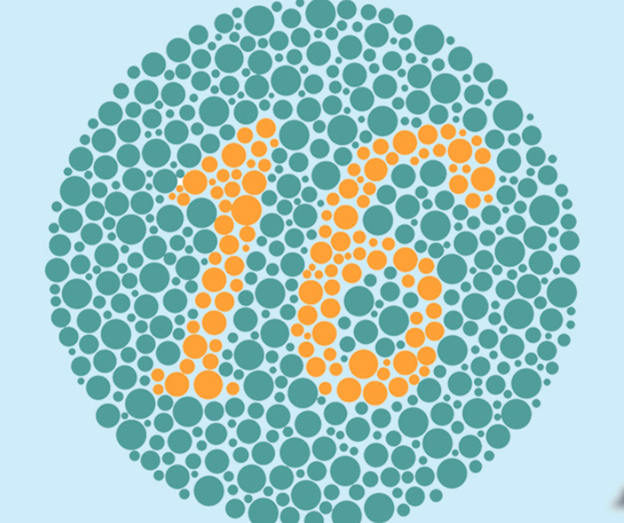
    Color blindness occurs when individuals cannot distinguish certain colors due to defects in the eye’s color-detecting cones. Are you color blind? Red-green color blindness is the most common form. About 8% of men and 0.5% of women worldwide experience some type of color blindness. Blue-yellow color blindness and total color blindness are rarer forms. Though it primarily affects men, women can also develop this condition, but at a much lower rate.

    Are you Color Blind? Can you see this number below clearly?

    are you color blind
    Are you color blind

    The website Color Vision Testing provides comprehensive information about color vision deficiencies, commonly known as colorblindness. Here are some key features of the site:

    1. Educational Content: It explains what colorblindness is, the different types, and the underlying causes.
    2. Resources for Educators and Parents: The site offers guidance for teachers, school nurses, and parents on how to support children with color vision deficiencies.
    3. Online Color Vision Tests: Users can take free online tests to check for colorblindness and determine the type and severity of their deficiency.
    4. Research and Articles: The site includes articles on color vision research and new pediatric color vision tests.
    5. Products for Screening: It offers color vision tests for purchase, suitable for schools, aviation, hospitals, and employment agencies.

    Here is How to see your computer better if you need adjustments to see screen better

    Other Vision impairment Information


  • Type directly on PDF for Geometry with screen reader

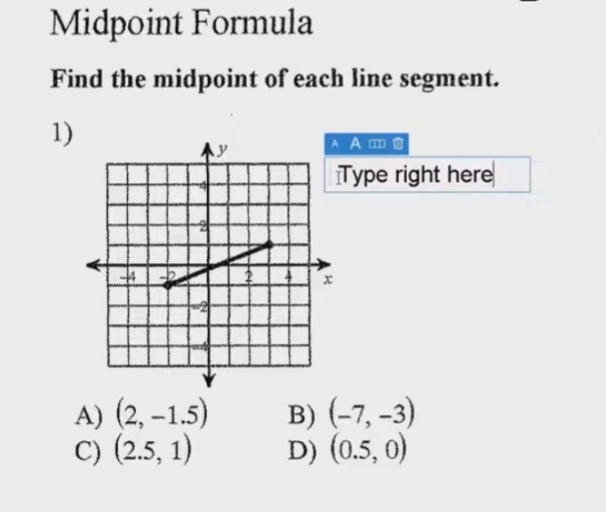
    You can perform all these tasks using current PDF versions, even with inaccessible scanned images. First, demonstrate how to write text directly on scanned PDFs, then save the edited file. Next, show students how to type directly on PDF and email the completed PDF to their teacher for submission. Perfect touch typing is always preferred for ease.

    For low vision users, all math content with voice output offers additional support. Combine this tool with text manipulation in PDFs to make materials more accessible. This approach ensures students can interact with complex materials efficiently, despite any visual challenges.

    Here are some useful keyboard commands for working with PDFs in Adobe Acrobat, focusing on enlarging the screen and typing on the document:

    Type directly on PDF commands

    Enlarge Screen (Zoom In/Out)

    1. Zoom In:
      • Press Ctrl + + (Plus sign) on Windows.
      • Press Cmd + + (Plus sign) on Mac.
    2. Zoom Out:
      • Press Ctrl + - (Minus sign) on Windows.
      • Press Cmd + - (Minus sign) on Mac.
    3. Fit to Screen:
      • Press Ctrl + 0 (Zero) on Windows.
      • Press Cmd + 0 (Zero) on Mac.

    Typing on a PDF

    Typing on PDF
    Type Directly on PDF
    1. Add Text:
      • Select the Text Box Tool by pressing Ctrl + Shift + T on Windows.
      • On Mac, you might need to manually select the tool from the toolbar.
    2. Type in a Form Field:
      • Navigate to the form field using the Tab key.
      • Press Enter to start typing.
    3. Add a Comment:
      • Press Ctrl + 6 to open the comment tool on Windows.
      • Press Cmd + 6 on Mac.
    4. Save Changes:
      • Press Ctrl + S to save the document on Windows.
      • Press Cmd + S on Mac.

    More PDF Lessons:

    Math and taking inaccessible to accessible in WORD

    Type directly on a PDF

    Transcribe Math Images from PDF

    Take Large PDFs and Print to PDF for a few pages

    If you have any computer issues, fix it up yourself and get going on work.

    These commands should help you navigate and edit PDFs more efficiently.

    Video on How to SEE your computer better with Low vision is also very helpful.

  • Kids Bright Eye Glasses or Eye Patches

    Kids Bright eye glasses will help your child “WANT” to wear them.

    Kids bright eye glasses
    Kids bright eye glasses

    Find the perfect adorable pair of glasses for your little one… Or even cute patches to have 1 eye patched.

    At Kids Bright Eyes, the focus is on nurturing children’s vision health through a range of engaging services. They emphasize the importance of early eye exams and offer tailored solutions to address common vision issues in children. The site highlights their commitment to using advanced technology for accurate diagnoses and personalized care. Parents can access valuable resources and tips for maintaining their child’s eye health and learn about various vision problems and treatments. Additionally, Kids Bright Eyes provides educational content to help parents understand how to recognize early signs of vision issues and the steps to take for effective intervention. Overall, Kids Bright Eyes combines expert knowledge with a compassionate approach to support and enhance children’s visual development.

    As you begin thinking about technology instruction, little fingers can easily learn skills based on vision levels. Whether low vision on a computer or needing more advanced lesson, we are here to help.

    Go to Bright Eyes Glasses and find out more

    Other child resources

    Other Vision impairment Information


  • Set up Outlook Alarm with Screen Reader

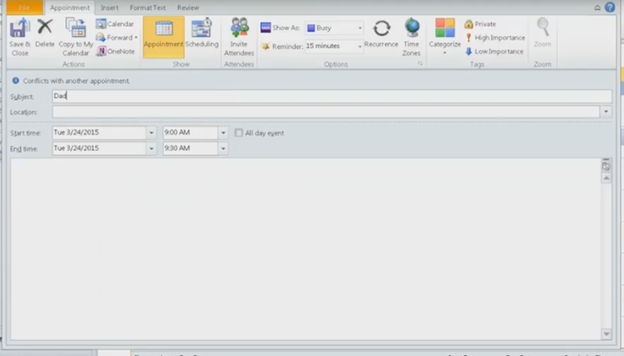
    Set up Outlook alarm with screen reader

    Set up Outlook Alarm
    Scheduling an Outlook Alarm

    To set up an alarm in Outlook with JAWS, press Ctrl + 2 to switch to Calendar view. Next, press Ctrl + N to create a new appointment. JAWS announces each field as you navigate through the form. Enter the subject, then press Tab to move to the location field. Continue pressing Tab to set the start and end times. To adjust the date, use Alt + Down Arrow to access the date picker.

    Press Alt + H to open the appointment tab, then A to set the reminder. Use arrow keys to select the desired reminder time, then press Enter to confirm. Finally, press Ctrl + S to save the appointment. At the scheduled time, JAWS will announce your reminder.

    If you discover your computer is not working well, check your Setups on windows and if you are low vision, here are setup options also for better viewing.

    More Outlook Lessons

  • Braille Reading Speed Standards

    So many people ask, “How fast should my child be reading?” When discussing Braille Reading Speed Standards, it’s essential to remember that blind children are just as intelligent as sighted children so standard reading speed should be used for all children. Braille Reading Fast.

    The Jerry Johns Basic Reading Inventory is a widely used tool for assessing reading speeds and comprehension levels in students. It helps educators determine a student’s instructional, independent, and frustration reading levels. This is done by evaluating their speed, accuracy, and comprehension. This inventory is particularly useful for identifying students’ reading capabilities and tailoring instruction to meet their needs. By measuring reading speeds, educators can see how students process text and find areas where they need more help to improve fluency and comprehension.

    Here are the national standards as presented by Jerry Johns, a leading reading specialist in the country. 

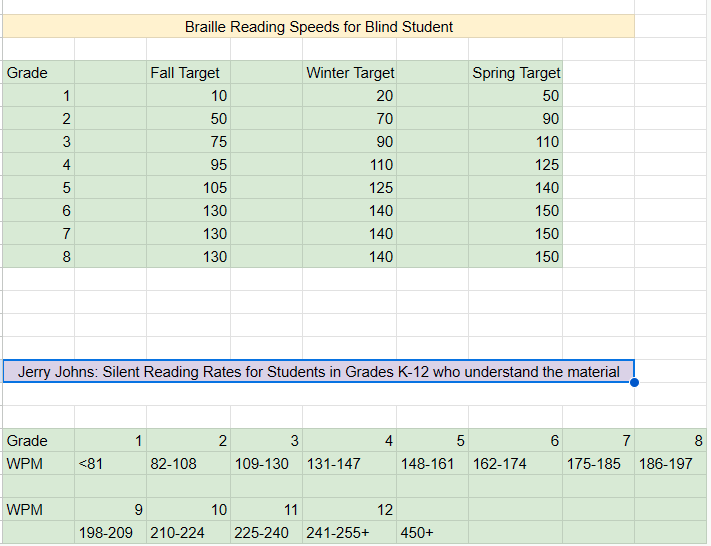
    Braille Reading Speeds for Blind Student 
             
    Grade Fall Target Winter Target Spring Target  
    1 10 20 50  
    2 50 70 90  
    3 75 90 110  
    4 95 110 125  
    5 105 125 140  
    6 130 140 150  
    7 130 140 150  
    8 130 140 150  


    Jerry Johns: Silent Reading Rates for Students in Grades K-12 who understand the material 
      
             
    Grade12345678
    WPM<8182-108109-130131-147148-161162-174175-185186-197
             
    WPM9101112    
     198-209210-224225-240241-255+450+   
    Braille Reading Standards Chart

    Use the SAME Braille Reading Speed Standards

    For another extensive list of information on Braille standards go to California Reading Standards

    The TechVision Team use these same standards for all blind and low vision students. To name just a couple, Batya reads both Hebrew and English Braille and Dani excels to the top of her class also. If you set high standards then children will meet those standards. We have taken on beginner students and told them how fast they would be reading braille in a couple months, even in middle and high school. Just remember the older you start the longer it will take for them to gain speed.  At the end of the 2 months, as their fingers would fly across the page reading braille, as they were timed with a fast speed, We would ask, “So did you really think you would be able to read that fast?” They would reply, “Of course, because you told me I would be able to.”

    So, tell them, they can, and they will. Our Mission and Purpose is to have students (especially with similar intelligence) at the highest levels they can be with hard work and instruction to get them there as their peers.

    Get to the Highest Levels

    Tricks to use
    Time them every week (sometime everyday), so they see their progress
    Have them reread the same material to get flow and fluency
    Have them braille the material first using contractions, then read what they wrote

    braille reading speed chart
    Visual braille reading speed chart as above accessible version

    Make sure you add in Computer skills with Perfect touch typing to truly allow students to be at the highest levels of learning.

  • Prevent Back and Neck Pain from Leaning over devices

    Leaning over while working over a computer or Phone can negatively impact your back. Leaning over devices causes compressed inter-vertebral discs, strained muscles, and altered spinal alignment. This posture can lead to chronic back pain, tension headaches, and long-term musculoskeletal issues. To prevent back and neck pain, maintain good posture, take regular breaks, and ensure your workspace is ergonomically designed.

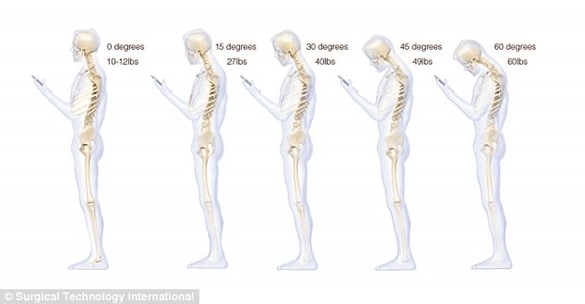
    Prevent Back and Neck Pain from Leaning over image of skeleton with curved back
    Prevent Back and Neck Pain from Leaning over- image of skeleton with curved back

    Low vision children are particularly vulnerable to neck and back problems, but anyone who leans over their work will eventually pay a high cost. Research shows that slumping over a phone adds significant pressure on the cervical spine. Bending the head to a 60-degree angle can add 60 pounds of pressure, equivalent to more than four stone. Proper posture can also lead to great touch typing skills.

    Prevent Back and Neck Pain

    Leaning over while working can have several negative effects on your back. Here are some key points:

    1. Compression of Inter-vertebral Discs: Slouching or leaning forward compresses the inter-vertebral discs, which act as shock absorbers between the vertebrae. Over time, this can lead to disc degeneration, herniation, and nerve compression, resulting in back pain and conditions like sciatica1.

    2. Muscle Strain: Prolonged leaning can strain the muscles in your back, neck, and shoulders. This strain can cause pain, stiffness, and reduced blood supply to these muscles, leading to chronic discomfort2.

    3. Postural Changes: Habitual poor posture can alter the natural curvature of your spine. This can lead to long-term changes in your spinal alignment, increasing the risk of chronic back pain and other musculoskeletal issues3.

    4. Tension Headaches: Tightness in the neck muscles from leaning over can lead to tension headaches that radiate from the neck up to the head4.

    To mitigate these effects, it’s important to maintain good posture, take regular breaks to move around, and ensure your workspace is ergonomically designed to support your spine health.