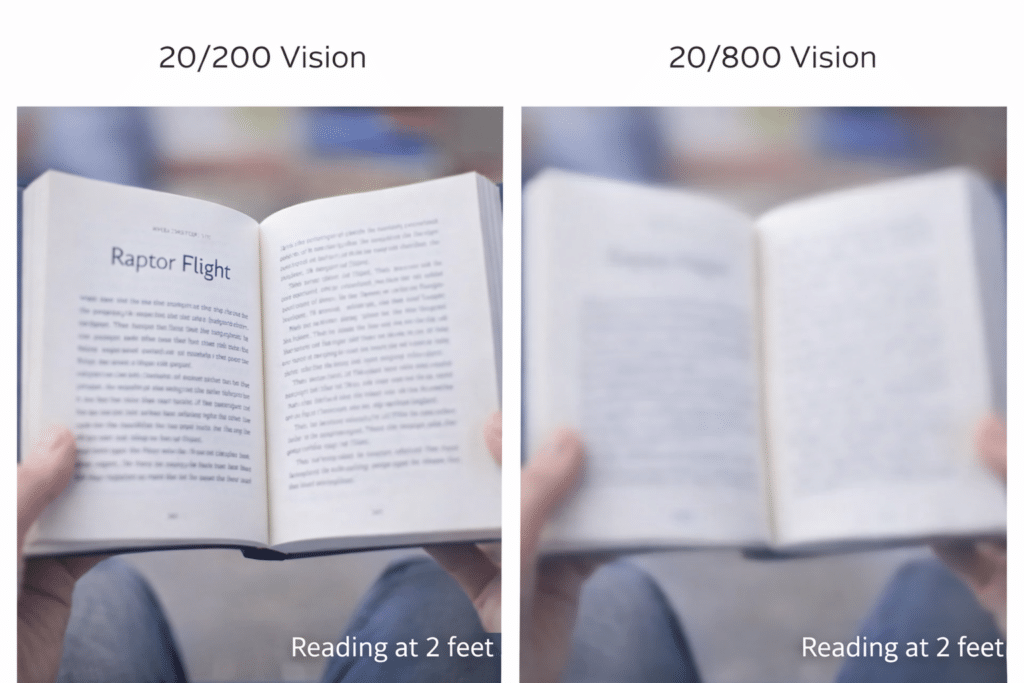
20/800 is one of the most misunderstood acuity levels and is considered legally blind.
People often assume it means “total blindness,” but that’s not accurate.
20/800 is severe low vision, and while it dramatically reduces detail at distance, many students and adults still use this vision every day — just differently.
Let’s break down what 20/800 really means in daily life.
What Does 20/800 Vision Mean?
A person with 20/800 vision sees at 20 feet what a person with typical vision sees at 800 feet.
That’s a forty‑times loss of detail.
This affects:
- distance clarity
- facial recognition
- reading speed
- contrast sensitivity
- navigation
- visual fatigue
But it does not mean “no vision.”
It means very limited detail, especially beyond arm’s length.
How 20/800 Vision Shows Up in Real Life
1. Distance detail is extremely limited
At 20/800, the world beyond a few feet becomes shapes, outlines, and movement — not detail.
Signs, faces, and board work are not readable at any distance.
2. Faces are recognized by shape, hair, and movement
Students often identify people by voice, posture, hairstyle, or clothing rather than facial features.
3. Reading requires magnification or digital access
Print must be significantly enlarged, or accessed digitally with zoom, contrast, and speech support.
4. Contrast becomes essential
Low‑contrast materials disappear.
Bold, high‑contrast visuals make a dramatic difference.
5. Mobility relies on pattern recognition, not detail
Students may navigate familiar spaces independently but need support in unfamiliar or visually complex environments.
How 20/800 Compares to Other Acuity Levels
20/800 vs. 20/200
20/200 is the legal definition of blindness.
20/800 is four times further down the chart — but the functional difference is not linear.
20/200 students may still catch some large details at distance.
20/800 students rely almost entirely on near vision, contrast, and nonvisual cues.
20/800 vs. 20/100
20/100 students can often access large print and some distance information with effort.
20/800 students cannot access distance information visually at all.
20/800 vs. “no vision”
It is not total blindness.
Students may still detect:
- light
- motion
- large shapes
- high‑contrast objects
- bold colors
This remaining vision can be incredibly useful when paired with the right tools.
What Students With 20/800 Need
- digital access of all work with speech
- predictable classroom layouts
- tactile and auditory information
- mobility support when needed
- lighting that reduces glare
- read using laptops with screen readers
- work independently with braille, braille displays and tactile graphics
- navigate confidently with cane and GPS
- complete assignments alongside their peers using access technology
- If instruction begins early and stays consistent, they thrive.
These aren’t “extras.”
They’re access tools that allow students to participate fully and confidently.
The Bottom Line
20/800 is severe low vision — but it is still usable vision.
Students with 20/800 rely on a combination of visual, tactile, and auditory information, and with the right supports, they can read, learn, navigate, and thrive.
Understanding what 20/800 really means helps educators stop assuming “total blindness” and start providing the access, dignity, and clarity every student deserves.
Understanding Vision in Children: What Visual Acuity Really Means
Signs of Low Vision in Children Even when they Pass Screening
What 20/40 Vision Means and Why “Almost Normal” Still Matters
20/70 Vision Explained: What It Really Means and How It Affects Daily Life
What does 20/100 vision look like?
20/200 Vision Explained: What Everyone Gets Wrong About “Legal Blindness”
What Does 20/400 Vision Look Like?
What does 20/800 vision look like?
When Vision Problems Look Like Misbehavior: What Parents and Teachers Miss