
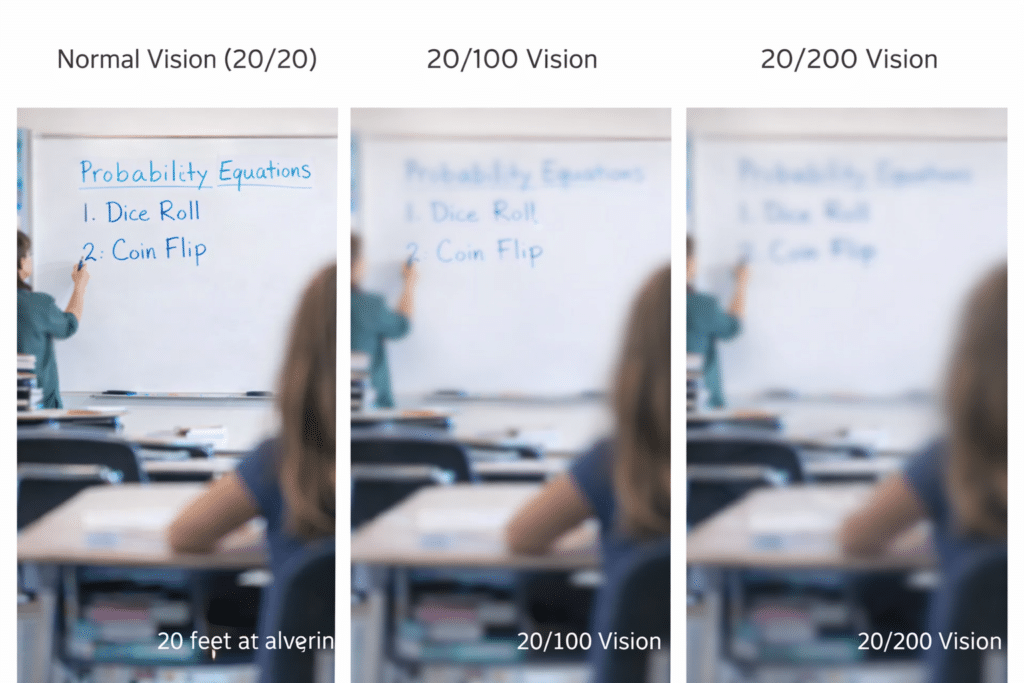
20/100 Vision: What It Really Means for People (Not legally blind, but close)
Many people hear “20/100” and think it is only “blurry.” But what does 20/100 vision look like for someone in everyday life?
It is far more than that.
For a student, 20/100 changes access to learning, classroom speed, and social interaction.
1. The board exists, but details disappear
A student with 20/100 sees the board, but letters fade quickly.
Low contrast, faint markers, and glare make decoding slow.
2. Text requires extra effort
The eyes work harder to hold focus.
Small print drains energy fast.
Reading becomes a stamina task, not an intelligence test.
3. Faces and expressions lose clarity
At 20/100, subtle expressions vanish.
Social cues move too fast.
Misunderstandings follow because detail drops before meaning forms.
4. Mobility becomes cautious
Depth and detail shrink.
Hallway movement requires more scanning.
Crowded spaces increase stress and accidental bumps.
5. Fatigue arrives early
Eyes strain harder to stay clear.
By mid-day, the visual system tires.
Students feel the fatigue long before they report it.
6. Behavior changes are often misread
A student who looks away, slows down, or avoids reading is not lazy.
They are adapting to a visual load others cannot see.
20/100 Is Not “Almost Fine”—It Is Reduced Access
This acuity does not reflect intelligence or motivation.
It reflects how much effort a student must spend to access the same information as peers.
With stronger contrast, better lighting, correct seating, and the right tools, students with 20/100 can thrive.
How 20/100 Shifts Toward 20/200 During the Day
Visual clarity changes with fatigue.
By afternoon, students often experience:
- slower refocusing
- reduced contrast sensitivity
- more blur at distance
- difficulty maintaining near clarity
This shift can push functional acuity close to 20/200, especially under stress, glare, or eye strain.
It works much like a Snellen chart:
A student who reads 20/100 in the morning may miss one or two extra letters later, shifting the score.
Missing those letters can lower acuity enough to look more like 20/160–20/200, even though the eye disease did not change—only the fatigue did.
Summary
20/100 vision affects more than reading.
It changes learning, speed, confidence, and daily stamina.
Early support, correct tools, and intentional teaching help students keep pace and protect their energy.
Keep in mind that life is competition so to keep up:
Life is a measure of access.
With the right tools, students with 20/100 vision:
- can read using laptops and screen readers
- People with 20/100 vision can work independently and may or may not need braille, braille displays, or tactile graphics, depending on whether their eye condition is stable or degenerative.
- navigate confidently with cane and GPS
- complete assignments alongside their peers using access technology
If instruction begins early and stays consistent, they thrive.
Understanding Vision in Children: What Visual Acuity Really Means
Signs of Low Vision in Children Even when they Pass Screening
What 20/40 Vision Means and Why “Almost Normal” Still Matters
20/70 Vision Explained: What It Really Means and How It Affects Daily Life
What Does 20/70 Vision Look Like?
What does 20/100 vision look like?
20/200 Vision Explained: What Everyone Gets Wrong About “Legal Blindness”
What Does 20/400 Vision Look Like?
What does 20/800 vision look like?
When Vision Problems Look Like Misbehavior: What Parents and Teachers Miss