Understanding 20/40 Vision: Why “Almost Normal” Still Matters in the Classroom
When people hear 20/40 vision, they often assume it means “just a little blurry.”
But for many students, 20/40 affects how they access learning, social cues, and the fast‑moving visual world of school. It’s not a measure of intelligence or effort — it’s a measure of visual access.
Here’s what 20/40 really means, and why it deserves attention.
What Does 20/40 Vision Mean?
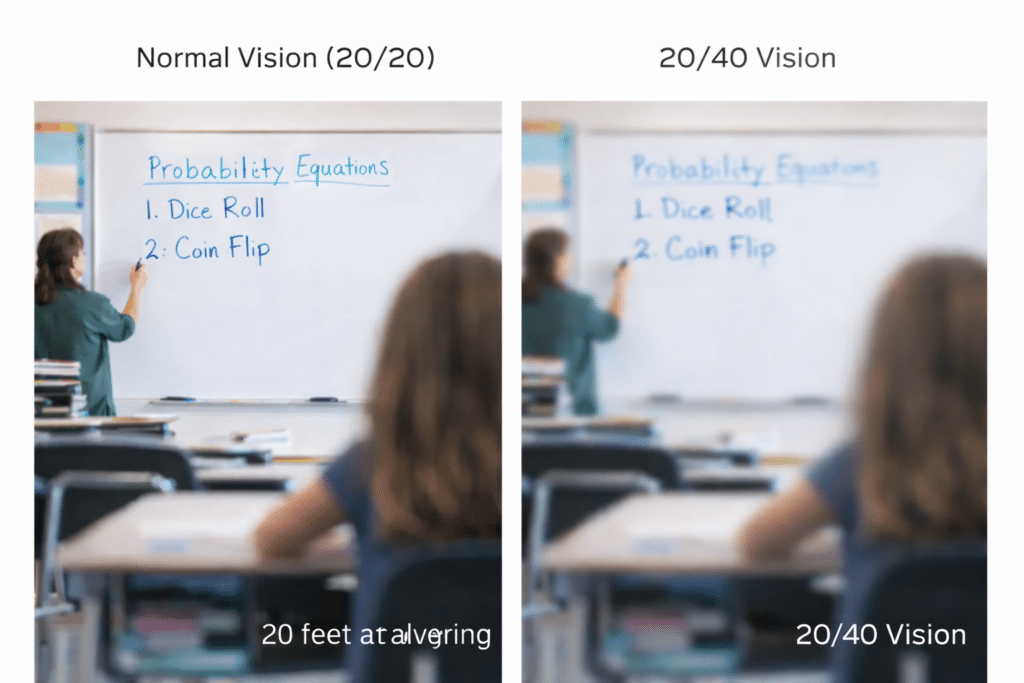
A student with 20/40 vision sees at 20 feet what a student with typical vision sees at 40 feet.
That difference may sound small, but in real‑world environments — classrooms, hallways, playgrounds, screens — it adds up quickly.
20/40 is still within the “legal driving” range in many places, but that doesn’t mean it’s effortless.
It simply means the student can function — not that they can function comfortably.
How 20/40 Vision Shows Up in Daily School Life
1. The board is readable… until conditions change
Students may read the board when the lighting is perfect and the marker is bold.
But add glare, faint ink, low contrast slides, or distance, and clarity drops fast.
This leads to guessing, leaning forward, or quietly copying from a friend.
2. Small print requires more effort
Worksheets with tiny fonts, cluttered layouts, or dense text slow students down.
They can read it — but it takes more energy, and fatigue shows up long before frustration.
3. Social cues can be harder to interpret
Facial expressions, quick gestures, and subtle movements may be harder to see from across the room.
This can lead to misunderstandings that look like inattention or missed cues.
4. Outdoor environments are visually demanding
Playgrounds, fields, and parking lots introduce glare, shadows, and low‑contrast backgrounds.
Spotting details — a ball, a friend waving, a step — takes more effort.
5. Students may not report difficulty
Kids with 20/40 often assume everyone sees this way.
They adapt quietly, work harder than adults realize, and rarely complain.
Why 20/40 Still Matters for Access
20/40 doesn’t require the same level of support as 20/200 or 20/70, but it still impacts:
- reading speed
- visual endurance
- accuracy at distance
- social interpretation
- comfort in bright or low‑contrast environments
Small changes can make a big difference:
- better contrast on the board
- bold markers
- seating that reduces glare
- slightly larger print
- uncluttered worksheets
- digital access when possible
These aren’t “accommodations.”
They’re access strategies — the same ones sighted students benefit from, just more essential here.
The Bottom Line
20/40 is not “almost normal.”
It’s a visual profile that requires awareness, thoughtful design, and small adjustments that protect a student’s energy and confidence.
When we understand what 20/40 really means, we stop assuming students are “fine” — and start giving them the clarity they deserve and access to their world.
Understanding Vision in Children: What Visual Acuity Really Means
Signs of Low Vision in Children Even when they Pass Screening
What 20/40 Vision Means and Why “Almost Normal” Still Matters
20/70 Vision Explained: What It Really Means and How It Affects Daily Life
What does 20/100 vision look like?
20/200 Vision Explained: What Everyone Gets Wrong About “Legal Blindness”
What Does 20/400 Vision Look Like?
What does 20/800 vision look like?
When Vision Problems Look Like Misbehavior: What Parents and Teachers Miss