
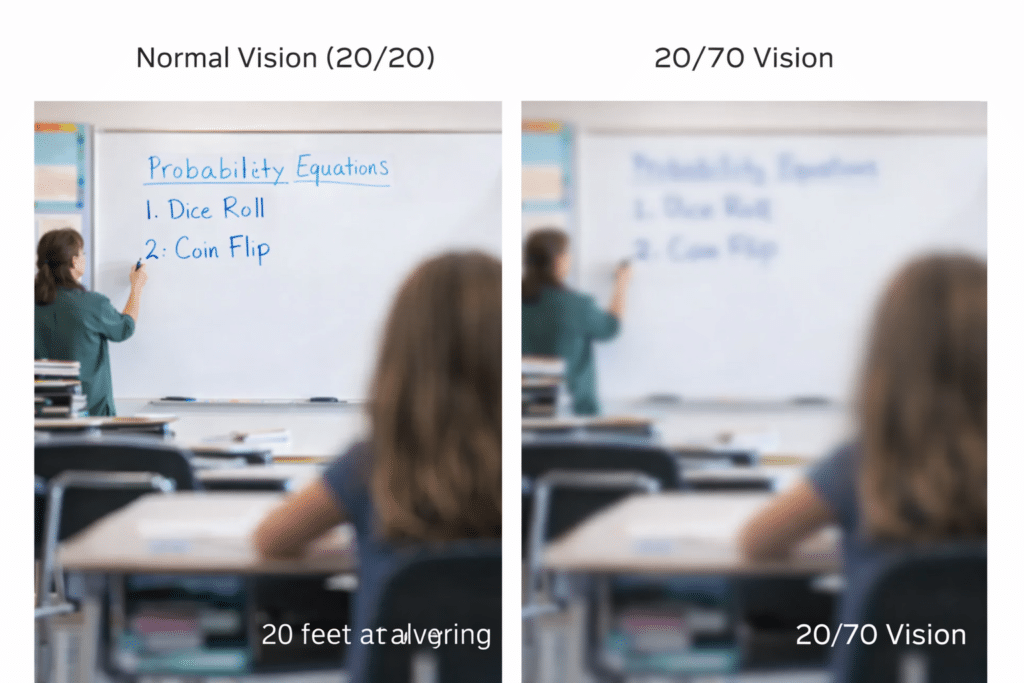
20/70 vision gets dismissed as “not that bad,” or “just a little blurry,” yet it changes a student’s entire school day. It affects how they read, learn, socialize, and move through their world. Teachers often miss the signs because the student looks like they are seeing “well enough,” but their visual system works harder every minute.
Here’s what 20/70 often looks like in real life:
1. The board is visible… but not comfortably
Students may technically read the board, but only with effort.
Low contrast, faint markers, and glare turn every lesson into a slow decoding task.
2. Faces and expressions lack detail
Social cues move quickly.
At 20/70, subtle expressions, eyebrow movements, and small gestures can be missed — leading to misunderstandings that look like inattention.
3. Reading takes more energy
It’s not about ability.
It’s about the visual system working harder to maintain clarity, especially with dense text or poor contrast.
4. “Clumsy” moments aren’t clumsiness
Reduced detail and depth perception affect navigation, especially in busy classrooms, hallways, and playgrounds.
5. Fatigue shows up before frustration
When every task requires extra visual effort, students tire faster — long before they complain.
6. Behavior changes are often misunderstood
A student who looks away, loses place, or avoids reading isn’t unmotivated.
They’re adapting.
20/70 is not a measure of intelligence or effort and it does not limit intelligence, motivation, or potential. It only limits access. With simple changes—better contrast, stronger lighting, proper seating, and the right tools—students stop struggling and start thriving. When schools understand what 20/70 really means, they unlock a student’s ability to learn with confidence and independence.
Understanding Vision in Children: What Visual Acuity Really Means
Signs of Low Vision in Children Even when they Pass Screening
What 20/40 Vision Means and Why “Almost Normal” Still Matters
20/70 Vision Explained: What It Really Means and How It Affects Daily Life
What does 20/100 vision look like?
20/200 Vision Explained: What Everyone Gets Wrong About “Legal Blindness”
What Does 20/400 Vision Look Like?
What does 20/800 vision look like?
When Vision Problems Look Like Misbehavior: What Parents and Teachers Miss