
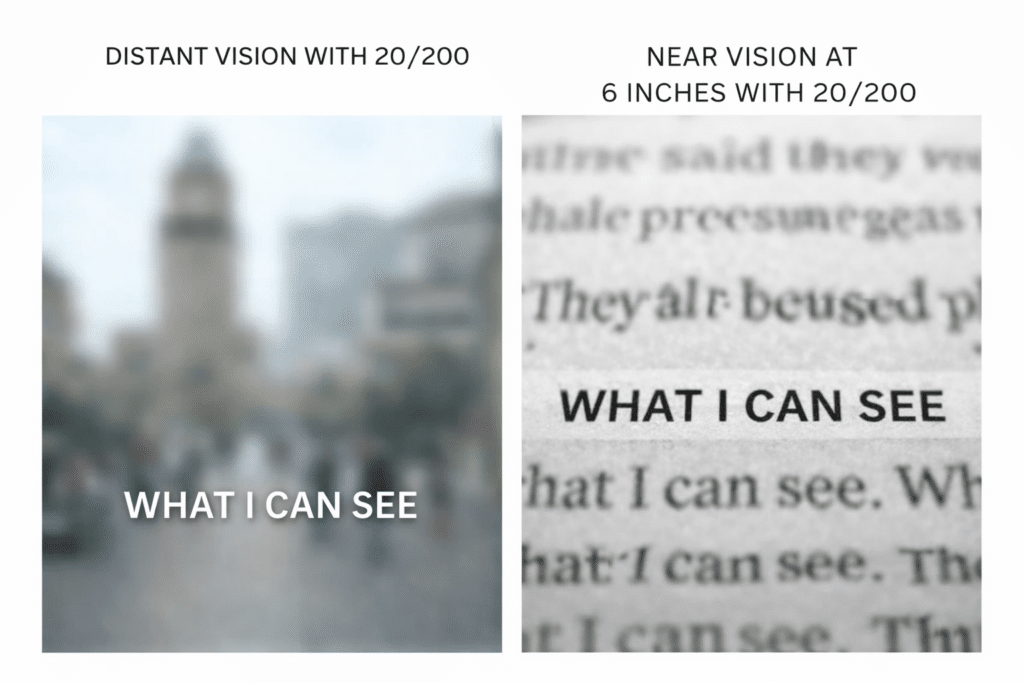
Many people misunderstand what 20/200 vision actually means. The term appears simple, yet the truth often surprises families and teachers. Many assume 20/200 equals total blindness, but it does not. This number describes legal blindness, not the absence of sight. People with 20/200 vision may still see shapes, motion, and colors. However, they cannot see detail clearly enough for daily tasks without support. Understanding this difference matters, because it guides education, training, and future independence. Clear knowledge empowers parents, schools, and professionals to build the right plan.
Misunderstanding 1: “20/200 means total blindness”
20/200 is the legal definition of blindness in the United States, but it is not the functional definition. Many people with 20/200:
- See light, color, and large shapes
- Navigate familiar spaces
- Recognize faces at close distances
- Read with magnification or large print
The myth comes from assuming “blindness” means “no vision at all,” when in reality it describes a range of usable vision.
Misunderstanding 2: “If someone has 20/200, they can’t read”
Reading ability depends far more on print size, contrast, and lighting than on the acuity number alone. Someone with 20/200 may read:
- Large print
- High‑contrast text
- Digital text with zoom
- Braille, depending on preference and fatigue
The real barrier is often visual clutter, not the acuity itself.
Misunderstanding 3: “20/200 looks the same for everyone”
Two people with the same acuity can have completely different experiences depending on:
- Field loss
- Light sensitivity
- Glare
- Contrast sensitivity
- Stability of the condition
Acuity is only one slice of functional vision.
Misunderstanding 4: “If you get close enough, everything becomes clear”
Distance helps, but clarity depends on contrast, lighting, and the condition causing the vision loss. Someone with 20/200 may still struggle with:
- Low‑contrast text
- Faded pencil writing
- Busy backgrounds
- Dim rooms
- Bright glare
Getting closer doesn’t fix those.
Misunderstanding 5: “20/200 means you can’t be independent”
People with 20/200 routinely:
- Work full‑time
- Travel independently
- Use smartphones and computers
- Parent
- Cook
- Drive with bioptics in some states
Independence is shaped by training, tools, and environment, not just acuity.
With the right tools, students with 20/200 vision:
- read using laptops and screen readers
- work independently with braille, braille displays and tactile graphics
- navigate confidently with cane and GPS
- complete assignments alongside their peers using access technology
If instruction begins early and stays consistent, they thrive.
Misunderstanding 6: “20/200 is the same in every situation”
Someone with 20/200 may function very differently depending on:
- Indoors vs. outdoors
- Daylight vs. fluorescent lighting
- High‑contrast vs. low‑contrast environments
- Familiar vs. unfamiliar spaces
Functional vision is context‑dependent, not fixed.
Misunderstanding 7: “If you have 20/200, you’ll eventually lose all your vision”
Acuity doesn’t predict the future.
Some conditions are stable for life.
Most vision fluctuates daily and hourly.
Some improve with treatment.
Some decline slowly or unpredictably.
The number describes today, not destiny.
Misunderstanding 8: “20/200 means you can’t see faces”
Most people with 20/200 can see faces at close range. What’s difficult is:
- Recognizing faces across a room
- Reading expressions from a distance
- Catching subtle social cues
This is why students may appear “uninterested” or “unaware” when they’re actually working twice as hard to interpret the room.
Misunderstanding 9: “Glasses can fix 20/200”
If glasses could correct it, it wouldn’t be classified as 20/200.
The number reflects best‑corrected vision, not uncorrected vision.
Misunderstanding 10: “20/200 is rare”
It’s more common than people think, especially among:
- Students with albinism
- Individuals with optic nerve conditions
- Adults with diabetic retinopathy
- People with congenital low vision
The number shows up across many diagnoses.
Globally, more than 33 million people meet the legal blindness threshold of 20/200 vision or worse, making this level of sight loss far more common than most people realize.
Understanding Vision in Children: What Visual Acuity Really Means
Signs of Low Vision in Children Even when they Pass Screening
What 20/40 Vision Means and Why “Almost Normal” Still Matters
20/70 Vision Explained: What It Really Means and How It Affects Daily Life
What does 20/100 vision look like?
20/200 Vision Explained: What Everyone Gets Wrong About “Legal Blindness”
What Does 20/400 Vision Look Like?
What does 20/800 vision look like?
When Vision Problems Look Like Misbehavior: What Parents and Teachers Miss