
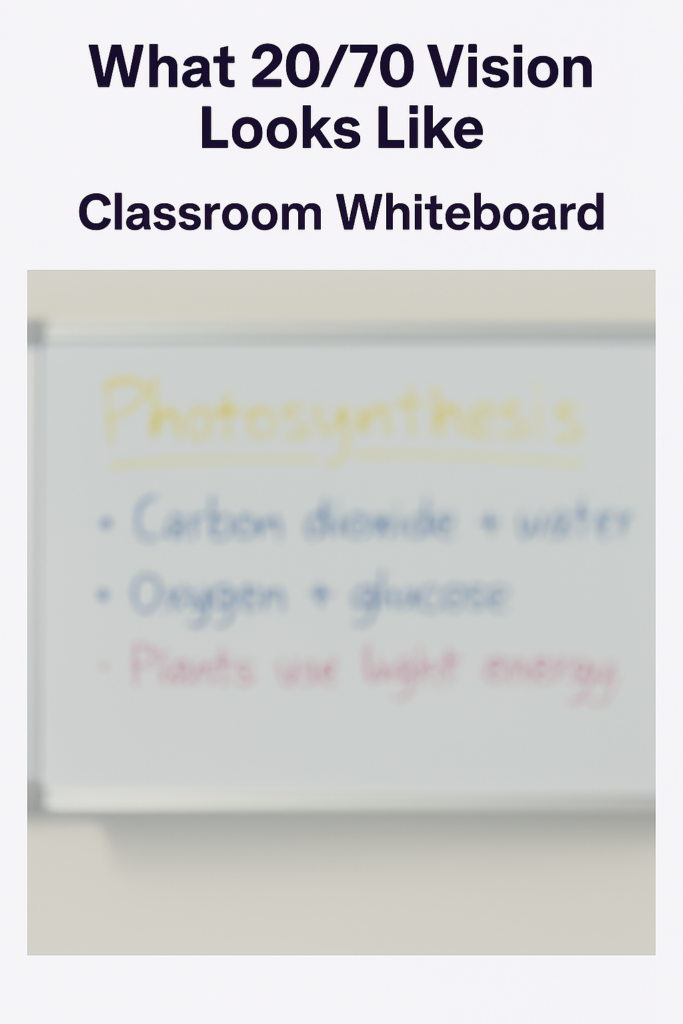
20/70 Vision Looking at whiteboard 20 feet ahead in a room
Overview
Many people wonder, What Does 20/70 Vision Look Like in everyday life? 20/70 vision means a person must stand 20 feet away to see what someone with typical 20/20 vision can see at 70 feet. It represents moderate low vision and often affects reading, recognizing faces, and seeing details at a distance — especially in classrooms, hallways, and outdoor environments.
This page gives you:
- A simple explanation
- Real‑world examples
- Functional impact
- Classroom implications
- Technology supports
- A visual simulation (we’ll add images next)
Simple Definition
20/70 vision is a measurement of visual acuity, describing how clearly a person sees detail.
- 20 = the testing distance
- 70 = the distance at which a person with 20/20 vision sees the same detail
So:
If a student with 20/20 vision can read a sign at 70 feet,
a student with 20/70 vision must move to 20 feet to see it.
What 20/70 Vision Looks Like in Daily Life
People with 20/70 vision often describe:
- Blurry details at a distance
- Difficulty reading small print
- Needing to move closer to see faces clearly
- Trouble with classroom boards or projectors
- Missing fine details in worksheets or diagrams
- Needing brighter lighting to see comfortably
They can usually navigate independently but may struggle with:
- Street signs
- Bus numbers
- Classroom whiteboards
- Small text on screens
- Low‑contrast materials
Real‑World Examples
(We’ll create images for each of these.)
1. Classroom Whiteboard
- Letters appear soft or fuzzy
- Thin markers are difficult to see
- Low‑contrast colors (yellow, light blue) nearly disappear
2. Reading a Book or Worksheet
- Small print blurs
- Crowded text becomes tiring
- Students may hold materials close
3. Recognizing Faces Across a Room
- Facial features blur
- Expressions are harder to read
- Social cues may be missed
4. Street Signs or Hallway Signs
- Letters blur at a distance
- Students may walk closer to read room numbers
Functional Impact in School
Students with 20/70 vision may:
- Miss information written on the board
- Struggle with fast‑paced visual instruction
- Fatigue quickly during reading
- Need more time for visual tasks
- Prefer sitting closer to the front
- Benefit from bold, high‑contrast materials
They often compensate well but may appear:
- Distracted
- Slow to copy notes
- Unsure of directions
- Hesitant in new environments
These are vision‑based challenges, not cognitive ones.
Supports That Help
Students with 20/70 vision often benefit from:
Classroom Supports
- Preferential seating
- High‑contrast markers
- Bold print materials
- Larger text (14–18 pt)
- Clear, uncluttered worksheets
Technology Supports
- Zoom or magnification tools
- High‑contrast mode
- Larger font settings
- Screen readers for longer text
- Digital copies of board notes
Environmental Supports
- Good lighting
- Reduced glare
- Clear signage
- High‑contrast labels
Is 20/70 Vision Considered Legally Blind?
No.
Legal blindness is defined as:
- 20/200 or worse in the better eye with correction,
or - A visual field of 20 degrees or less.
20/70 is moderate low vision, not legal blindness.
Frequently Asked Questions
Is 20/70 vision correctable?
Sometimes. Glasses or contacts may improve clarity, but many students still function in the low‑vision range even with correction.
Can a student with 20/70 vision read regular print?
Yes — but they may need larger print, bold text, or better lighting to reduce fatigue.
Does 20/70 vision affect mobility?
Most students navigate independently, but may struggle with signs, steps, or low‑contrast obstacles.
Is 20/70 vision stable?
It depends on the underlying condition. Some remain stable; others may change over time.
Understanding Vision in Children: What Visual Acuity Really Means
Signs of Low Vision in Children Even when they Pass Screening
What 20/40 Vision Means and Why “Almost Normal” Still Matters
20/70 Vision Explained: What It Really Means and How It Affects Daily Life
What does 20/100 vision look like?
20/200 Vision Explained: What Everyone Gets Wrong About “Legal Blindness”
What Does 20/400 Vision Look Like?
What does 20/800 vision look like?
When Vision Problems Look Like Misbehavior: What Parents and Teachers Miss