
Theme: The Weight They Carry
The Silent Exhaustion Teens Carry Into the Classroom
The bell rang at 7:05 AM, but most of the class did not look up. At the front of the room, Ms. Sage watched them, really watched them and saw something most adults miss. In moments like this, it becomes clear why so many people are talking about Today’s Teens Feeling Overwhelmed. Twenty‑seven juniors sat in rows; faces washed in the cold glow of their screens. Their thumbs moved faster than their eyes. Notifications popped like fireworks. Someone laughed at a meme. Someone posted a photo… then deleted only minutes later because of fear someone judging the image.
Ms. Sage stood with sadness and concern.
The Hidden Weight Social Media Places on Today’s Teens
She had taught for thirty‑two years, but this generation was different. Not worse, just heavier. According to the latest national data, 57% of teen girls and 29% of teen boys now report persistent sadness or hopelessness, the highest levels ever recorded. And teens who spend more than three hours a day on social media which is nearly all of them, are twice as likely to experience symptoms of anxiety and depression.
She saw those numbers every day in their faces: tired, anxious, overwhelmed, disconnected, and fragile.
“Phones away,” she said gently. “All the way away.”
A few groaned. One boy rolled his eyes. But they obeyed.
On her desk sat a plain cardboard box. Nothing special. But today, it mattered.
“I want you to write down one thing,” she said, handing out slips of paper. “Not your name. Not a joke. Just the truth.
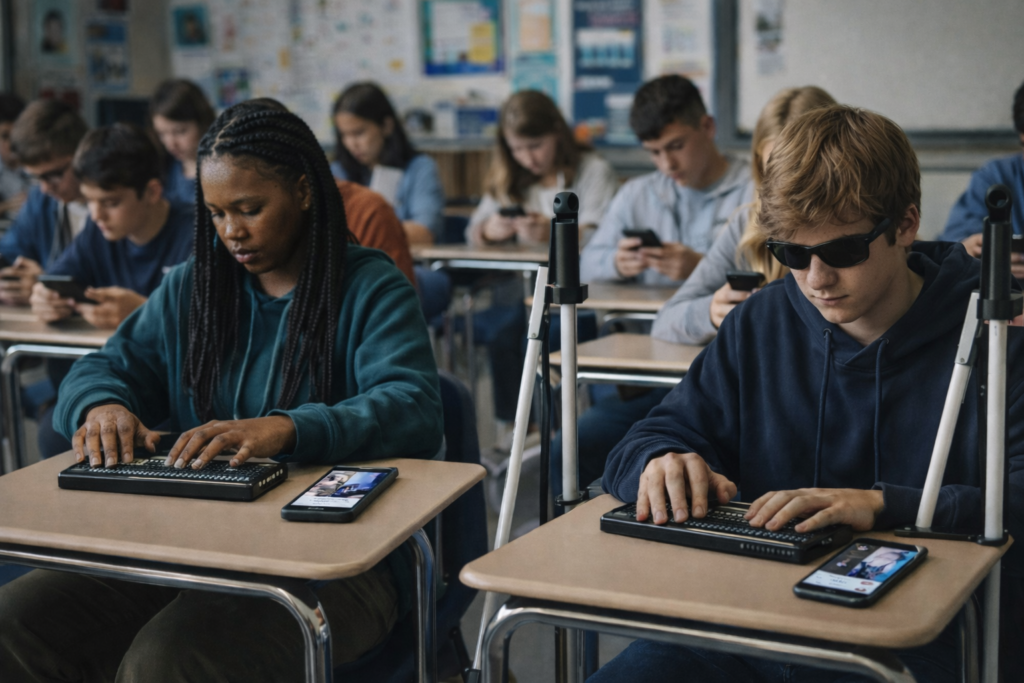
Then she turned to Suzy and John, her blind students. “You two can text me using SendAnonymousSMS,” she said. “I’ll copy your message onto a paper slip and drop it in the box with the others.” “That way no one will know who it’s from.”
She looked back at the room. “Everyone Write down the thought that runs through your mind — your heart — whenever you scroll your accounts. The one you never say out loud.”
The room stilled. Eyes wide.
When Comparison Becomes a Daily Battle for Teens
A cheerleader in the back, Lila, known for her perfect Instagram feed, stared at her blank paper under crushing pressure to “look” perfect. Her hands trembled. Just last week, she had confessed to the counselor that she spent over eight hours a day comparing herself to girls she did not even know, staying up late and scrolling into the early morning hours. And she was not alone. National surveys show that 46 percent of teens say social media makes them feel worse about their bodies and their families, and one in three teen girls say they feel “ugly” because of what they see online.
Every day, they scroll past smiling faces, perfect vacations, flawless skin, and filtered happiness and somewhere deep inside, they start believing everyone else is living a better life. They compare those highlight reels to their own quiet struggles and convince themselves they’re the only ones who feel sad, lonely, or left out.
Lila finally wrote something down and continued to move her pencil across the paper.
The Loneliness Behind the Laughs
Next to her, Jordan, the class clown tapped his pencil. He had 12,000 followers on TikTok. People loved him. But last month, he told a friend he felt “fake.” Research shows that teens who curate a “perfect” online persona are three times more likely to report loneliness, even when surrounded by people.
Jordan knew that feeling too well. He had one friend he could joke around with, someone he could confide in on the surface, but no one he trusted deeply. His parents had split two years ago, and his mom now worked two jobs just to keep the lights on. Most nights, he ate dinner alone while his sister stayed in her room, scrolling and picking at her food. They did homework alone. They fell asleep alone. The silence in the house made the loneliness louder, and the more he scrolled through everyone else’s “happy” lives, the more he believed he was the only one who felt this empty even though he saw the same despondent look on his sister’s face. So, he posted constantly, leaning into his class‑clown persona, trying to joke the loneliness away.
Blind Teens See a World That Rarely Sees Them Back
In the front of the room, Suzy and John knew what it felt like to be outsiders. Being blind set them apart before they even opened their mouths, and the feeling only sharpened when they scrolled through social media. With apps that read pictures aloud, the isolation deepened because no matter how many posts they explored, they rarely found people who were like them, lived like them, succeeded like them. They searched for blind mentors who could show them what was possible, yet they found few and sometimes none. Each empty search pressed the loneliness deeper. Students rarely talked with them because their blindness created a barrier built from difference and fear. Still, they kept scrolling, because that’s what teens did, even when it hurt.
Most of the class was not made up of kids like Lila, Jordan, or the school’s sports heroes. It was kids like Joe and Sue, the ones who sat in the back or middle rows, who blended in, who were never chosen first for anything. They weren’t popular, not even close, and they felt it every day. Students like Joe and Sue were the ones pushed aside in hallways, called hurtful names, talked over in group projects, laughed at for clothes their families could afford or hobbies no one else understood. They watched the popular kids climb the social ladder while they stayed invisible on the bottom rung, and the invisibility hurt almost as much as the teasing and social media scrolling. Being unseen didn’t protect them; it only made the loneliness sharper.
Brilliance and Secrets
Then, there were the two brilliant minds in the room: Jessica and James. The kind of students who competed at everything, from test scores to running for class president to who could finish the assignment first. They seemed happier than most, partly because they checked their social media feeds far less often than everyone else. They still used it — they were teens, after all — but they’d learned that too much scrolling made them feel worse, so they kept their distance when they could.
Even so, that choice, along with their drive, set them apart in a different way. They were the outliers, the only two who cared more about academics and future goals than trends or popularity. And because of that, some kids picked on them, calling them “perfectionists” or “teacher’s pets,” never understanding that Jessica and James weren’t trying to outshine anyone — they were just trying to build a future shaped by the dreams their parents had poured into them. That came with its own kind of pressure. When they fell short of what their parents expected, it hit their hearts harder than anything they could ever read online.
The Emotional Pressure Today’s Teens Feel but Rarely Share
Across the room, Tyler, the star running back with the big smile, the one everyone assumed had it all together leaned back in his chair, spinning his pen between his fingers. On the field, he was unstoppable. In the hallways, he walked with the kind of confidence people mistook for certainty. But inside, he was unraveling. Athletes are often seen as the “strong ones,” yet studies show they experience depression at the same rates as their peers; they just do not talk about it. Tyler lived that statistic.
He had teammates he joked with, guys he could talk football with, but no one he trusted with the truth. He had one friend he could confide in superficially, but no one who knew him deeply; no one who understood the pressure he carried. His parents had split last year, and his dad moved two states away. His mom worked double shifts at the hospital, leaving before sunrise and coming home long after he’d gone to bed. Most nights, the house was dark and quiet, and Tyler ate dinner alone at the counter, scrolling through highlight reels of other athletes who seemed stronger, faster, happier.
Online, he saw boys his age posting scholarship offers, perfect bodies, perfect lives. He compared their victories to his private fears and convinced himself he was falling behind. Research shows that nearly 1 in 3 teen boys feel pressure to appear “strong” online, and many hide their stress behind humor, sports, or silence. Tyler was no different. The louder the crowd cheered on Friday nights, the more alone he felt walking off the field.
He tapped his pencil harder. Then, slowly, he picked up his paper and began to write.
The Truth Teens Admit Only When They Feel Safe
One by one, they walked up and dropped their slips inside.
Ms. Sage waited until the last student sat down. Then she opened the box.
She pulled the first slip…and read.
“I feel invisible unless someone likes my posts.”
Another.
“I delete every picture of myself. I hate how I look.”
Another.
“I check my phone 200 times a day because I’m scared I’ll miss something and people will forget me.”
Another.
“I pretend I’m confident online. I’m not.”
Another.
“I don’t know who I am without my phone and my likes.”
She paused. The room was silent. No one moved.
Then she read the one that made her throat tighten.
“I don’t want to be here anymore… Everyone else looks happy, and I feel lost, hurting, and completely alone.”
The Centers for Disease Control and Prevention (CDC) reports that 22% of teens have seriously considered suicide, and the rates are rising fastest among those who spend the most time online. Ms. Sage knew that statistic. But hearing it in her classroom, in a child’s handwriting was different.
She folded the paper gently and stifled her tears.
Breaking the Lies Teens Believe About Themselves
“This,” she said, resting her hand on the box, “is what you’re carrying; this heavy, invisible weight.”
Her voice softened.
“And you need to know something. You are not the only one.
Everyone who scrolls feels this pressure in some way, even adults.
Loneliness is quietly shaping all of us, more than we admit.”
She looked up, steady and kind.
“You’re not strange for feeling overwhelmed.
You are not weak for feeling the ache.
You’re human.
And you’re not carrying this alone.”
Seeing Through the Lies of Social Media
What you see online is not real life. What you feel is real, but it is not the end of your story.” Talk with each other about truth and make a friend, knowing that what is online, is a persona, something false pretending to be real. Your “likes” should come from right here in this room or at home.
Many students wiped their eyes.
Lila reached over and squeezed another cheerleader’s hand as she began to weep uncontrollably.
For the first time all year, they weren’t scrolling. They were listening. They were human again and looking around at each other.
Ms. Sage closed the box slowly, her hands resting on the cardboard as if it were something alive. Then she looked up.
“We’re not leaving this here,” she said quietly. “Come with me.”
The students exchanged confused glances, but no one argued. She picked up the box, hugged it to her chest, and led them out of the classroom, down the hallway, and through the back doors of the school.
The winter air hit them first; sharp, clean, honest.
Behind the building, near the maintenance shed, the old janitor, Mr. Alden, stood beside a metal burn barrel. Flames licked the rim, crackling softly. He nodded at Ms. Sage. They had arranged this.
“This,” she said, holding the box tightly to her chest, “is where we let go of what we were never meant to carry alone.”
The students formed a loose circle around the barrel. No one spoke. The only sound was the fire breathing.
Letting Go of What Teens Were Never Meant to Carry Alone
Ms. Sage opened the box. The folded slips of paper, their secrets, their fears, their midnight thoughts, rustled in the wind.
“Every one of you wrote something real,” she said. “Something heavy. Something you’ve been holding in the dark. Today, we burn the lies that told you were alone and not seen.”
She lifted the box and tipped it gently. One by one, the papers slid into the flames. They curled, blackened, and disappeared.
A hush fell over the group. Some students stepped closer. Others wiped their eyes. Jordan and several boys shoved their hands into their pockets, blinking hard as they fought the ache. Lila and the cheerleader teammate mirrored each other without meaning to, arms wrapped tightly around their own bodies, heads bowed as tears were blinked back and slipping free. They stood in a protective posture girls slip into when they don’t want anyone to see them break, watching the fire as if it were rewriting their stories.
Suzy pressed her head into her cane as rocked back and forth trying to comfort her pain. John stood next to her like a statue, gripping his cane so tightly his knuckles turned white, as he fought back tears.
Burning Lies
Because as the papers burned, they weren’t just burning confessions, they were burning the lies they had believed about themselves.
The lie that they weren’t enough.
Continued lie that everyone else was happier.
The lie that they were alone.
The lie that their worth depended on likes, followers, or filters.
Tyler stepped forward. He reached out and waved the ashes and said “goodbye”, a quiet, aching release. Then another hand lifted beside him with “goodbye”. And another. And another. Soon the whole group stood around the barrel, their hands rising over the heat, each wave a soft, brave goodbye to the weight they had carried… and a trembling welcome to the freedom they were finally claiming.
No one rushed or joked or hid.
When the last ember died, Ms. Sage spoke again, her voice steady.
“You don’t walk alone,” she said. “And the lies you waved goodbye to… they’re gone. You don’t have to carry them anymore.”
Returning to the Classroom with a New Strength and Solidarity
They stood there a moment longer, breathing in the cold air, feeling lighter than they had in years.
Then, slowly, they walked back inside; not as strangers scattered across rows, but as a group bound by the truth that they were more alike than different.
They were not alone.
Learning to Use Social Media Without Losing Yourself
Quitting social media isn’t really an option in this day and age; it’s about learning how to use it differently, in ways that lift you instead of draining you. You can follow people who inspire you, mute the accounts that make you compare yourself or feel worse about who you are, set smaller time limits (even a simple timer on your phone helps), and remind yourself that real connection happens in real conversations.
And when you look up from your screen, you’ll start to notice the people around you, classmates who hurt too, who could use a friend, who might become real friends if you gave them a chance. Speak to someone at school, or give someone a call after school, invite them over for pizza and a movie, make popcorn, hang out, or get a couple of people together just to laugh and talk. You don’t need perfection to feel better, just a healthier rhythm, a middle ground where your screen doesn’t get to decide your worth or your friendships.
Faith Reflection: The God Who Sees the Overwhelmed and Brokenhearted
When life feels heavy and everyone else online looks happier, God sees what you’re carrying — the real you, not the filtered version. In Scripture, Hagar calls Him “El Roi — the God who sees me.” He sees your hurt, your questions, your loneliness, and He doesn’t look away.
Psalm 34:18 says,
“The Lord is close to the brokenhearted.”
Not just the strong. Not just the confident.
The brokenhearted.
The thoughts you wrote down — the lies you’ve believed — don’t define you. God’s truth does.
You are loved.
And chosen.
You are enough.
And you are not alone.
Even on the days you feel invisible, God whispers:
“I see you. I’m with you. I’m not letting go.
Video: Teens Feel Overwhelmed and Carry Heavy Stress Alone as Social Media Adds Pressure
Related Stories
The Invisible Backpack: Noticing the Emotional Weight You Carry
The Weight We Carry: Understanding Emotional Rucking
Biblical Meaning of Luggage: Discovering Spiritual Lessons from Our Life’s Journey