All Test-Taking Challenges and Access Barriers for Blind and Low-Vision Students in Standardized and Classroom Testing
I. Barriers in Refer‑Back Test Questions for Screen Reader Users
Purpose of This Report
Blind and visually impaired test takers who rely on screen readers such as JAWS or NVDA, with or without a braille display, face significant barriers when assessments require rapid reference to earlier paragraphs or statements. These formats are inherently visual and not accessible in their current design.
1. Description of the Test Format
Many standardized test items require students to:
- Read a question
- Refer back to a paragraph, statement, or numbered section
- Return to the question and select the correct answer
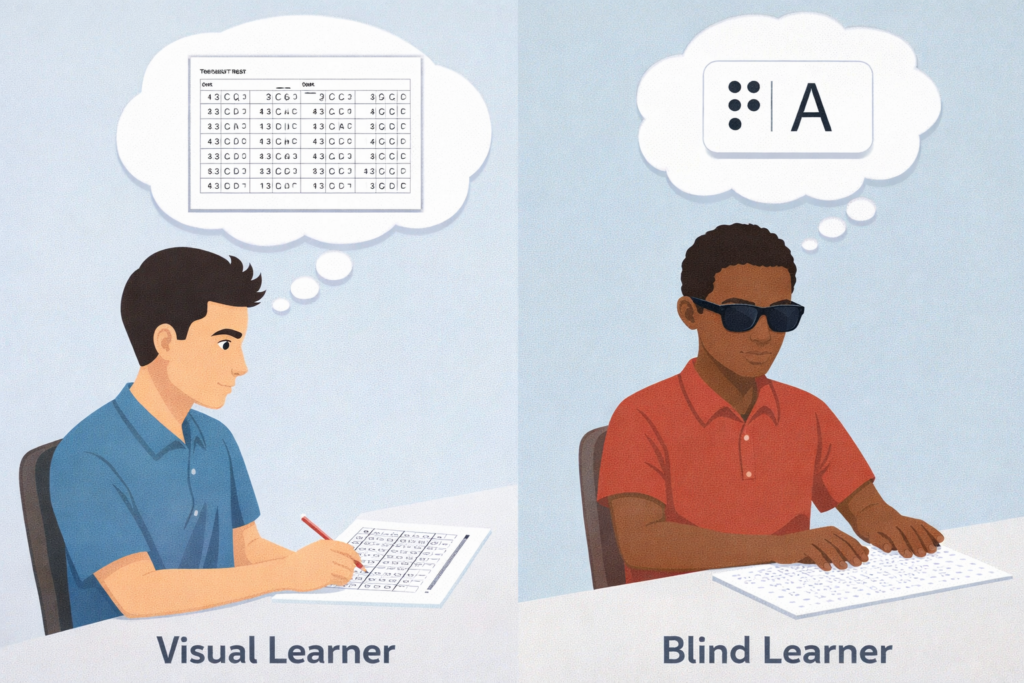
Sighted test takers can visually scan and relocate information instantly. Screen reader users cannot.
2. Why This Format Is Not Accessible to Screen Reader Users
2.1 Loss of Visual Proximity
Screen readers present content linearly, not spatially. Sighted students see the question and referenced paragraph in the same visual field; blind students do not.
2.2 Excessive Navigation Required
To “refer back,” a blind student must navigate backward through multiple elements, locate the correct paragraph, reread it, then navigate forward again to find the question. This process is slow, cognitively demanding, and fundamentally different from the visual experience the test assumes.
2.3 Increased Cognitive Load
Screen reader users must retain the paragraph in memory, relocate the question, and answer while juggling both sets of information. This creates a dual cognitive burden sighted students never encounter.
2.4 Timing Disadvantage
Linear navigation takes significantly longer than visual scanning. This is a structural access barrier, not a skill issue.
3. Why a Sighted Reader Restores Equal Access
A trained sighted reader allows the blind test taker to:
- Hear the question and referenced paragraph immediately
- Avoid unnecessary navigation delays
- Demonstrate knowledge rather than screen reader navigation skills
This restores equal access, not an advantage.
4. Recommended Solutions
4.1 Immediate Access Support
Provide a human reader for all refer‑back items so blind test takers can access referenced material at the same speed as sighted peers.
4.2 Long‑Term Accessible Test Design
To make future tests independently accessible:
- Place referenced paragraphs directly above the question
- Provide a “Repeat Paragraph” button or link
- Use collapsible sections operable with a single keystroke
- Label paragraphs with headings or landmarks
- Avoid long‑distance navigation requirements
These practices align with WCAG 2.2 and accessible assessment standards.
II. Barriers Created by Inadequate Image Descriptions for Blind Test Takers
Purpose of This Section
Image‑based test items—charts, diagrams, maps, graphs, illustrations, and labeled pictures—are inaccessible when alt text is incomplete. Blind students require accurate descriptions and, when appropriate, tactile materials to access visual information equitably.
1. Description of the Test Format
Many test questions require students to:
- View an image
- Interpret visual details
- Answer questions based on those details
Sighted students can scan images instantly. Blind students rely entirely on alt text and screen reader output.
2. Why Inadequate Alt Text Makes the Test Inaccessible
2.1 Alt Text Lacks Critical Details
Alt text often reflects limited understanding of what blind users need. Vague descriptions such as “a chart” or “a diagram of a cell” do not provide the information required to answer test questions.
2.2 Screen Readers Cannot Interpret Images
A screen reader only reads the alt text provided. If the alt text is incomplete:
- The student receives no meaningful information
- The student cannot analyze the image
- The student cannot answer the question
2.3 Visual Information Is Spatial
Images rely on position, direction, size, patterns, color coding, and labeled locations—details that require a complete verbal description or tactile representation.
3. Impact on Blind Test Takers
3.1 Severe Information Loss
Incomplete or vague alt text omits key data, relationships, labels, and overall structure. When test questions rely on images, the assessment no longer measures the student’s knowledge—it measures the limitations of the format.
A trained sighted human describer who works directly with the blind student can provide the detailed visual information necessary for equal access and valid assessment.
3.2 Increased Cognitive Load
Blind test takers must infer missing details, hold incomplete information in memory, and attempt to answer without full access. This creates an inequitable cognitive burden.
3.3 Timing Disadvantage
Blind students rely on detailed descriptions, trial‑and‑error navigation, and tactile graphics, resulting in significant time loss.
4. Why a Sighted Human Describer Is Essential for Equal Access
A trained describer can:
- Verbally explain the image in full detail
- Identify labels, relationships, and spatial layout
- Provide tactile graphics when appropriate
- Answer clarifying questions about structure (not content)
This ensures blind test takers understand the image at the same conceptual level as sighted peers.
5. Recommended Solutions
5.1 Immediate Access Support
Provide a trained sighted describer who can deliver complete visual information and support understanding of image‑based content.
5.2 Long‑Term Accessible Test Design
To make image‑based items independently accessible:
- Provide complete, descriptive alt text
- Include long descriptions for complex graphics
- Offer tactile graphics
- Use clear, structured metadata
- Follow WCAG 2.2 and accessible assessment guidelines
Final Summary
Refer‑back questions and image‑based test items create significant access barriers for blind students who rely on screen readers or braille displays. These barriers stem from visual assumptions built into test design—assumptions that do not translate to linear, audio‑based navigation or incomplete alt text. Equal access requires redesigning assessments to remove visual dependencies and, when necessary, providing trained human support such as readers or describers. When tests are built with accessibility in mind, they measure what students know—not how well they can navigate inaccessible formats.
This applies to all types of testing, so teachers must stay aware and provide full support for the blind or low-vision student in their classroom.