Is your computer running slow, freezing, or taking forever to start up? Speed Up a Slow Computer with a few simple maintenance steps can make a huge difference. This is especially true for beginners and blind/low‑vision users who rely on consistent performance with JAWS or NVDA.
In this TechVision tutorial, I walk you through practical, real‑life steps to speed up your PC and keep it running smoothly:
✔ Update your .NET Framework Having the latest .NET installed in your Control Panel helps programs run correctly. It also reduces system errors.
✔ Manage your startup programs Too many apps launching at boot can slow everything down. Turning off unnecessary startup items gives you a faster, cleaner start.
Keep Windows and Office updated
Regular updates improve performance, stability, and security — and prevent many common slow‑computer issues.
✔ Declutter your system Uninstall programs you don’t use and delete temporary files to free up space. This also reduces background load.
✔ Run a full antivirus scan Malware can dramatically slow down your system. A full scan helps identify and remove hidden threats.
✔ Perform regular maintenance Disk Cleanup, defrag (for HDDs), or optimize for SSD and clearing temp files all help your computer run more efficiently.
These steps are simple, effective, and perfect for anyone building independence and confidence with their technology.
TechVision: Empowering real‑life tech skills with clarity, accessibility, and confidence.Video with steps here
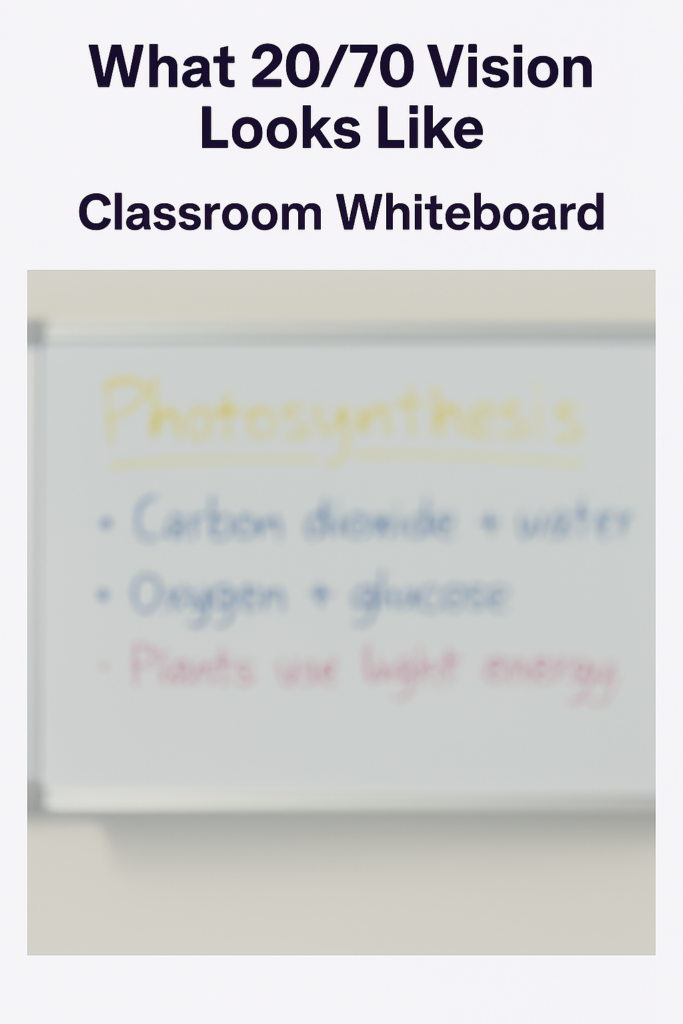
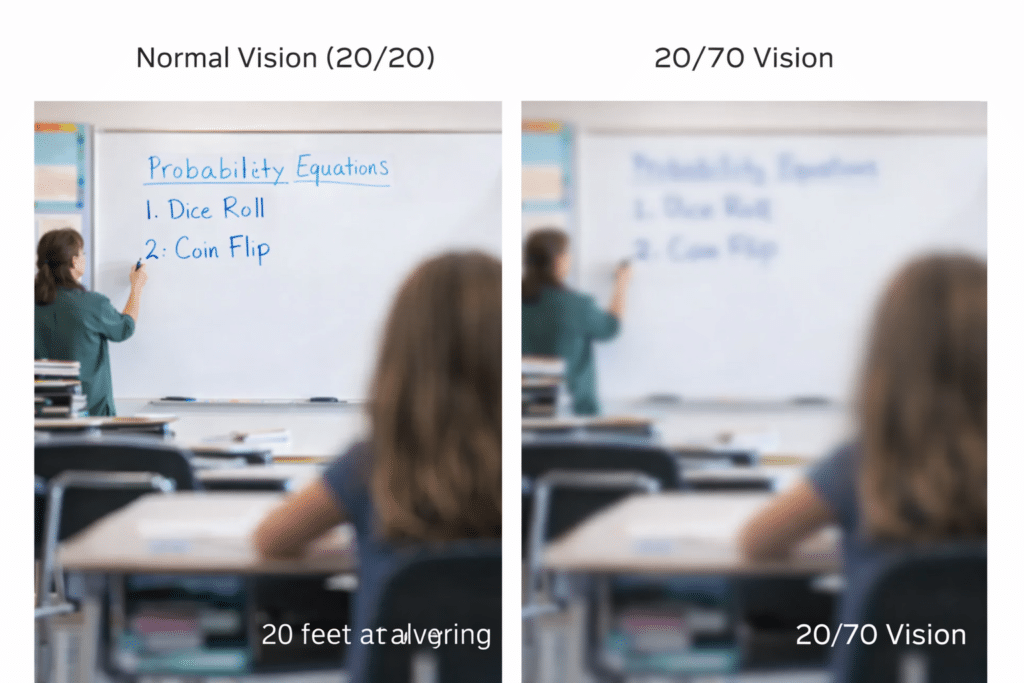
20/70 Vision Looking at whiteboard 20 feet ahead in a room
Overview
Many people wonder, What Does 20/70 Vision Look Like in everyday life? 20/70 vision means a person must stand 20 feet away to see what someone with typical 20/20 vision can see at 70 feet. It represents moderate low vision and often affects reading, recognizing faces, and seeing details at a distance — especially in classrooms, hallways, and outdoor environments.
This page gives you:
A simple explanation
Real‑world examples
Functional impact
Classroom implications
Technology supports
A visual simulation (we’ll add images next)
Simple Definition
20/70 vision is a measurement of visual acuity, describing how clearly a person sees detail.
20 = the testing distance
70 = the distance at which a person with 20/20 vision sees the same detail
So:
If a student with 20/20 vision can read a sign at 70 feet, a student with 20/70 vision must move to 20 feet to see it.
What 20/70 Vision Looks Like in Daily Life
People with 20/70 vision often describe:
Blurry details at a distance
Difficulty reading small print
Needing to move closer to see faces clearly
Trouble with classroom boards or projectors
Missing fine details in worksheets or diagrams
Needing brighter lighting to see comfortably
They can usually navigate independently but may struggle with:
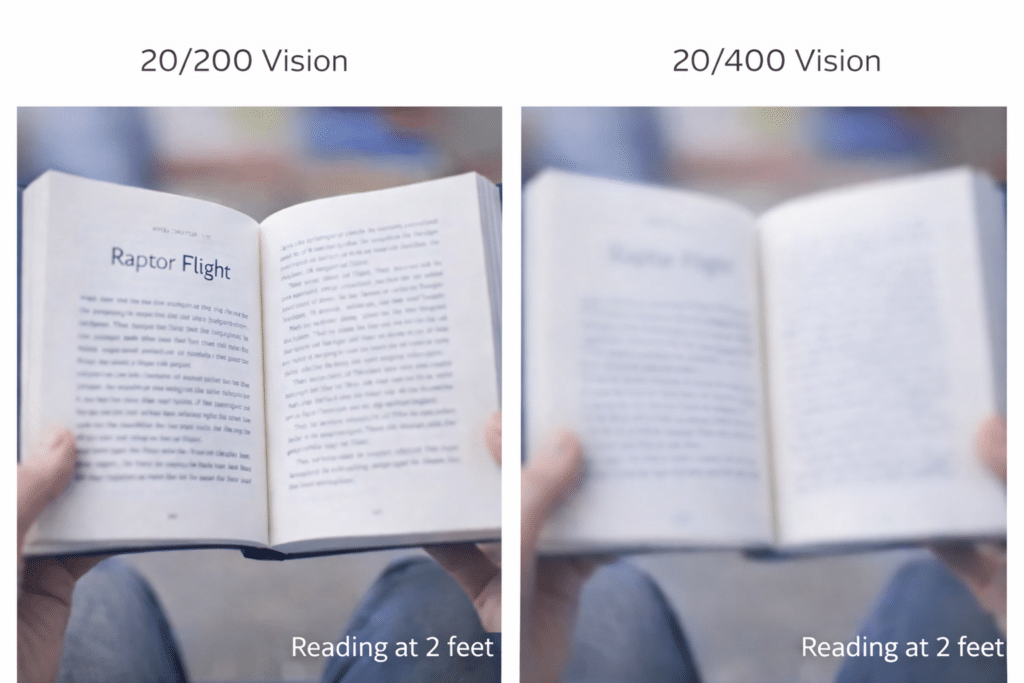
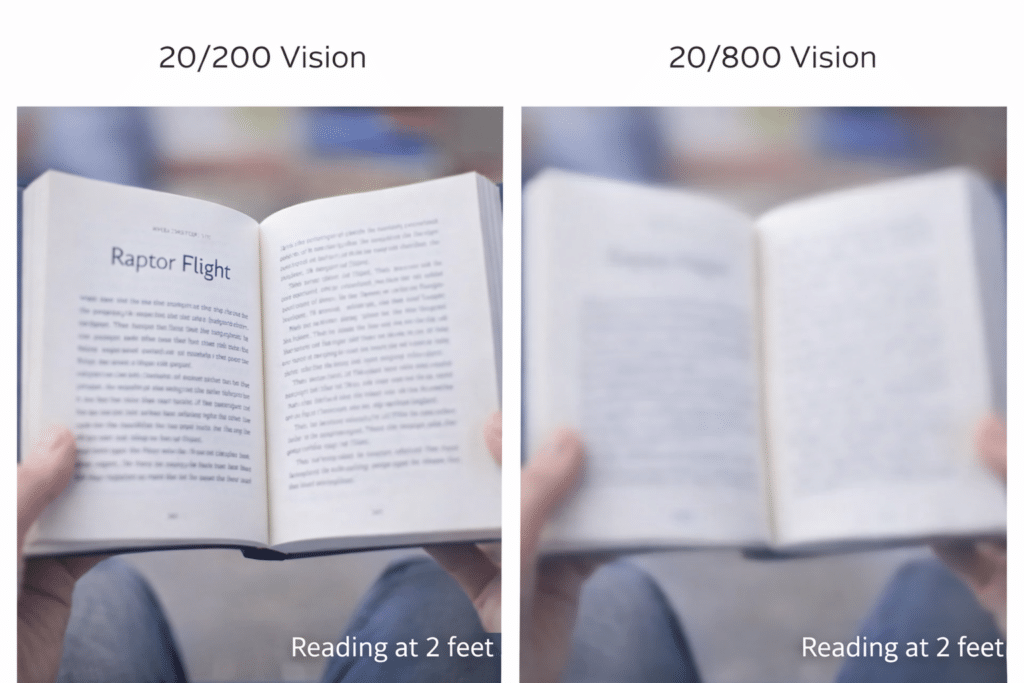
What does 20/800 vision look like: 20/200 vision compared to 20/800
20/800 is one of the most misunderstood acuity levels and is considered legally blind. People often assume it means “total blindness,” but that’s not accurate. 20/800 is severe low vision, and while it dramatically reduces detail at distance, many students and adults still use this vision every day — just differently.
Let’s break down what 20/800 really means in daily life.
What Does 20/800 Vision Mean?
A person with 20/800 vision sees at 20 feet what a person with typical vision sees at 800 feet. That’s a forty‑times loss of detail.
This affects:
distance clarity
facial recognition
reading speed
contrast sensitivity
navigation
visual fatigue
But it does not mean “no vision.” It means very limited detail, especially beyond arm’s length.
How 20/800 Vision Shows Up in Real Life
1. Distance detail is extremely limited
At 20/800, the world beyond a few feet becomes shapes, outlines, and movement — not detail. Signs, faces, and board work are not readable at any distance.
2. Faces are recognized by shape, hair, and movement
Students often identify people by voice, posture, hairstyle, or clothing rather than facial features.
3. Reading requires magnification or digital access
Print must be significantly enlarged, or accessed digitally with zoom, contrast, and speech support.
4. Contrast becomes essential
Low‑contrast materials disappear. Bold, high‑contrast visuals make a dramatic difference.
5. Mobility relies on pattern recognition, not detail
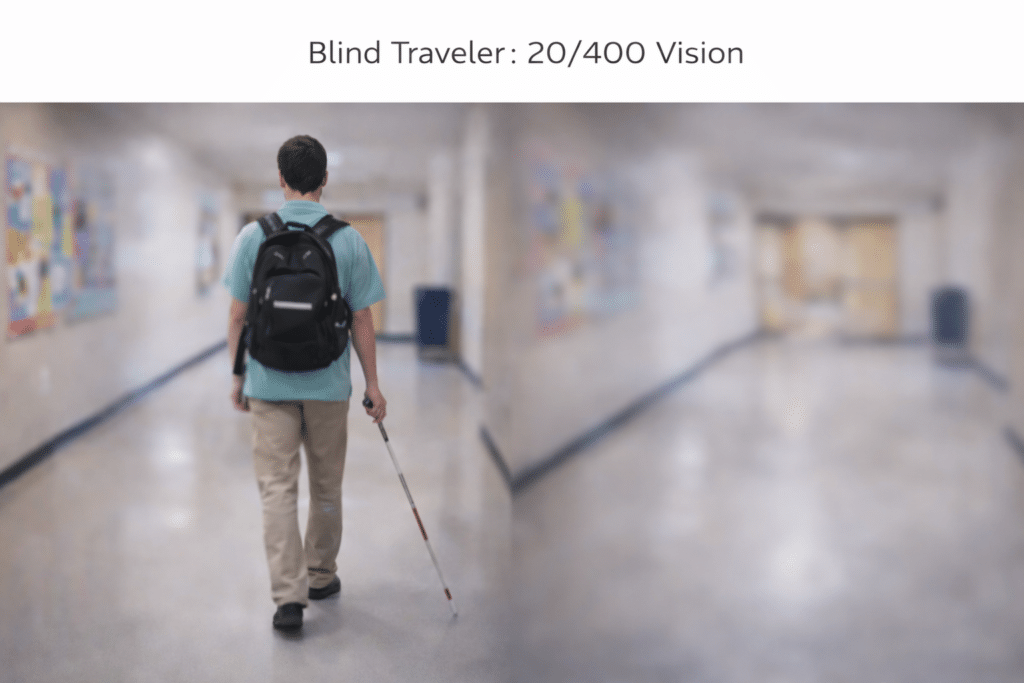
Students may navigate familiar spaces independently but need support in unfamiliar or visually complex environments.
How 20/800 Compares to Other Acuity Levels
20/800 vs. 20/200
20/200 is the legal definition of blindness. 20/800 is four times further down the chart — but the functional difference is not linear.
20/200 students may still catch some large details at distance. 20/800 students rely almost entirely on near vision, contrast, and nonvisual cues.
20/800 vs. 20/100
20/100 students can often access large print and some distance information with effort. 20/800 students cannot access distance information visually at all.
20/800 vs. “no vision”
It is not total blindness. Students may still detect:
light
motion
large shapes
high‑contrast objects
bold colors
This remaining vision can be incredibly useful when paired with the right tools.
What Students With 20/800 Need
digital access of all work with speech
predictable classroom layouts
tactile and auditory information
mobility support when needed
lighting that reduces glare
read using laptops with screen readers
work independently with braille, braille displays and tactile graphics
navigate confidently with cane and GPS
complete assignments alongside their peers using access technology
If instruction begins early and stays consistent, they thrive.
These aren’t “extras.” They’re access tools that allow students to participate fully and confidently.
The Bottom Line
20/800 is severe low vision — but it is still usable vision. Students with 20/800 rely on a combination of visual, tactile, and auditory information, and with the right supports, they can read, learn, navigate, and thrive.
Understanding what 20/800 really means helps educators stop assuming “total blindness” and start providing the access, dignity, and clarity every student deserves.
Understanding Vision in Children: What Visual Acuity Really Means
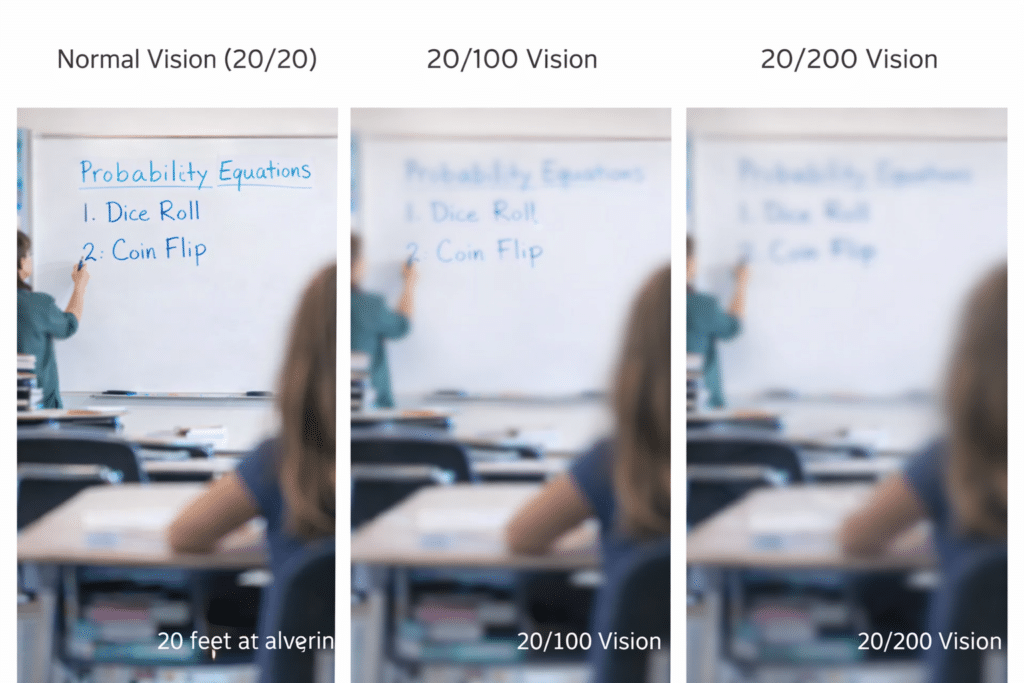
What does 20/100 vision look like: 3 comparisons: 20/20, 20/100 and 20/200
20/100 Vision: What It Really Means for People (Not legally blind, but close)
Many people hear “20/100” and think it is only “blurry.” But what does 20/100 vision look like for someone in everyday life? It is far more than that. For a student, 20/100 changes access to learning, classroom speed, and social interaction.
1. The board exists, but details disappear
A student with 20/100 sees the board, but letters fade quickly. Low contrast, faint markers, and glare make decoding slow.
2. Text requires extra effort
The eyes work harder to hold focus. Small print drains energy fast. Reading becomes a stamina task, not an intelligence test.
3. Faces and expressions lose clarity
At 20/100, subtle expressions vanish. Social cues move too fast. Misunderstandings follow because detail drops before meaning forms.
4. Mobility becomes cautious
Depth and detail shrink. Hallway movement requires more scanning. Crowded spaces increase stress and accidental bumps.
5. Fatigue arrives early
Eyes strain harder to stay clear. By mid-day, the visual system tires. Students feel the fatigue long before they report it.
6. Behavior changes are often misread
A student who looks away, slows down, or avoids reading is not lazy. They are adapting to a visual load others cannot see.
20/100 Is Not “Almost Fine”—It Is Reduced Access
This acuity does not reflect intelligence or motivation. It reflects how much effort a student must spend to access the same information as peers.
With stronger contrast, better lighting, correct seating, and the right tools, students with 20/100 can thrive.
How 20/100 Shifts Toward 20/200 During the Day
Visual clarity changes with fatigue. By afternoon, students often experience:
slower refocusing
reduced contrast sensitivity
more blur at distance
difficulty maintaining near clarity
This shift can push functional acuity close to 20/200, especially under stress, glare, or eye strain.
It works much like a Snellen chart: A student who reads 20/100 in the morning may miss one or two extra letters later, shifting the score. Missing those letters can lower acuity enough to look more like 20/160–20/200, even though the eye disease did not change—only the fatigue did.
Summary
20/100 vision affects more than reading. It changes learning, speed, confidence, and daily stamina. Early support, correct tools, and intentional teaching help students keep pace and protect their energy.
Keep in mind that life is competition so to keep up:
Life is a measure of access.
With the right tools, students with 20/100 vision:
can read using laptops and screen readers
People with 20/100 vision can work independently and may or may not need braille, braille displays, or tactile graphics, depending on whether their eye condition is stable or degenerative.
navigate confidently with cane and GPS
complete assignments alongside their peers using access technology
If instruction begins early and stays consistent, they thrive.
Understanding Vision in Children: What Visual Acuity Really Means
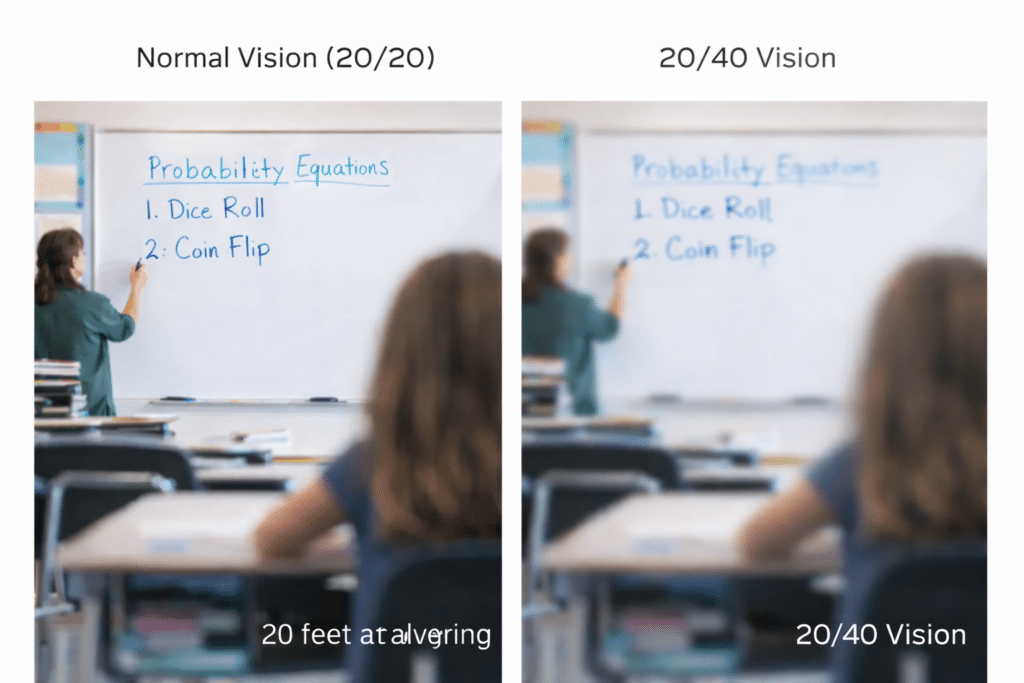
What 20/40 vision means at 20 feet trying to look at board
Understanding 20/40 Vision: Why “Almost Normal” Still Matters in the Classroom
When people hear 20/40 vision, they often assume it means “just a little blurry.” But for many students, 20/40 affects how they access learning, social cues, and the fast‑moving visual world of school. It’s not a measure of intelligence or effort — it’s a measure of visual access.
Here’s what 20/40 really means, and why it deserves attention.
What Does 20/40 Vision Mean?
A student with 20/40 vision sees at 20 feet what a student with typical vision sees at 40 feet. That difference may sound small, but in real‑world environments — classrooms, hallways, playgrounds, screens — it adds up quickly.
20/40 is still within the “legal driving” range in many places, but that doesn’t mean it’s effortless. It simply means the student can function — not that they can function comfortably.
How 20/40 Vision Shows Up in Daily School Life
1. The board is readable… until conditions change
Students may read the board when the lighting is perfect and the marker is bold. But add glare, faint ink, low contrast slides, or distance, and clarity drops fast.
This leads to guessing, leaning forward, or quietly copying from a friend.
2. Small print requires more effort
Worksheets with tiny fonts, cluttered layouts, or dense text slow students down. They can read it — but it takes more energy, and fatigue shows up long before frustration.
3. Social cues can be harder to interpret
Facial expressions, quick gestures, and subtle movements may be harder to see from across the room. This can lead to misunderstandings that look like inattention or missed cues.
4. Outdoor environments are visually demanding
Playgrounds, fields, and parking lots introduce glare, shadows, and low‑contrast backgrounds. Spotting details — a ball, a friend waving, a step — takes more effort.
5. Students may not report difficulty
Kids with 20/40 often assume everyone sees this way. They adapt quietly, work harder than adults realize, and rarely complain.
Why 20/40 Still Matters for Access
20/40 doesn’t require the same level of support as 20/200 or 20/70, but it still impacts:
reading speed
visual endurance
accuracy at distance
social interpretation
comfort in bright or low‑contrast environments
Small changes can make a big difference:
better contrast on the board
bold markers
seating that reduces glare
slightly larger print
uncluttered worksheets
digital access when possible
These aren’t “accommodations.” They’re access strategies — the same ones sighted students benefit from, just more essential here.
The Bottom Line
20/40 is not “almost normal.” It’s a visual profile that requires awareness, thoughtful design, and small adjustments that protect a student’s energy and confidence.
When we understand what 20/40 really means, we stop assuming students are “fine” — and start giving them the clarity they deserve and access to their world.
Understanding Vision in Children: What Visual Acuity Really Means
20/70 vision gets dismissed as “not that bad,” or “just a little blurry,” yet it changes a student’s entire school day. It affects how they read, learn, socialize, and move through their world. Teachers often miss the signs because the student looks like they are seeing “well enough,” but their visual system works harder every minute.
Here’s what 20/70 often looks like in real life:
1. The board is visible… but not comfortably
Students may technically read the board, but only with effort. Low contrast, faint markers, and glare turn every lesson into a slow decoding task.
2. Faces and expressions lack detail
Social cues move quickly. At 20/70, subtle expressions, eyebrow movements, and small gestures can be missed — leading to misunderstandings that look like inattention.
3. Reading takes more energy
It’s not about ability. It’s about the visual system working harder to maintain clarity, especially with dense text or poor contrast.
4. “Clumsy” moments aren’t clumsiness
Reduced detail and depth perception affect navigation, especially in busy classrooms, hallways, and playgrounds.
5. Fatigue shows up before frustration
When every task requires extra visual effort, students tire faster — long before they complain.
6. Behavior changes are often misunderstood
A student who looks away, loses place, or avoids reading isn’t unmotivated. They’re adapting.
20/70 is not a measure of intelligence or effort and it does not limit intelligence, motivation, or potential. It only limits access. With simple changes—better contrast, stronger lighting, proper seating, and the right tools—students stop struggling and start thriving. When schools understand what 20/70 really means, they unlock a student’s ability to learn with confidence and independence.
Understanding Vision in Children: What Visual Acuity Really Means
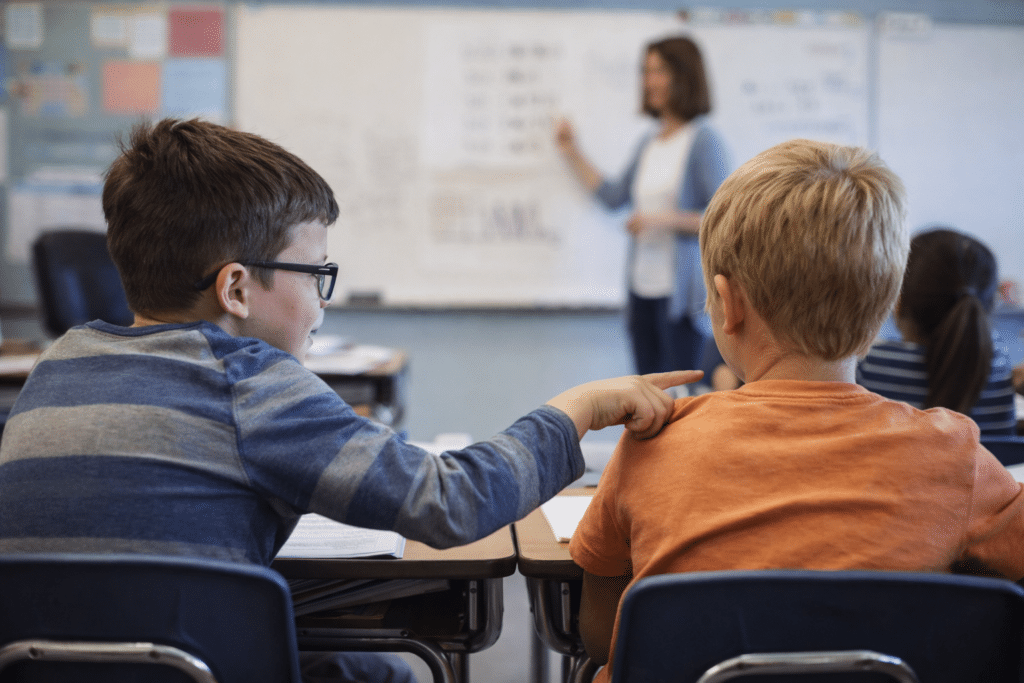
When Vision Problems Look Like Misbehavior as kid pokes another student in class to ask question
Why Vision Challenges Often Look Like “Behavior” in Kids and Adults
Vision challenges often hide in plain sight, yet they shape behavior every day. For many families, it can be confusing when vision problems look like misbehavior. A child avoids reading because letters blur. An adult seems distracted because focusing hurts. Teachers and parents notice frustration, not vision strain. Misunderstanding grows quickly when no one knows the eyes work too hard. When vision becomes clear, behavior improves, confidence rises, and daily tasks feel easier. This illustrates why vision problems sometimes appear as misbehavior.
Many vision issues do not appear as “I can’t see.” They appear as everyday behaviors people misunderstand. These signs often show that vision—not motivation—is the real struggle.
• “Why can’t my child see the board?” Distance vision is only part of the story. Low contrast, glare, and faint markers make even the front row feel far away.
• “Why does my student squint?” Squinting is often a contrast problem, not a distance problem. It’s the brain trying to sharpen an image that isn’t clear enough.
• “Why does my child hold things close?” Close viewing is a strategy, not a flaw. Many students see best within a narrow range where print is larger, clearer, and higher contrast. When vision problems arise, they may mimic misbehavior rather than signal a visual challenge.
• “Why does my student miss social cues?” Facial expressions, eye contact, and gestures are low‑contrast, fast‑moving, and often far away. Missing them is a vision access issue, not a social one.
Vision Problems Look Like Misbehavior in small but significant ways
• “Why is my child clumsy?” Depth perception, peripheral vision, and glare sensitivity all affect movement. Tripping or bumping into things is often functional vision—not coordination.
• “Why does my student avoid reading?” Avoidance is usually fatigue. Low contrast, small print, and visual clutter make reading physically exhausting long before it becomes academically challenging. In many cases, vision problems may be mistaken for misbehavior in students avoiding tasks.
Why does my child interrupt conversations or seek attention in the wrong ways? If you can’t clearly see who is talking, where the group’s attention is focused, or when it’s your turn to join in, you rely on timing guesses. What looks like interrupting or attention‑seeking is often a student trying to participate without the visual information everyone else takes for granted. Vision Problems Look Like Misbehavior all the time with habits such as these.
When we understand the why, we stop labeling these behaviors as inattentive, unmotivated, or disruptive—and start creating environments where students can thrive.
Understanding Vision in Children: What Visual Acuity Really Means
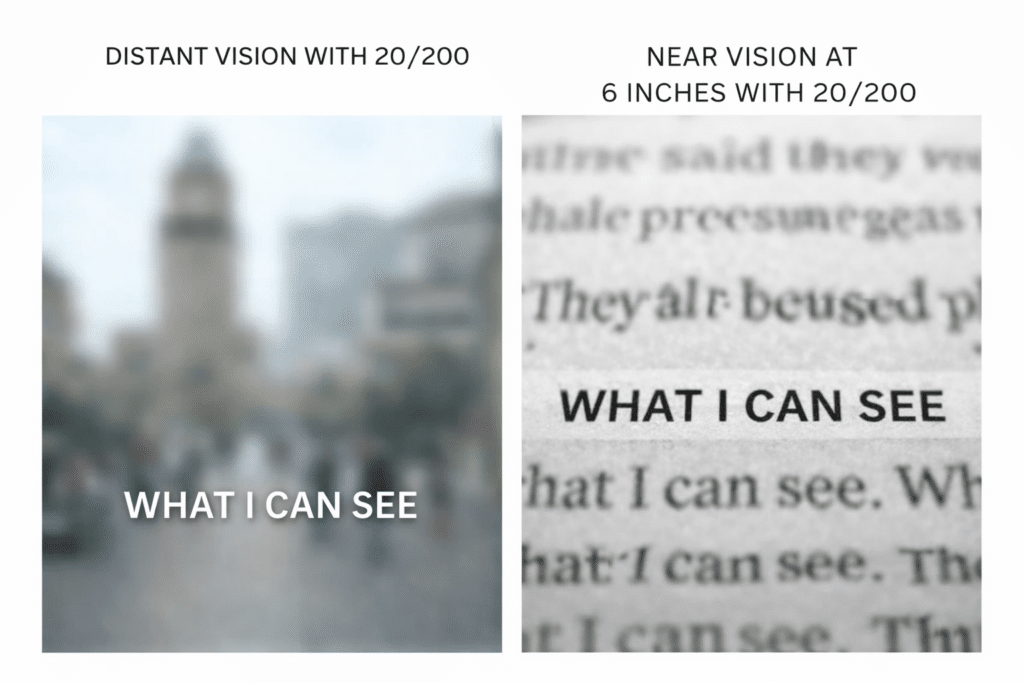
20/200 vision explained-in the distance and up close with 1 line seen at 20/20 perfect vision
Many people misunderstand what 20/200 vision actually means. The term appears simple, yet the truth often surprises families and teachers. Many assume 20/200 equals total blindness, but it does not. This number describes legal blindness, not the absence of sight. People with 20/200 vision may still see shapes, motion, and colors. However, they cannot see detail clearly enough for daily tasks without support. Understanding this difference matters, because it guides education, training, and future independence. Clear knowledge empowers parents, schools, and professionals to build the right plan.
Misunderstanding 1: “20/200 means total blindness”
20/200 is the legal definition of blindness in the United States, but it is not the functional definition. Many people with 20/200:
See light, color, and large shapes
Navigate familiar spaces
Recognize faces at close distances
Read with magnification or large print
The myth comes from assuming “blindness” means “no vision at all,” when in reality it describes a range of usable vision.
Misunderstanding 2: “If someone has 20/200, they can’t read”
Reading ability depends far more on print size, contrast, and lighting than on the acuity number alone. Someone with 20/200 may read:
Large print
High‑contrast text
Digital text with zoom
Braille, depending on preference and fatigue
The real barrier is often visual clutter, not the acuity itself.
Misunderstanding 3: “20/200 looks the same for everyone”
Two people with the same acuity can have completely different experiences depending on:
Field loss
Light sensitivity
Glare
Contrast sensitivity
Stability of the condition
Acuity is only one slice of functional vision.
Misunderstanding 4: “If you get close enough, everything becomes clear”
Distance helps, but clarity depends on contrast, lighting, and the condition causing the vision loss. Someone with 20/200 may still struggle with:
Low‑contrast text
Faded pencil writing
Busy backgrounds
Dim rooms
Bright glare
Getting closer doesn’t fix those.
Misunderstanding 5: “20/200 means you can’t be independent”
People with 20/200 routinely:
Work full‑time
Travel independently
Use smartphones and computers
Parent
Cook
Drive with bioptics in some states
Independence is shaped by training, tools, and environment, not just acuity.
With the right tools, students with 20/200 vision:
read using laptops and screen readers
work independently with braille, braille displays and tactile graphics
navigate confidently with cane and GPS
complete assignments alongside their peers using access technology
If instruction begins early and stays consistent, they thrive.
Misunderstanding 6: “20/200 is the same in every situation”
Someone with 20/200 may function very differently depending on:
Indoors vs. outdoors
Daylight vs. fluorescent lighting
High‑contrast vs. low‑contrast environments
Familiar vs. unfamiliar spaces
Functional vision is context‑dependent, not fixed.
Misunderstanding 7: “If you have 20/200, you’ll eventually lose all your vision”
Acuity doesn’t predict the future. Some conditions are stable for life. Most vision fluctuates daily and hourly. Some improve with treatment. Some decline slowly or unpredictably.
The number describes today, not destiny.
Misunderstanding 8: “20/200 means you can’t see faces”
Most people with 20/200 can see faces at close range. What’s difficult is:
Recognizing faces across a room
Reading expressions from a distance
Catching subtle social cues
This is why students may appear “uninterested” or “unaware” when they’re actually working twice as hard to interpret the room.
Misunderstanding 9: “Glasses can fix 20/200”
If glasses could correct it, it wouldn’t be classified as 20/200. The number reflects best‑corrected vision, not uncorrected vision.
Misunderstanding 10: “20/200 is rare”
It’s more common than people think, especially among:
Students with albinism
Individuals with optic nerve conditions
Adults with diabetic retinopathy
People with congenital low vision
The number shows up across many diagnoses.
Globally, more than 33 million people meet the legal blindness threshold of 20/200 vision or worse, making this level of sight loss far more common than most people realize.
Understanding Vision in Children: What Visual Acuity Really Means
Speed up your computer and fix slow-loading programs with a few adjustments and updates. Ensure all necessary .NET runtimes for programs are installed in the control panel. This allows programs to run smoothly.Regularly update your computer system to improve performance. Maintain a clean computer system, optimize performance, and disable unnecessary startup applications to keep your computer running efficiently.
Fix a Slow computer To Do List:
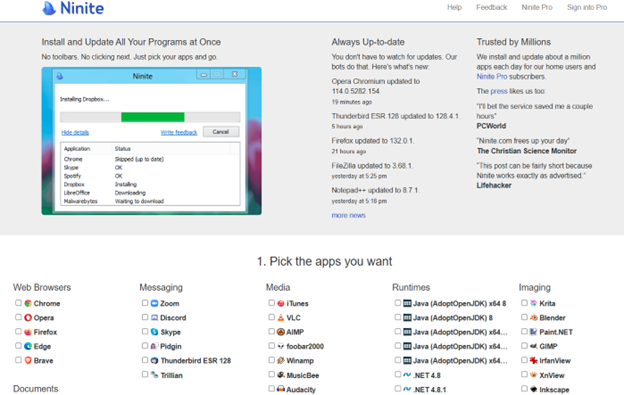
Users to update their .NET runtime to version 8 (and version 9 by end of 2024) using ninite.com.
Users to clean out their temp folder by running %temp% in Windows Run and deleting the contents to help speed up the computer.
Users to disable unnecessary startup apps in Task Manager to improve computer startup speed.
Details:
Downloading and Installing Runtimes for better Performance
Download and install these runtimes using the .NET Microsoft download and the Ninite.com website. Make sure to download the correct versions, specifically 64-bit and 86-bit. Use a screen reader to navigate the download process if needed. Check if the runtimes are correctly installed in programs and features. Update to version 9 by the end of December 2024.
Ninite.com will help speed up and fix a slow computer
Improving Computer Speed and Fix slow Computer Network
Improving computer speedand network connection involves cleaning the computer by removing temporary files and emptying the recycle bin. Regularly check for updates to keep the system running efficiently. Navigate to the temp folder and delete unnecessary files, handling files in use appropriately. Use windows key and type in updates to go to check for updates and do them several times a week. Keep your software updated also and the speed of your computer increases with every fix and adjustment. Here are other Tech Tricks to improve you computer and new commands for Google