
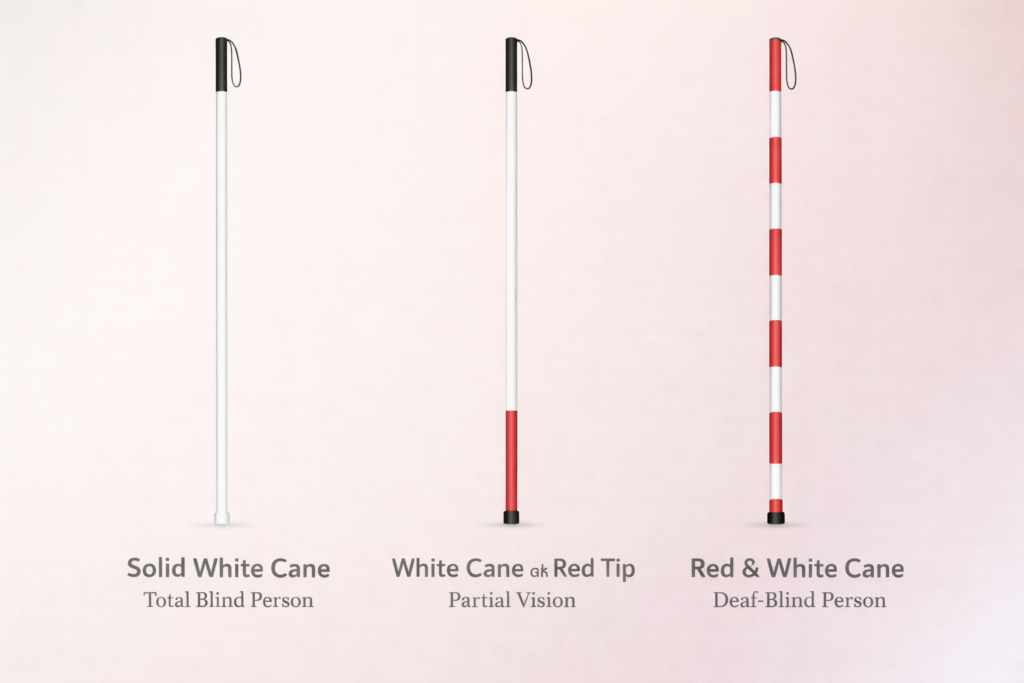
White canes help identify travelers with vision loss and support safe, independent navigation. Different cane markings communicate different levels of vision impairment. Understanding these differences helps the public respond appropriately and promotes safer environments for people who are blind or visually impaired.
Solid White Cane
A solid white cane commonly indicates that the traveler is blind or has very little functional vision. The cane serves two main purposes. First, it helps the traveler detect obstacles, steps, drop-offs, and changes in surface texture. Second, it alerts drivers and pedestrians that the individual may not see approaching hazards.
Orientation and mobility specialists often teach travelers to use the white cane with systematic scanning techniques that detect objects along the walking path. The cane becomes an extension of touch, allowing the traveler to move confidently and safely.
White Cane with a Red Tip
A white cane with a red tip or red section near the bottom typically indicates that the traveler has low vision or partial sight. The individual may see some shapes, movement, or contrast but still requires the cane to detect obstacles and navigate safely.
The red marking signals that the traveler may rely on a combination of remaining vision and tactile feedback from the cane. Even though some vision exists, obstacles and environmental hazards may still be difficult to detect without the cane.
Why Cane Identification Matters
Recognizing these cane markings helps others respond safely. Drivers should slow down and yield when a traveler with a white cane approaches a crossing. Pedestrians should provide space and avoid grabbing the cane or interfering with its movement.
White canes represent independence, mobility, and access to the world. Whether solid white or marked with red, the cane serves as an essential tool that allows individuals with vision loss to travel safely and confidently.