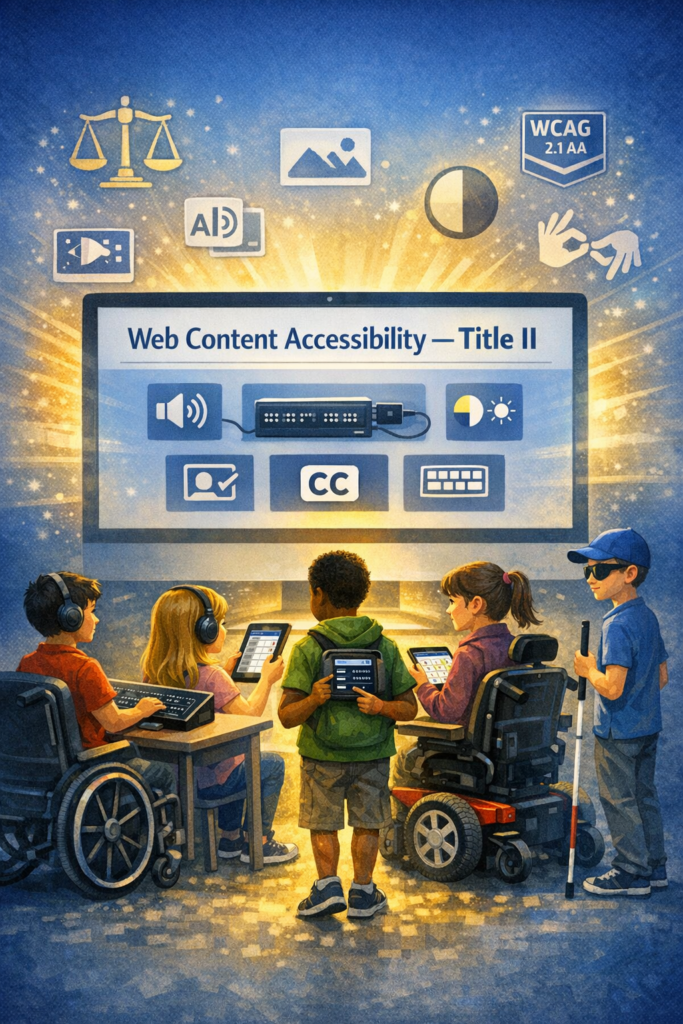
In April 2024, the U.S. Department of Justice published its final rule updating Title II of the ADA to require that state and local governments make their websites and mobile apps accessible by conforming to WCAG 2.1 Level AA. (WCAG 2.1 AA) or face the consequences.
This is the first time the DOJ has formally adopted a specific technical standard for digital accessibility under Title II.
What changed? https://collegiseducation.com/insights/title-2-web-accessibility-higher-ed/
Who must comply?
All state and local government entities, including:
- State agencies
- Counties, cities, municipalities
- Independent school districts
- Special district governments
- Contractors or vendors providing public‑facing digital services on behalf of these entities
This includes any third‑party platform used to deliver services (payment portals, scheduling systems, learning platforms, etc.).
Compliance deadlines
The DOJ set two compliance timelines:
- April 24, 2026 → Entities with 50,000+ population
- April 26, 2027 → Entities with <50,000 population and special districts
These dates apply to full conformance with WCAG 2.1 AA for all covered digital content.
What WCAG 2.1 AA requires
WCAG 2.1 AA addresses barriers affecting people with:
- Blindness or low vision
- Deafness or hearing loss
- Cognitive or learning disabilities
- Mobility or dexterity impairments
Key requirements include:
- Text alternatives for images
- Captioning and audio description for video
- Keyboard accessibility for all functions
- Sufficient color contrast
- Logical heading structure
- Resizable text and responsive layouts
- Avoiding motion‑based inputs (e.g., shaking a device)
- Touch target size and spacing for mobile apps
What content is covered?
The rule applies to all web content and mobile apps a public entity provides or makes available.
This includes:
- Websites
- Mobile apps
- Online forms
- PDFs and digital documents
- Portals and dashboards
- Learning platforms
- Third‑party tools used to deliver public services
What content is not required to comply?
The rule includes limited exceptions:
- Archived web content
- Preexisting traditional electronic documents (e.g., old PDFs)
- Content posted by non‑affiliated third parties
- Password‑protected individual documents
- Preexisting social media posts
These exceptions are narrow—most active, public‑facing content must meet WCAG 2.1 AA.
Why the DOJ adopted WCAG 2.1 AA
The DOJ emphasized that inaccessible digital services create real barriers—for example:
- Blind users unable to access images without alt text
- Inaccessible forms blocking access to voting, tax info, or school services
- Barriers to participating in civic events
The rule aims to ensure equal access to essential public services.
What this means schools, colleges and any educational institution
For blind/low‑vision students and families receive real‑time, nonvisual access to digital content. WCAG 2.1 AA now gives legal backbone for the accessibility standards people advocate for—especially around:
- Alt text
- Keyboard access
- Logical structure
- Screen‑reader compatibility
- Accessible PDFs
- Mobile app access ease with braille display or Voice Over
- Captioning and audio description
This is a powerful tool for your advocacy with districts, IEP teams, and state agencies.
You’re not imagining it — public colleges and universities really are scrambling, and the panic is coming from several very real, structural reasons that the higher‑ed sector has been avoiding for years. Here’s what the current reporting and expert analysis show, grounded in the sources we just pulled.
Why colleges and Schools are panicking about the new Title II WCAG 2.1 rule
1. The rule is no longer “guidance” — it’s enforceable law
Public colleges and universities are now legally required to meet WCAG 2.1 AA across all digital services. This is a major shift from the old “best practice” era.
For higher ed, which has thousands of pages, PDFs, videos, portals, and legacy systems, this is a massive lift.
2. The deadlines are tight — especially for large institutions
Public institutions serving populations of 50,000+ must comply by April 24, 2026.
Smaller ones have until April 26, 2027.
Most colleges are nowhere near WCAG 2.1 AA compliance today.
3. Higher ed has huge accessibility debt
Experts note that colleges have:
- Decentralized web teams
- Fragmented domains
- Thousands of legacy PDFs
- Inaccessible videos
- Third‑party tools that aren’t compliant
This means they’re not starting from zero — they’re starting from negative.
4. Colleges have been relying on “accommodations,” not accessible design
For years, many institutions leaned on disability services offices to “fix” inaccessible content after the fact.
The new rule requires proactive accessibility, not reactive accommodations.
This is a cultural shift higher ed has resisted for decades.
5. The exceptions are narrow — and colleges hoped they’d be broader
The DOJ’s exceptions (archived content, pre‑existing social media posts, third‑party content, etc.) are very limited.
Most active content must be fully accessible.
6. Colleges and schools fear litigation and OCR complaints
Higher ed is already a top target for ADA and Section 504 complaints.
Now that WCAG 2.1 AA is the explicit legal standard, colleges know enforcement will increase.
7. They know they can’t fix this with a one‑time project
Experts warn that accessibility must become a digital operating model, not a “compliance project.”
That means governance, training, workflows, and accountability — areas where higher ed is historically weak.
Colleges and schools are panicking — because they’re unprepared.Rules to follow from ADA
DOJ Title II Explained
A New Era of Access: How DOJ’s New Title II Rule Transforms Education for Every Child in America
Why K–12 Is Scrambling: What the DOJ’s Title II WCAG 2.1 Rule Means for Every School District
DOJ Title II Requires Web Content Accessibility : What Schools Must Do Next
Private Schools and Title II With Teeth: How the New DOJ Accessibility Rule Changes Everything
Title II Meaning for Vocational Rehabilitation and Adult Rehab Centers
Penalties for Noncompliance With DOJ Title II and WCAG 2.1 AA Requirements
Title II Non-Compliance Can Lead to Job Loss in K–12 Schools and Colleges