As Our team teaches blind low vision, this article is directed toward that population but this is true for ALL populations of children.
For decades, blind and low‑vision students have been expected to “make do” with inaccessible schoolwork, delayed accommodations, and digital tools that were never designed for them. Parents have fought and Teachers of the visually impaired have patched and remediated-transcribed work until late in the evenings. Students have worked twice as hard for half the access.
But now, everything is changing.
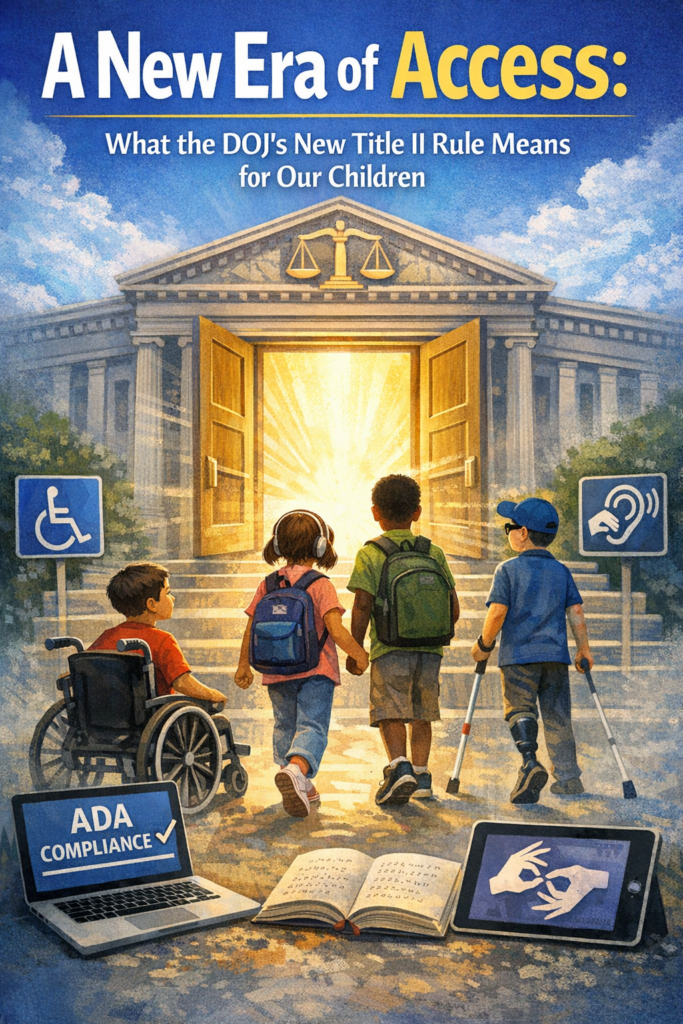
In April 2024, the U.S. Department of Justice issued a landmark update to Title II of the Americans with Disabilities Act, requiring all state and local governments — including every public school district in the country — to make their websites, digital learning platforms, documents, and mobile apps accessible by following WCAG 2.1 Level AA.
This is not guidance or a suggestion.
This is federal law.
And for the first time, our children have a clear, enforceable right to full, equal, real‑time access to their education.
Why this rule matters so much for blind and low‑vision students
Blind and low‑vision students have always been the most impacted by inaccessible digital content. When a worksheet is posted as an image, when a math assignment is scanned sideways, when a teacher uploads a PDF with no tags, when a learning platform isn’t keyboard accessible — that student is locked out.
The new rule changes that.
WCAG 2.1 AA requires schools to ensure:
- All images have alt text
- All documents are structured for screen readers
- All videos have captions and audio description
- All platforms work with keyboard navigation
- All math and STEM content is accessible
- All mobile apps are operable for non-visual users
- All content is perceivable, operable, understandable, and robust
This is the first time the federal government has said, in clear language:
“Your digital content must be accessible from the start.”
No more waiting or retrofitting.
No more “we’ll fix it later” or “we didn’t know.”
Why schools are scrambling or should be scrambling— and why that’s good news
K–12 districts are suddenly realizing that:
- Teachers create inaccessible content every day
- Thousands of PDFs and worksheets must be remediated
- Google Classroom, Schoology, Canvas, and other platforms must meet WCAG
- Vendor tools must be accessible — and the district is responsible if they’re not
- They need training, workflows, and accountability
- They must comply by 2026 or 2027, depending on district size
This is overwhelming for them — but it’s also the first time blind and low‑vision students have the law fully on their side… as do all students!
So if you hear panic you’re it is not a bad thing.
It’s the sound of a system finally being required to do what it should have done all along.
What this means for your child
It means your child has the right to:
- Access their schoolwork at the same time as their peers
- Use screen readers, magnification, braille displays, and other tools without barriers
- Receive accessible math, science, and STEM content
- Navigate school websites and portals independently
- Access digital textbooks and curriculum materials
- Participate fully in online learning
- Receive materials in formats that work for them — every time
This is not optional.
Or “if the teacher has time.”
This is not “if the district can figure it out.”
This is their legal right.
What this means for teachers
Teachers are not expected to become accessibility experts overnight. But they are expected to learn the basics of accessible digital design — and districts are required to train them.
This rule gives teachers clarity, structure, and support.
It gives them a roadmap.
It gives them permission to slow down and do things right.
And it gives them the tools to reach every learner, not just those who can see the screen.
What this means for TVIs and accessibility professionals
For years, TVIs have been forced into the role of “fixer” — remediating inaccessible content after the fact, often late at night, often under pressure, often without the authority to change the system.
This rule changes your role.
You are no longer the emergency repair technician.
You are now the accessibility leader your district must rely on.
Your expertise is finally recognized as essential, not optional.
Why this is a moment of hope
For the first time in U.S. history, blind and low‑vision (and all) students have a federal rule that:
- Names the standard
- Sets the deadlines
- Defines the expectations
- Holds districts accountable
- Protects students’ right to equal access
This is the beginning of a new era — one where our children can learn, participate, and thrive without barriers.
And for families who have spent years advocating, fighting, and explaining the same issues over and over, this rule is a long‑awaited validation:
Your child deserves full access.
All children deserve independence.
Your child deserves equal opportunity.
And now, the law finally backs you up.
DOJ Title II Explained
A New Era of Access: How DOJ’s New Title II Rule Transforms Education for Every Child in America
Why K–12 Is Scrambling: What the DOJ’s Title II WCAG 2.1 Rule Means for Every School District
DOJ Title II Requires Web Content Accessibility : What Schools Must Do Next
Private Schools and Title II With Teeth: How the New DOJ Accessibility Rule Changes Everything
Title II Meaning for Vocational Rehabilitation and Adult Rehab Centers
Penalties for Noncompliance With DOJ Title II and WCAG 2.1 AA Requirements
Title II Non-Compliance Can Lead to Job Loss in K–12 Schools and Colleges