
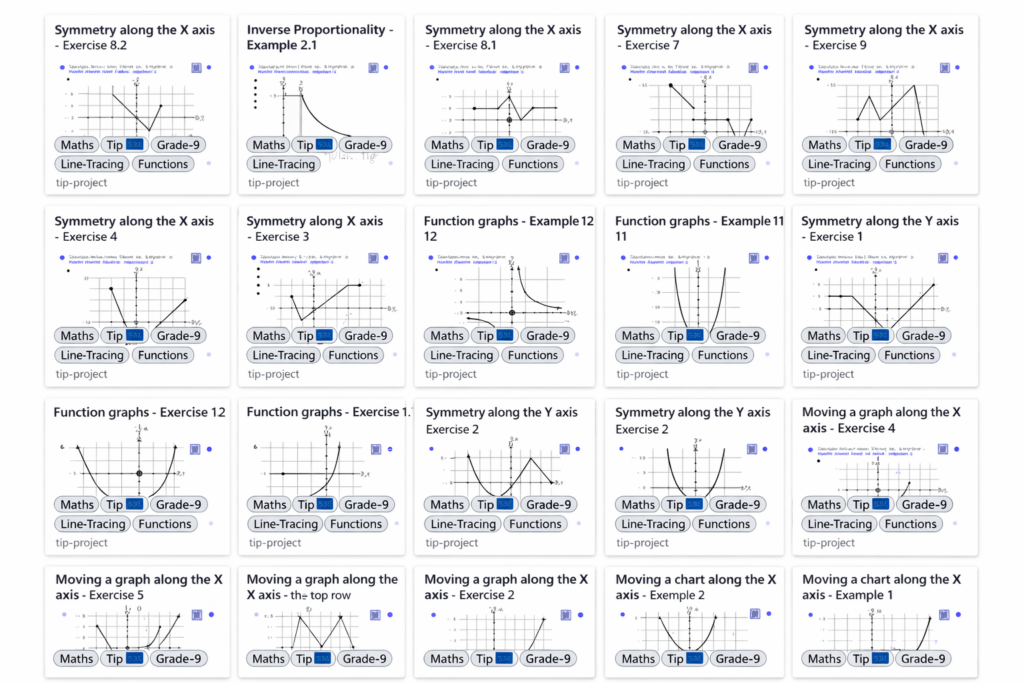
Finding high-quality tactile graphics for advanced math often feels overwhelming, especially when you support blind students who want deeper conceptual understanding. However, you can simplify the process with a clear list of reliable sources. To begin, you can explore this curated collection of teacher-vetted tactile math libraries. These sites cover algebra and pre-calculus through Calculus I–III. In addition, they include limits, derivatives, integrals, function behavior, curves, and coordinate systems. As a result, you gain ready-to-use tactiles that strengthen conceptual learning for all students. For example, many of these graphics support problem-solving, graph analysis, and multi-step reasoning. Though the focus leans toward higher-level math, these sites still offer tactile graphics for every math level. Finally, you can review them in order, moving from the most comprehensive to excellent, knowing each one provides strong and dependable options.
The information below is in order of the most comprehensive to excellent so all options are great for finding anything you need. On the European site, just remember to select English
1. Tactile Inclusion Project (TIP) — 1,250+ Math Tactiles (Grades 1–13, including Calculus)
STPT = Science, Technology, Physics, and Tactile
It’s one of the major content categories inside the Tactile Inclusion Project (TIP) collection.
TIP created a huge set of tactile graphics across:
- Math
- Science
- Physics
- Technology
- Geometry
- Calculus
- Data & graphs
Best source for calculus‑level tactile graphics.
This project includes audio‑tactile and swell‑paper‑ready graphics for algebra → calculus, created by math teachers for blind students.
Calculus‑related tactiles available
- Limits (approaching values, left/right limits)
- Derivative concepts (slopes, tangent lines)
- Curve behavior (increasing/decreasing, concavity)
- Graphs of functions (polynomials, exponential, trig)
- Area under curves (Riemann rectangles)
- Integrals (definite/indefinite visualizations)
- Coordinate planes, axes, quadrants
- Piecewise functions
- Parametric curves
- Sequences & series visuals
- Optimization diagrams
Why it’s ideal for blind students:
- Graphics are simplified to core mathematical meaning
- Includes audio explanations
- Translatable into 29 languages
- Free to download
2. ProBlind — Global Database of 1,250+ Tactile Math Graphics- make sure you choose your language preference:
Calculus‑level graphics include:
- Function families
- Derivative slope diagrams
- Concavity & inflection points
- Trig function curves
- Exponential/logarithmic curves
- Limits & asymptotes
- Area under curves
- 3D surfaces (simplified for tactile use)
- Calculus
- Limits
- Derivatives (slopes, tangent lines)
- Integrals (area under curves)
- Concavity & inflection points
- Function families
- Riemann sums
- Asymptotes & behavior at infinity
- Pre‑Calculus & Algebra
- Trig functions
- Exponential/logarithmic curves
- Coordinate planes
- Piecewise functions
- Parametric curves
- Geometry & STEM
- Shapes
- Graphs
- Data displays
- 3D surfaces (simplified)
- All graphics are:
- Swell‑paper ready
- Embosser friendly
- Audio‑described
- Designed specifically for blind learners
- Where TIP Lives Now
- Because the original TIP website has a broken SSL certificate, the safe, active home for all TIP graphics is:
- ProBlind (secure host of TIP content)
- https://www.problind.org
- Everything TIP created is available there.
- Why Teachers Love TIP
- Graphics are clean, uncluttered, and concept‑focused
- Designed by math teachers who understand tactile learning
- Perfect for bright blind students who need conceptual depth
- Free and globally accessible
- Why it’s powerful:
- Free because it is:
- Designed specifically for blind students
- Covers all grade levels, including advanced math
- Graphics are tested in blind schools
Best Tactile and Math Graphics for Blind Students at Perkins
3. Perkins School for the Blind — Tactile Graphics Library
Large library of tactile graphics ready for PIAF/Swell machines.
Calculus‑related graphics include:
- Coordinate planes
- Graphs of functions
- Trigonometric curves
- Geometry foundations needed for calculus
- Rate‑of‑change visuals
- Area/volume diagrams
Why it’s useful:
- Teacher‑adapted worksheets
- Clean, uncluttered diagrams
- Many graphics can be used as pre‑calculus foundations
4. BTactile is included in Perkins link— 5,500+ Swell‑Paper‑Ready Graphics
One of the largest free tactile image libraries online.
Calculus‑related graphics include:
- Graphs of functions
- Trig curves
- Exponential/logarithmic functions
- Geometry for limits & derivatives
- Coordinate systems
Why it’s valuable:
- Massive library
- Ready for immediate embossing
- Great for enrichment and practice
5. APH Tactile Graphic Image Library (TGIL)
Search output of Links of all graphics
Requires free registration.
Calculus‑related graphics include:
- Graphs
- Coordinate planes
- Geometry diagrams
- Algebraic foundations
Why it matters:
- APH graphics follow tactile design standards
- Good for building conceptual scaffolding
6. Zychem Tactile Library is included in the APH Library
Swell‑paper graphics for math and science.
Calculus‑related graphics include:
- Graphs
- Geometry
- Trig curves
- Function diagrams
7. Paths to Technology (Perkins) — Individual Tactile Math Lessons
Useful for calculus prep:
- Absolute position
- Coordinate grids
- Graphing activities
- Function behavior
8. Tactile Graphics for Geoscience Education
Not calculus‑specific, but includes 3D surfaces, gradients, and spatial diagrams helpful for multivariable calculus.
9. APH Tactile Graphics Image Library
Search the Tactile Graphic Image Library
The TGIL: History and Mission
The TGIL was established in 2007 by the American Printing House for the Blind (APH) to support transcribers by providing free, customizable tactile graphics templates for images that are commonly used in K-12 education. The goal of the TGIL was to help speed up textbook transcription by providing a good starting point for creating high-quality tactile graphics.
While supporting transcribers remains an important part of the TGIL’s mission, we have recently expanded the scope and purpose of the TGIL to provide graphics that have been “optimized for the Monarch.” These graphics support direct-to-student delivery of graphics for use in a digital format with the Monarch multi-line tactile display.
The metadata for each graphic in TGIL will indicate whether the graphic was created for embossing and/or whether it has been optimized to display on the Monarch. We also invite users to request graphics for use on the Monarch — or request remediation of an existing graphic — when an “optimized for Monarch” alternative is not yet available.