Search results for: “WORD”

  • Blind Braille‑Math Student Fights STEM Book Shortages and Stigma

    This story is rewritten from original post.

    JEFFERSON COUNTY, Tenn. As school resumed, a Jefferson County student waited weeks for an important textbook to arrive from out of state. This doesn’t seem like a big deal, except it’s a calculus book for Math for blind students and it’s written in Braille. Campbell Rutherford is a home school student in Jefferson County.

    She started homeschooling with a teacher for the visually impaired because math for blind students was no longer available in the local school district. Campbell was born blind and has been reading braille since she was 3 years old. “I rely completely on braille and screen readers to access the printed word,” she said. Campbell, accustomed to reading Braille, competes in state Braille reading competitions yearly and has even reached nationals. So naturally, she’d like to be able to read her textbooks in Braille.

    Because each page has to be embossed with the Braille indentations, Campbell’s textbooks are huge. Here’s her AP physics book. All these binders are one book for Math for blind students, containing everything in the print book next to it, just in Braille.
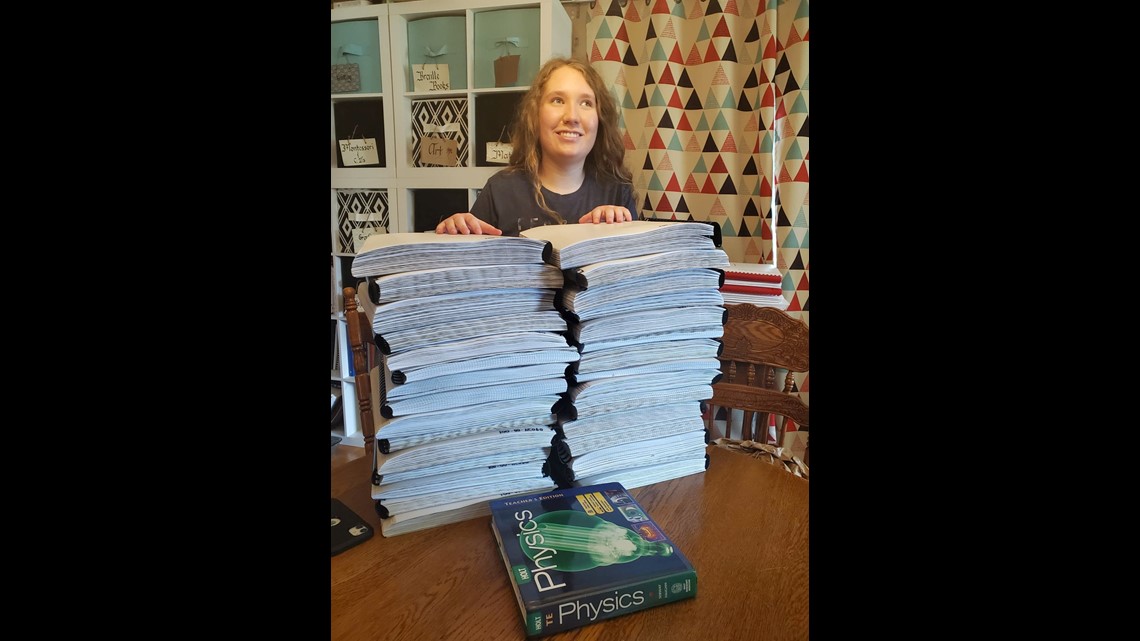
    Credit: Liza Rutherford: Campbell Rutherford stands with her AP Physics book in Braille, next to the book in print. Math for blind students

    Credit: Liza Rutherford: Campbell Rutherford stands with her AP Physics book in Braille of 25 volumes of 11 x11.5 size, next to the book in print of 2 inches thick.

    “I used to have to borrow a truck to go get her books,” said her mom, Liza Rutherford. Braille books are larger because the text must be big enough for readers to feel with their fingertips. A standard physics book may have four graphs on one page, but in Braille, each graph requires its own page. The National Braille Press reported about 12 percent of blind school-age students can read Braille, limiting access to advanced textbooks.

    NO AP Math Books

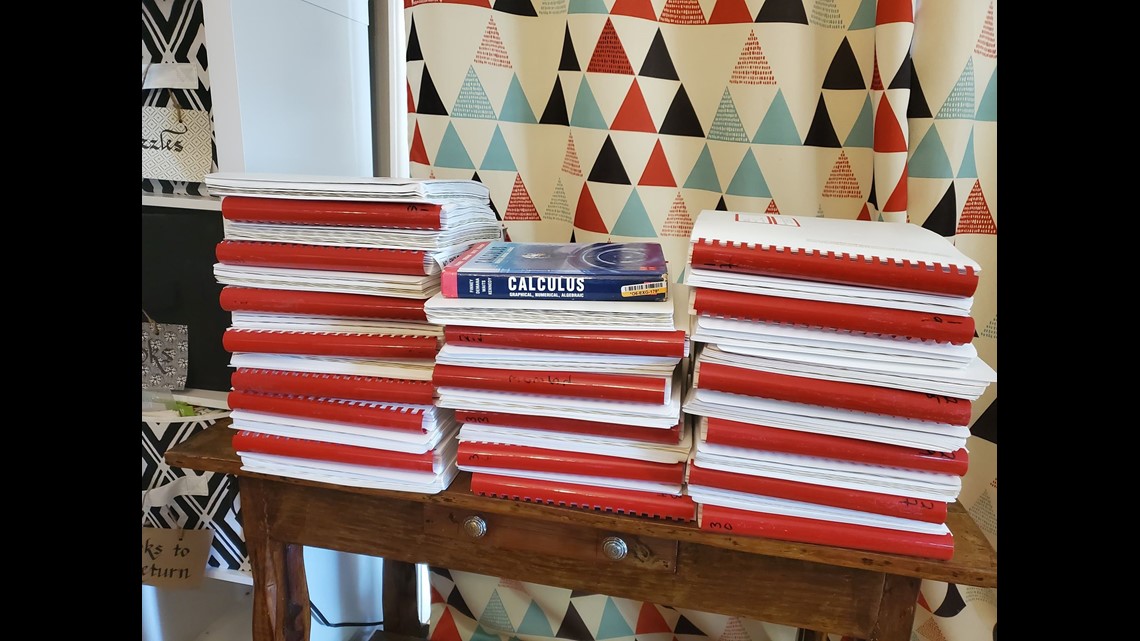
    There were no Braille AP calculus books in the state of Tennessee. The Rutherford’s worked with the Tennessee School for the Blind to find this 20-year-old edition from Maryland. Campbell said schools often discourage visually impaired students from taking challenging courses. “I have friends that, when they’re struggling with Math, they’ve been told, ‘it’s okay that blind people aren’t good at math typically,’” said Campbell.
    Credit: Liza Rutherford

Campbell Rutherford's calculus book in Braille. Math for blind students

    Credit: Liza Rutherford-Campbell Rutherford’s calculus book in Braille of 32 volumes of 11 x11.5 size, by to the book in print of 2 inches thick..

    Campbell plans to major in math in college and go into epidemiology. She said it’s those low expectations that hinder her and others the most, not her lack of vision. “We even had an administrator at one point come to me and say, ‘does Campbell really need a high school diploma for her adult life?’” said her mom Liza Rutherford. “That’s probably the one that’s infuriated me the most over the years,” said Campbell.

    Lack of Advanced Placement (AP) Math for blind students Books

    The National Federation for the Blind reported only 31.6 percent of blind individuals hold a high school diploma or GED. The Rutherford’s believe a shortage of teachers for the visually impaired adds to this problem.
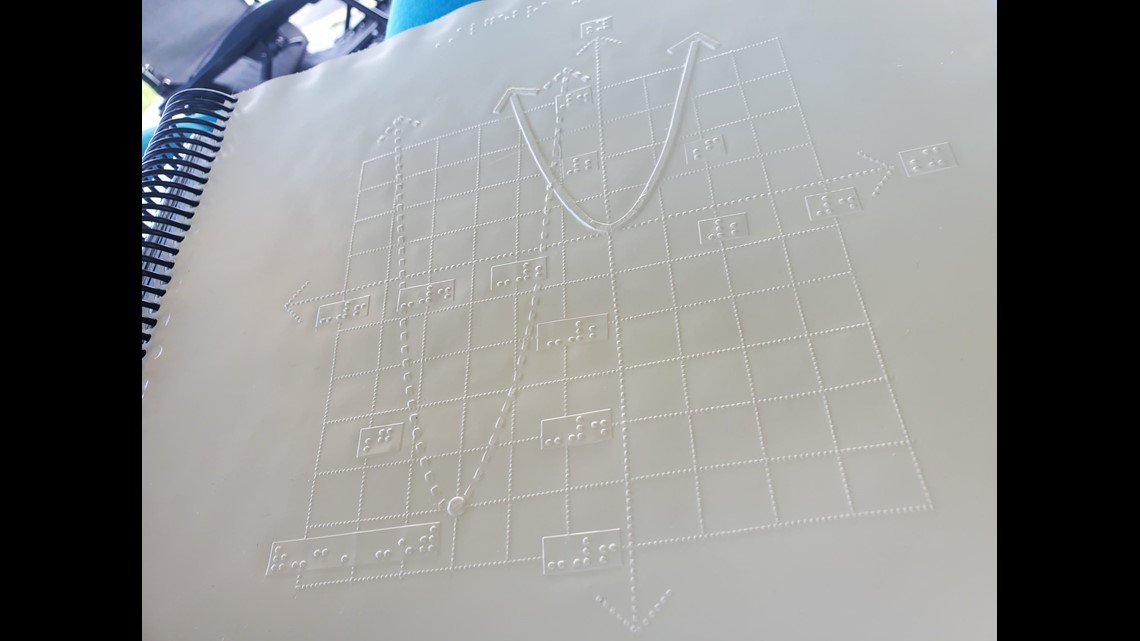
    Credit: Liza Rutherford: A mathematical graph transcribed in Braille.

    Credit: Liza Rutherford: A mathematical graph transcribed in Braille.

    They are hopeful that as technology spreads, more blind students will have the educational access they need. “There are other ways of doing things besides the sighted way or the able way,” said Campbell. Campbell connected with a blind math professor from Connecticut who assists her with any course-related questions. She took AP physics and AP calculus with a proctor who will describe the graphs and record her multiple-choice answers.

     Math for Blind Students- Full Broadcast and article

    Campbell is now attending Harvard University taking Applied Mathematics as a major and a Junior.

    Lessons to Prepare YOU!

    Math Lessons:

    Transcribe Math Images

    Quadratic Math

    STEM with Embossing

    Perfect Digital Math

    JAWS and MathCat

    Unicode with UEB Math

    UEB Math with Jaws

    UEB LaTex math with Jaws

    Braille Math in WORD Editor-Multi-line

    Split Braille for Buffer Mode

    Braille Blaster

    complete multi line BME-Braille Math Editor

    math student fights Stigma

    More Desmos Lessons:

    Desmos 3D graphing

    for Geometry in Desmos

    for STEM and Embossing in Desmos

    Desmos and inserting graphs into Math Work in WORD

    Creating shaded Parabolas in Desmos

    Games with Desmos with Drag and Drop

    Drag n Drop in Macmillan Learning

    Creating Geometry Table

    Venn Diagram

    Solving inequalities

    Create Histogram

    Excel Trend line with Scatter Plot

    Other Excel Lessons that you can do in Sheets
    Flashcard Study


  • Accessible Math for All Ages: Bridging the Gap for Blind Students

    Math for all ages, Math Team, Dr. Robinson, along with Professor Betsey, Campbell Rutherford (teacher intern), led the session. Nate Kile (Access Tech Specialist) was the moderator. Math Team emphasized the importance of ensuring blind students can access their technology independently and efficiently. Nate Kile assisted by handling participant questions during the presentation, allowing attendees to type inquiries in the Zoom chat box. Mr Kile would ask the Math Team from the virtual attendees.

    Each presenter built on the others’ lessons. Dr. Robinson began with elementary math training skills and how JAWS and other assistive technologies play crucial roles in blind students’ education. Teaching math for all ages, she typed out typically math problems in elementary school to show audience how easily math is completed in WORD. Nate provided opportunities for participants to unmute themselves using Alt + A or Alt + M to ask questions.

    Math for all Ages: Dr Robinson

    The Math Team turned off their videos to optimize bandwidth. When teaching virtually, turning off video offers better bandwidth for a flow of uninterrupted instruction. Dr. Robinson started the discussion by running JAWS, a screen reader. She explained how to troubleshoot JAWS issues, recommending minimizing programs and restarting the software for optimal performance.

    The session highlighted key JAWS commands, such as Windows + D for quick access to the desktop. Dr. Robinson demonstrated how blind students could use Braille displays for math, including Nemeth code. She showed how blind students control their computers by personalizing settings like screen readers and Bluetooth. Customizing the setup is essential for supporting math learning at all ages.

    Math for all ages math formulas in word
    Math for all ages math formulas in Word

    Math for all Ages: Professor Betsey

    Professor Betsey demonstrated how to effectively use Braille displays, including advanced setups for students. She went into MathType and LaTex and how to use advanced Math techniques to accomplish all math levels. She emphasized the importance of maintaining accessibility and autonomy for students through personalized settings. As a college-level math professor, she explains that using a PC for math enables full inclusion of blind students. Prof. Betsey emphasizes that this technology allows blind students to participate equally in all aspects of their education. This approach supports the goal of providing math for all ages.

    Math for all Ages: Campbell

    Campbell Rutherford, a teacher intern, demonstrated how to integrate graphing and mathematical functions using accessible technology for blind students. Campbell began by demonstrating how to write a function in Word using LaTeX. She then transitioned to graphing that function in Desmos, an online graphing calculator. Using her braille display and screen reader, she input and analyzed the graph. Campbell explained how blind students can explore mathematical properties like intercepts and undefined points. After reviewing the graph, she took a screenshot and pasted it into a Word document. This tied together the written mathematical properties and the visual representation. Throughout, Campbell stressed the importance of accessible math for students of all ages.

    Throughout the session, the Math Team emphasized the importance of managing constant software updates. They explained how providing local admin rights empowers students to update their programs and devices independently. This in-turn prepares them for both academic success and future employment. The TechVision team’s approach ensures that students can fully access their education and maintain control of their technology. This ultimately sets them up for long-term success but especially the STEM field. More Math Lessons here:

    Math Lessons Galore

    Setup Computer and Screen Readers first

    Optimizing Windows 11 for Screen Reader Efficiency with Key Settings and Configurations

    MathCAT-set it up with NVDA or JAWS, UEB MATH or Nemeth with screen readers

    Hayes learns proper Word setup for Math with Math Editor and Jaws commands with brailliant display

    Setting up Braille Math editor in WORD to left justify and work in computer and contracted braille

    UEB or Nemeth Math Lessons Galore with JAWS or NVDA

    Digital UEB Math & Braille Math Editor in WORD with JAWS UEB Mode

    UEB Math using Braille Math and Word Math Editors with Jaws and split-braille-for-buffer-mode

    UEB Math with NVDA in WORD using unicode-LaTex or Braille -easy to advanced math

    Digital Math with UEB Math, NVDA completing Matrices in WORD Math Editor 365

    JAWS or UEB Math in WORD Math Editor-Unicode-LaTex Braille=learning easy to advanced math

    Quadratic Formulas with UEB Math or Nemeth and/or display with JAWS audio & MathCat

    Matrices in WORD Math Editor-Braille Math editor with Jaws using LaTex, auditory and/or Braille

    MathKicker. AI- Solutions to Math Issues

    Digital Quadratic Math with Jaws or NVDA in Mathkicker.ai – auditory and/or braille display

    Complete Advanced Math with LaTex to finish math fast using Mathkicker.AI, JAWS, NVDA and/or display

    Math & AI =Mathkicker.ai convert PDF math or any work into WORD docx.

    Perfect Digital Math at all levels using only audio or tactile Braille or both in Mathkicker.ai

    Math & AI is MathKicker.ai — convert to .docx from clipboard- make inaccessible accessible

    Mathkicker.ai-take an image of math and make it perfect Math in Word Math editor with screen reader

    Mathkicker.AI -change Math PDF to text in WORD Math editor in less than a minute with screen reader

    Graphing, Split Braille and More

    Transcribe Math into Word documents for blind students using Math editor, Jaws and a Braille Display

    Quadratic equation and how to fix math mistakes, braille math editor, Jaws in Word Math editor

    Braille Math in Word with editor, JAWS, braille display and ease for multi-line math problems

    Graphing Inequalities, functions and shading with Desmos and screen reader

    Create Geometry Shapes from Math Work in Desmos with screen reader

    Geometry in DESMOS graphing Calculator with screen reader

    Desmos graphing calculator with shaded Parabolas, screen reader, braille display and embosser

    Students with Math

    Prof Betsey with Mathtype

    Braille Math editor Contracted out, computer in mode with Tay–most efficient

    Jaws Braille Math editor in Word by Aubrey

    Braille Math Editor in Word with Jaws, Focus Braille Display by Campbell

    do video for website: Complete Advanced Math with LaTex to finish math fast using Mathkicker.AI, JAWS, NVDA and/or display

    Create Geometry Shapes from Math Work in Desmos with screen reader

    Quadratic equation and how to fix math mistakes, braille math editor, Jaws in Word Math editor

    Transcribe Math into Word documents for blind students using Math editor, Jaws and a Braille Display

    MathCAT-set it up with NVDA or JAWS, UEB MATH or Nemeth with screen readers

    Setting up Braille Math editor in WORD to left justify and work in computer and contracted braille

    Braille Math Editor in Word with Jaws, Focus Braille Display by Campbell

    Learn how to Get a JOB with your knowledge

  • Accessible MathType with LaTeX: Using JAWS and NVDA for Digital Math

    To use MathType and LaTeX with screen readers like JAWS or NVDA, you can easily create and render math formulas directly in Word or Google Docs. Here’s how to get started with MathType in both platforms and some important points for using LaTeX commands.

    MathType in Word:

    1. Download MathType: First, download and install MathType as an add-on for Word. This will allow you to use LaTeX commands within your Word documents.
    2. Using Alt = for Equations:
      • In Word, pressing Alt + = will activate the equation editor, allowing you to type math formulas using LaTeX-like syntax without needing the dollar signs ($).
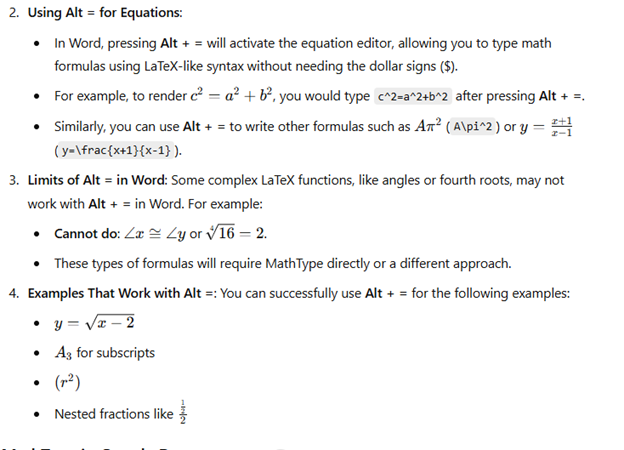
      • For example, to render c2=a2+b2c^2 = a^2 + b^2c2=a2+b2, you would type c^2=a^2+b^2 after pressing Alt + =.
      • Similarly, you can use Alt + = to write other formulas such as Aπ2A\pi^2Aπ2 (A\pi^2) or y=x+1x−1y = \frac{x+1}{x-1}y=x−1x+1​ (y=\frac{x+1}{x-1}).
    3. Limits of Alt = in Word: Some complex LaTeX functions, like angles or fourth roots, may not work with Alt + = in Word. For example:
      • Cannot do: ∠x≅∠y\angle x \cong \angle y∠x≅∠y or 164=2\sqrt[4]{16} = 2416​=2.
      • These types of formulas will require MathType directly or a different approach.
    4. Examples That Work with Alt =: You can successfully use Alt + = for the following examples:
      • y=x−2y = \sqrt{x-2}y=x−2​
      • A3A_3A3​ for subscripts
      • (r2)(r^2)(r2)
      • Nested fractions like 122\frac{\frac{1}{2}}{2}221​​

    Visual Rendering after you press enter in WORD for MathType with screen readers-LaTex

    Latex is typed out and this is the visual rendering of the LaTex from Mathtype
    Latex is typed out and this is the visual rendering of the LaTex from Mathtype

    MathType in Google Docs-though can give challenges based on technology:

    1. Add MathType Add-on: In Google Docs, go to Add-ons and download MathType. This will allow you to use LaTeX commands by rendering them in the document.
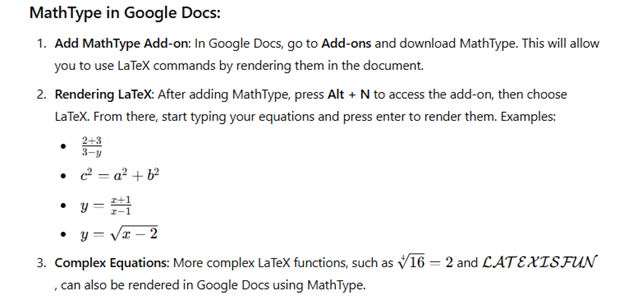
    2. Rendering LaTeX: After adding MathType, press Alt + N to access the add-on, then choose LaTeX. From there, start typing your equations and press enter to render them. Examples:
      • 2+33−y\frac{2+3}{3-y}3−y2+3​
      • c2=a2+b2c^2 = a^2 + b^2c2=a2+b2
      • y=x+1x−1y = \frac{x+1}{x-1}y=x−1x+1​
      • y=x−2y = \sqrt{x-2}y=x−2​
    3. Complex Equations: More complex LaTeX functions, such as 164=2\sqrt[4]{16} = 2416​=2 and LATEXISFUN\mathcal{LATEX IS FUN}LATEXISFUN, can also be rendered in Google Docs using MathType.
    visual rendering of math after translation of LaTex in Docs using mathtype addon
    Visual rendering of math after translation of LaTex in Docs using mathtype addon

    By using Alt + = in Word and MathType in Google Docs (but be aware there may be issues in Docs), you can seamlessly render a variety of math formulas and equations with ease. Screen readers like JAWS and NVDA will effectively read these equations, enhancing accessibility for blind and visually impaired students.

    MathType(LaTex) Alt = in WORD will render formulas to Math see below

    Download MathType for Word and Docs

    Video on: MathType LaTex in Word & Docs made easy with screen reader JAWS or NVDA

    Other MathType with screen readers-LaTex Math Formulas

    $c^2=a^2+b^2$

    1. use alt = in WORD without $ signs

    $A\pi^2$

    2. use alt = in WORD without $ signs

    $y=\frac{x+1}{x-1}$

    3. cannot do with alt =

    $\angle x\cong\angle y$

    $y=\sqrt{x-2}$

    4. use alt = in WORD without $ signs

    $y=\sqrt[3]{8}$

    5. does not work with alt =

    $\sqrt[4]{16}=2$

    6. does not work with alt =

    $A_3$

    7. use alt = in WORD without $ signs

    $(r^2)->$

    8.use alt = in WORD without $ signs

    $\frac{\frac{1}{2}}{2}$

    9. Does not work with alt =

    $\mathcal{LATEX IS FUN }$

    $\mathcal{LATEX}$

    use alt = in WORD without $ signs

    FOR Google Docs: example- go to ADD-on and add Mathtype then render with Alt N to add-on and LaTex and enter on Start

    $$\frac{2+3}{3-y}$$

    $$c^2=a^2+b^2$$

    $$y=\frac{x+1}{x-1}$$

    $$y=\sqrt{x-2}$$

    $$\sqrt[4]{16}=2$$

    $$\frac{\frac{1}{2}}{2}$$

    $$A_3$$

    Cheatsheet for LaTex: http://tug.ctan.org/info/undergradmath/undergradmath.pdf

    More Math Lessons

  • Focus 40 Braille Display for Subtraction in IXL Math

    Navigating IXL with a screen reader like JAWS allows blind students to access educational content easily. Using specific keyboard commands enables quick access to various elements on the page. For example, pressing H moves between headings, helping students locate sections in lessons or practice activities. When working on subtraction exercises in Focus 40 IXL, pressing B navigates to buttons like “Submit” or “Check Answer,” allowing students to interact with controls smoothly.

    Another helpful command is Insert + F7, which opens a list of links on the page. This makes moving between sections, such as practice questions and feedback, more efficient. Students can also use F to quickly jump to answer boxes or search fields. To read questions or instructions, pressing Insert + Up Arrow reads the current line, while Ctrl + Down Arrow skips ahead to the next section when working on Focus 40 IXL subtraction.

    JAWS Navigation Commands

    By using these commands, students navigate IXL independently, completing exercises and reviewing answers efficiently. The screen reader provides real-time feedback, guiding students as they interact with IXL’s educational content related to subtraction problems. This empowers students to fully engage in their learning experience.

    Essential IXL keyboard commands for navigating with JAWS:

    1. Navigate headings: Press H to jump between headings, allowing you to quickly move through sections of the page during subtraction practice.
    2. Navigate links: Use Insert + F7 to bring up a list of all links, and then use the arrow keys to select the desired one.
    3. Move to next button: Press B to navigate through buttons on the screen, such as “Submit” or “Check Answer” while working on subtraction in Focus 40 IXL.
    4. Move to form fields: Use F to jump between input fields, such as answer boxes or search fields.
    5. Navigate by list: Press L to move through lists of questions or answer choices, ensuring efficient navigation during subtraction lessons.
    6. Read the current line: Press Insert + Up Arrow to read the current line, useful for verifying questions or feedback.
    7. Repeat the last spoken phrase: Use Insert + 5 on the numpad to repeat the last spoken message.
    8. Skip to the next section: Press Ctrl + Down Arrow to quickly skip paragraphs and reach the next section of text, which can be especially useful in Focus 40 IXL subtraction lessons.

    Focus Display Commands

    Navigating IXL subtraction math using the Focus 40 Braille Display and JAWS enhances accessibility for blind students. By combining keyboard commands and tactile feedback, students can efficiently work through subtraction problems. Solving subtraction on a display is also easier than just audio feedback. Pressing H on the keyboard or using the Router Keys on the Focus 40 allows them to jump between headings, locating sections like instructions or problem sets quickly.

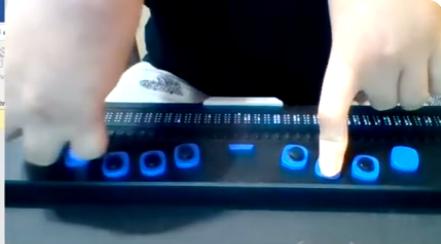
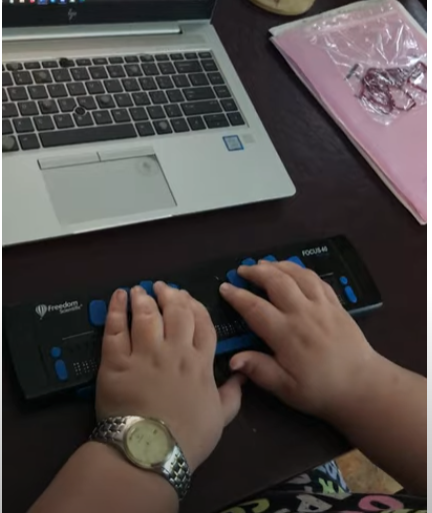
    Taylin using Focus 40 Display with 1 finger on left hand and 2 knuckles on right hand
    Taylin using Focus 40 Display with 1 finger on left hand and 2 knuckles on right hand

    For Focus 40 IXL subtraction problems, students can use E for edit or the Cursor Routing Buttons to jump directly to the answer input fields. As they enter their responses, the Braille display provides real-time feedback, ensuring accuracy. Pressing Insert + Up Arrow or using the Braille Display’s Line Reading feature reads the current subtraction problem, helping students verify their work. To check answers or move to the next problem, they can press B to navigate to buttons like “Submit,” or use the Panning Buttons to scroll through the page.

    Focus 40 Braille Display with JAWS

    The Focus 40 Braille Display, paired with JAWS, offers students the tactile and auditory support they need to complete all math problems independently in IXL. This combination enhances their confidence and accuracy in solving subtraction problems.

    These JAWS commands allow smooth and efficient navigation on IXL, enhancing the learning experience for blind and visually impaired students.

    Other videos for special hands:

    Typing 77 words per minute

    Other typing speed

    Math with 3 Fingers using Braille Display

    Fixing Typing Echo on Display

  • Fixing Jaws typing echo and cursor issues in google classroom by Taylin

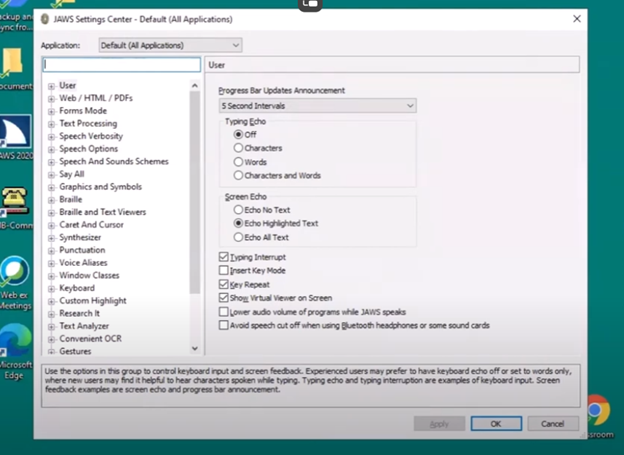
    Miss Taylin and Dr. Robinson addressed two common accessibility issues students face while navigating educational tools with JAWS. First, they resolved the issue of characters not being heard when typed, which prevents users from verifying their input. After adjusting the typing echo settings in JAWS, they enabled the device to read both characters and words aloud, providing better control and feedback during typing. Fixing Jaws typing echo significantly improved user experience. On the fly, you can also insert + 2 to change echo options.

    The second issue involved difficulties navigating through web links in the classroom browser, with JAWS sometimes reporting “no form fields” or “no lists available.” The problem arises when both the virtual and PC cursors are not enabled. Dr. Robinson explained that the virtual cursor is essential for browsing web pages, while the PC cursor helps manage navigation within a page. Miss Taylin accessed the links list and navigated classroom content efficiently by using “Insert + Z” to enable the virtual cursor. She ensured the PC cursor was active with the command “Insert + ;” which improved her browsing experience. Fixing Jaws typing and echo settings along with other settings changes, enhances productivity.

    Jaws settings and set default to permanently make changes to fix Jaws typing echo issues
    Jaws settings and set default to permanently make changes to typing echo

    Dr. Robinson emphasized the need to regularly check both cursor settings whenever JAWS encounters issues. This practice ensures smooth and uninterrupted navigation for users. Additionally, these steps empower students using screen readers to interact more effectively with digital learning platforms. These adjustments create an efficient workflow for students to complete assignments and navigate classroom tools seamlessly. Overall, addressing the issue of fixing Jaws typing echo and other settings ensure that students can fully participate in their learning environment with complete accessibility.

    See other lessons for navigation. For more on fixing Jaws typing echo, explore related resources.

  • Blind Teacher Lucas Navigates the Canvas Platform Using a Screen Reader

    Dr. Robinson and Lucas began the session by navigating Canvas, focusing on essential screen reader commands for effective navigation. They highlighted the importance of commands like Insert + F5, F6, and F7 to explore the page layout before moving through various elements. When discussing the Canvas school platform navigation, Dr. Robinson highlighted the need to recognize interactive elements like radio buttons and check-boxes to ensure smooth navigation in Canvas. By understanding these features, students can efficiently move through the platform and complete tasks effectively. Understanding Canvas school platform navigation is key for accessibility.

    To streamline their workflow, they used first-letter navigation, such as hitting “C” to quickly jump to courses. This method enables users to navigate faster without manually tabbing through multiple options. Lucas demonstrated how to access different sections of the Canvas interface, including courses and messages, using the appropriate keyboard commands. Mastering the navigation of the Canvas school platform efficiently requires knowing these shortcuts.

    InBox Management in Canvas school Platform Navigation

    For inbox management, Lucas efficiently used first-letter navigation to filter unread emails and compose a new message. Dr. Robinson guided him through composing an email, showing how typing the recipient’s name narrows down the list of available contacts. Lucas learned how to navigate, select recipients, and send messages within the Canvas interface. Canvas school platform navigation strategies significantly improved his inbox management skills.

    After addressing the inbox, they moved on to class assignments. Using heading and link navigation commands, Lucas accessed assignments and checked due dates. Dr. Robinson stressed the importance of using key commands, such as Insert + F7, to bring up lists of assignments and quickly navigate to relevant tasks on the Canvas school platform.

    Lastly, they tackled PDF accessibility. Dr. Robinson showed Lucas how to download and convert PDFs into Word documents for better accessibility and interaction. By converting documents, Lucas could add notes, adjust content, and work more effectively. These steps reinforced the power of screen reader commands, helping users stay organized and fully engaged in digital learning environments on the Canvas school platform.

  • Accessible Work at School: What Blind Students Need — by Eme

    Emery, a blind ninth-grader at Kalaheo, introduces herself and shares her love for math and technology. She uses a computer with a screen reader and Braille display to access her education. Eme navigates her world with a cane and texts friends using her phone. During the pandemic, her computer became essential for schoolwork. She explains how she uses various tools to access her education, including JAWS screen reader and Braille Display and other access technology. Eme highlights the importance of accessible assignments and demonstrates navigating an online platform despite its challenges. Accessible work at school is critical for her success.

    Emery uses tools like the JAWS screen reader and Braille display connected to her computer to navigate her studies. She emphasizes that accessible assignments are crucial because they allow her to engage with the same content as her peers. When assignments are not accessible, it creates significant barriers to her learning. It is evident that accessible work at school can make a big difference.

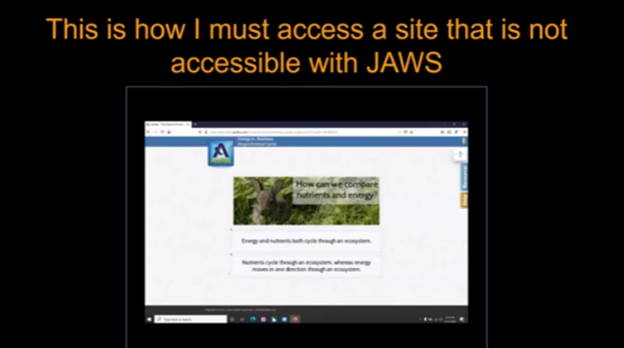
    Eme Making Work accessible on an inaccessible site
    Eme Making Work accessible on an inaccessible site

    By ensuring Teachers’ work is accessible, you empower students like Emery to succeed and participate fully in their education. Accessible materials foster a learning environment where all students can be included and thrive. Therefore, focusing on making work accessible at school helps all students.

    She thanks teachers for their commitment to making education accessible for everyone. Providing accessible work at school shows dedication to inclusion and highlights the importance of accessibility.

    Making Work Accessible:

    Complete Advanced Math with LaTex to finish math fast using Mathkicker.AI, JAWS, NVDA and/or display

    Math & AI =Mathkicker.ai convert PDF math or any work into WORD docx.

    Perfect Digital Math at all levels using only audio or tactile Braille or both in Mathkicker.ai

    Math & AI is MathKicker.ai — convert to .docx from clipboard- make inaccessible accessible

    Mathkicker.ai-take an image of math and make it perfect Math in Word Math editor with screen reader

    Mathkicker.AI -change Math PDF to text in WORD Math editor in less than a minute with screen reader

  • Miss Aubrey Learns to Work on a Braille Display and Computer

    Years ago, Aubrey was just learning how to learn remotely. Dr Robinson lived close by so was able to come over in person to help her with skills and hand under hand and hand over hand as needed to learn position of fingers. A major part of her lessons is to learn to do work on braille display and computer with keyboard shortcuts. This video is her just learning how to do math in WORD.

    To answer a Zoom call using keyboard shortcuts when on a braille display and computer, you can use the following:

    These shortcuts help you manage calls efficiently without needing to use a mouse. A braille display and computer can make these tasks smoother.

    Here are some additional keyboard shortcuts that Aubrey learned to enhance her navigation and accessibility experience:

    General Web Navigation on braille display and computer

    • Ctrl + L or Alt + D: Focus on the address bar.
    • Ctrl + T: Open a new tab when using a braille display and/or computer.
    • Ctrl + W: Close the current tab.
    • Ctrl + Shift + T: Reopen the last closed tab.
    • Ctrl + Tab: Switch to the next tab.
    • Ctrl + Shift + Tab: Switch to the previous tab.
    • Ctrl + R or F5: Refresh the current page.
    • Ctrl + F: Open the find bar to search within the page on your braille display and computer setup.

    Screen Reader Specific

    • Insert + F7: Open the links list in JAWS.
    • Insert + F6: Open the headings list in JAWS.
    • Insert + Down Arrow: Start reading continuously from the current position in JAWS.
    • Ctrl + Alt + Arrow Keys: Navigate by character, word, or line in NVDA for better synchronization with your braille display and computer.
    Aubrey using braille display and computer to learn how to complete math in WORD
    Aubrey using braille display and computer, to learn how to complete math in WORD

    Windows Accessibility commands for display and computer

    • Windows Key + U: Open the Ease of Access Center.
    • Windows Key + Plus (+): Turn on Magnifier and zoom in.
    • Windows Key + Minus (-): Zoom out with Magnifier.
    • Windows Key + Ctrl + N: Open Narrator settings.
    • Windows Key + Ctrl + O: Turn on the On-Screen Keyboard.

    Text Editing

    • Ctrl + C: Copy selected text.
    • Ctrl + X: Cut selected text.
    • Ctrl + V: Paste copied or cut text.
    • Ctrl + Z: Undo the last action.
    • Ctrl + Y: Redo the last undone action.

    These shortcuts can help you navigate more efficiently and make your web browsing and computer use more accessible. If you need more specific shortcuts or have other questions, feel free to ask!

  • Navigate Schoology with Jaws via Kim

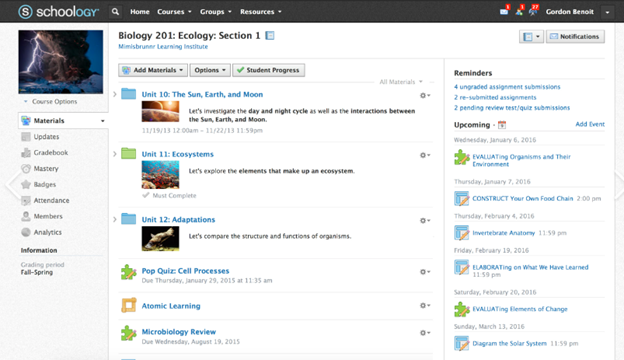
    To Navigate Schoology with Jaws is easy using these useful keyboard commands for navigation. When you’re using a screen reader like JAWS or NVDA it is very accessible. Kim demonstrates her skills, showing how to navigate schoology with efficiency. She shares with others how this training has allowed her to access her education.

    Schoology Navigation Skills Video-General Commands to help navigate Schoology

    1. Navigate to Courses:
      • Press Insert + F7 to bring up the links list.
      • Use the arrow keys to navigate to the desired course and press Enter.
    2. Access Course Materials:
      • Press H to navigate through headings until you reach the course materials section.
      • Use the arrow keys to select the material you want to access.
    3. Navigate to Assignments:
      • Press Insert + F6 to bring up the headings list.
      • Use the arrow keys to find and select the “Assignments” heading.
    4. Access Notifications:
      • Press Insert + F5 to bring up the form fields list.
      • Navigate to the notifications section and press Enter.
    5. Navigate to Discussions:
      • Press H to move through headings until you reach the “Discussions” section.
      • Use the arrow keys to select and enter a discussion.
    6. General Navigation:
      • Use Tab and Shift + Tab to move forward and backward through interactive elements.
      • Press G to navigate to graphics and L to navigate to lists.
    7. One Trick to remember is when a PDF viewer of work opens, the download in WORD link is at the very bottom. Use your links list or ctrl end and up arrow to find it.

    More Schoology Lessons to help Navigate Schoology with Jaws

    Navigate schoology with JAWS
    Navigate schoology with JAWS

    Let us know how we can help you: Contact US: TechVisionTraining@yourtechvision.com

  • Sighted Parents Set Up a Computer with a TechVision Trainer

    When sighted parents’ setup computer for their young child, they learn the commands and how to follow through with lessons after the TechVision Team completes working with their child.

    When sighted parents learn alongside their blind child, especially in the context of setting up and using a computer, it offers numerous benefits:

    1. Enhanced Understanding and Support: Parents gain a deeper understanding of the assistive technologies their child uses, such as screen readers and braille displays. This knowledge enables them to provide better support and guidance during practice and troubleshooting.
    2. Consistency in Learning: By learning the commands and techniques themselves, parents can ensure that the child receives consistent instruction and reinforcement of skills. This continuity is crucial for the child’s confidence and proficiency.
    3. Empowerment and Independence: Parents who are knowledgeable about the technology can empower their child to explore and use the computer independently. This fosters a sense of autonomy and self-reliance in the child.
    4. Improved Communication: Understanding the technology allows parents to communicate more effectively with their child about their learning experiences and challenges. This can strengthen the parent-child relationship and create a more supportive learning environment.
    5. Advocacy and Collaboration: Informed parents are better equipped to advocate for their child’s needs in educational settings and collaborate with teachers and specialists to ensure appropriate accommodations and resources are provided.
    6. Shared Learning Experience: Learning together can be a bonding experience, making the process enjoyable and less isolating for the child. It also demonstrates to the child that their parents are invested in their education and success.

    Here are some general essential keyboard commands to set up and navigate the JAWS screen reader:

    Starting and Basic Navigation

    1. Start JAWS:
      • Press Ctrl + Alt + J or if pinned to taskbar Windows 3 on this computer
    2. Activate PC Cursor:
      • Press Numpad +.
    3. Activate JAWS Cursor:
      • Press Numpad -.
    4. Silence Current Speech Output:
      • Press Ctrl.

    Help Sighted Parents Setup Navigating Web Pages

    1. List Links:
      • Press Insert + F7.
    2. List Headings:
      • Press Insert + F6.
    3. List Form Fields:
      • Press Insert + F5.
    4. Next Heading:
      • Press H.
    5. Next Link:
      • Press Tab.
    6. Previous Link:
      • Press Shift + Tab.

    Reading Text

    1. Read Next Line:
      • Press Down Arrow.
    2. Read Previous Line:
      • Press Up Arrow.
    3. Read Current Line:
      • Press Insert + Up Arrow.
    4. Read Next Word:
      • Press Insert + Right Arrow.
    5. Read Previous Word:
      • Press Insert + Left Arrow.

    Forms and Tables

    1. Enter Forms Mode:
      • Press Enter.
    2. Exit Forms Mode:
      • Press Numpad +.
    3. Navigate Table Cells:
      • Press Ctrl + Alt + Arrow Keys.

    Sighted Parents Setup computer successfully and if your child is Visually Impaired use this setup to SEE computer better

    and all lessons you need on YouTube